
Best Dry Dog Food for Sensitive Stomach & Loose Stool
Written by: Dr. Akram Khan, DVM
Medically Reviewed by: Dr. Khalid Mehmood, PhD
Last updated on September 06, 2026
Choosing the best dry dog food for sensitive stomachs & loose stool can feel confusing when your dog has soft stool, gas, or an upset stomach after eating. Many owners look for the best dry dog food for sensitive stomachs, the best dry dog food for loose stool, or a dog food to firm up stool, but the right choice depends on your dog’s protein tolerance, fat sensitivity, fiber needs, life stage, and overall digestive health. This guide helps you compare the best kibble for dogs with sensitive stomachs and soft stool, including sensitive-stomach formulas, salmon and rice dry food, chicken-free options, low-fat digestive diets, limited-ingredient kibble, probiotic formulas, and veterinary gastrointestinal dry foods.
Quick Answer: What Is the Best Dry Dog Food for Sensitive Stomach & Loose Stool?
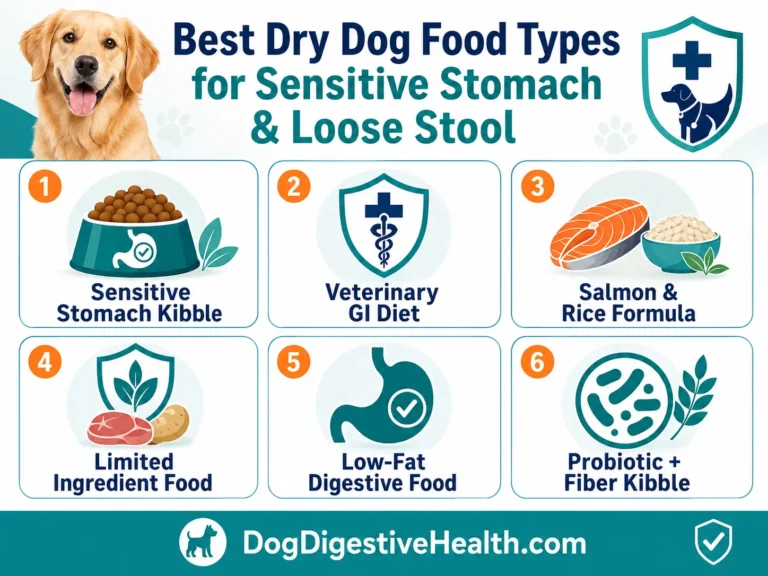
The best dry dog food for sensitive stomachs & loose stool is usually a highly digestible, sensitive-stomach kibble with a clear animal protein source, moderate fat, prebiotic fiber, and complete-and-balanced nutrition for your dog’s life stage. For dogs with recurrent loose stool, a veterinary gastrointestinal dry food may be a better option. Salmon and rice formulas, limited-ingredient dry foods, low-fat digestive diets, and probiotic-supported kibble can also help depending on your dog’s tolerance and stool pattern.
Best Dry Dog Food for Sensitive Stomach & Loose Stool: Quick Picks
Dog’s Need | Best Dry Food Type | Why It May Help |
Mild soft stool | Sensitive stomach dry dog food | Supports digestibility and daily stool consistency |
Recurrent loose stool | Veterinary gastrointestinal dry food | Designed for dogs needing stronger digestive support |
Stool worsens after fatty foods | Low-fat digestive dry food | May help dogs sensitive to rich or high-fat diets |
Possible chicken sensitivity | Chicken-free dry dog food | Uses salmon, turkey, lamb, duck, or another protein |
Complex formulas cause problems | Limited ingredient dry dog food | Makes protein and ingredient tracking easier |
Sensitive stomach plus itchy skin | Salmon and rice dry dog food | Often supports digestion, skin, and coat health |
Soft stool needing fiber support | Fiber-supported dry dog food | Helps support stool bulk and consistency |
Small dog with loose stool | Small-breed digestive care kibble | Uses smaller kibble and size-appropriate nutrition |
Puppy with sensitive digestion | Puppy-sensitive stomach dry food | Supports growth while being easier on digestion |
Senior dog with new loose stool | Senior digestive support dry food plus vet check | Older dogs may have underlying health issues |
What Is the Best Dry Dog Food for Sensitive Stomach and Loose Stool?
The best dry dog food for a sensitive stomach and loose stool is the one that matches your dog’s actual stool pattern. A dog with occasional soft stool may do well on a high-quality sensitive stomach kibble. A dog that gets loose stool after fatty treats may need a lower-fat digestive diet. A dog that does poorly on chicken may need a chicken-free formula. A dog with recurring diarrhea or long-term digestive problems may need a veterinary gastrointestinal dry food instead of another over-the-counter option.
There is no single best kibble for every dog. That is the point many dog food guides miss. Loose stool can be linked to digestibility, fiber balance, food sensitivity, fat tolerance, sudden food changes, treats, stress, parasites, infection, or chronic intestinal disease. Current veterinary guidance recognizes that chronic digestive problems in dogs often need a structured approach, including diet trials when food-responsive disease is possible (Heilmann, R. M., et al. 2026).
For mild stool problems, choosing a better dry food and transitioning slowly may be enough. For recurrent, watery, bloody, or worsening stool, food should not be used as a substitute for veterinary care.
When Should You See a Vet Before Changing Your Dog’s Food?
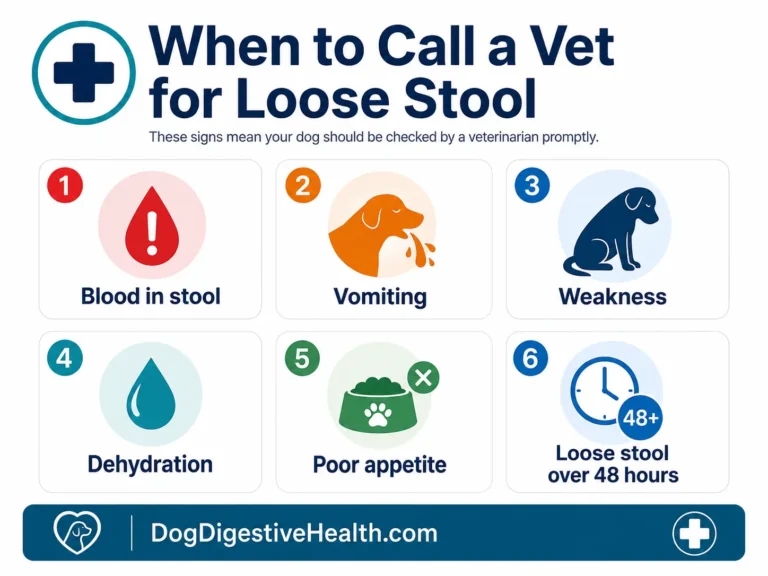
You should speak with a veterinarian before changing food if your dog has loose stool for more than 48 hours, watery diarrhea, blood in stool, black stool, repeated vomiting, fever, weakness, dehydration, poor appetite, weight loss, abdominal pain, or sudden behavior changes. Puppies, senior dogs, pregnant dogs, and dogs with known medical conditions also need extra caution.
A food change can help when the problem is diet-related, but it will not treat parasites, infections, pancreatitis, inflammatory bowel disease, or other medical problems. If your dog’s stool problem keeps returning, do not keep switching bags of food randomly. That makes the problem harder to track and can delay proper treatment.
The safer approach is simple: if the stool problem is mild and your dog seems normal, a careful food transition may be reasonable. If the stool problem is severe, persistent, or paired with other symptoms, get veterinary help first.
How We Choose the Best Dry Dog Food for Sensitive Stomach and Loose Stool
The best dry dog foods for sensitive stomachs and loose stool should do more than look good on the front of the bag. A strong digestive-support kibble should be selected based on ingredients, digestibility, fiber strategy, fat level, protein source, life stage, and feeding consistency.
For this guide, dry food categories were chosen based on the following practical standards:
- The food is dry kibble, not wet food, raw food, freeze-dried food, homemade food, or topper-based feeding.
- It uses a clear protein source such as chicken, salmon, turkey, lamb, duck, or a veterinary therapeutic protein strategy.
- It includes digestible carbohydrate sources such as rice, oatmeal, barley, potato, or sweet potato.
- It supports stool quality through prebiotic fiber, balanced fiber, gastrointestinal diet design, or microbiome-supporting ingredients.
- It avoids unnecessary ingredient complexity when food sensitivity is suspected.
- It matches the dog’s life stage, such as adult, puppy, senior, small breed, or large breed.
- It can be fed consistently without depending on too many treats, toppers, supplements, or table scraps.
Diet plays an important role in many dogs with chronic digestive problems. Recent reviews continue to discuss food-responsive enteropathy, microbiota changes, dietary trials, and nutrition-based management as important parts of canine digestive care (Dupouy-Manescau, N., et al. 2024).
Best Veterinarian-Guided Dry Dog Food for Sensitive Stomach and Loose Stool
Best for Recurrent Loose Stool: Veterinary Gastrointestinal Dry Food
Veterinary gastrointestinal dry food is often the best choice when loose stool is not occasional. These diets are made for dogs that need stronger digestive support and are commonly used when dogs have recurrent soft stool, poor stool quality, stool urgency, chronic digestive upset, or digestive problems that do not improve with ordinary sensitive-stomach kibble.
Examples in this category may include veterinary gastrointestinal diets from brands such as Hill’s Prescription Diet, Royal Canin Veterinary Diet, and Purina Pro Plan Veterinary Diets. The exact diet should be selected with your veterinarian because gastrointestinal diets are not all the same. Some focus on fiber. Some focus on low fat. Some focus on hydrolyzed protein. Some focus on microbiome support.
This category is important because many owners keep buying different retail foods when the dog may actually need a structured veterinary diet trial. If a dog has recurring loose stool, a veterinarian may recommend a gastrointestinal dry diet before moving to more advanced testing.
Why it may help:
- Designed specifically for digestive support.
- Often more targeted than standard sensitive-stomach food.
- May support stool quality, gut comfort, and digestive stability.
- Useful when stool consistency is the main feeding goal.
- Helps reduce random diet changes during a controlled food trial.
What to consider:
- Veterinary diets should be used under veterinary guidance.
- They usually cost more than regular dry food.
- Low-fat, hydrolyzed, fiber-modified, and microbiome-support diets serve different needs.
- They should not be mixed with random treats, table food, or multiple toppers during a diet trial.
Best fit:
Dogs with recurring loose stool, chronic soft stool, or digestive problems that have not improved after a careful transition to a regular sensitive-stomach dry food.
Best Overall Dry Dog Food for Sensitive Stomach and Loose Stool
Best for Mild Soft Stool: Sensitive Stomach Dry Dog Food
A high-quality, sensitive stomach dry dog food is usually the best first step for adult dogs that are otherwise healthy but have mild soft stool, occasional loose stool, gas, or general digestive sensitivity. These formulas are usually made with digestible ingredients, moderate fat, prebiotic fiber, and a protein-carbohydrate combination that many dogs tolerate well.
Common examples include formulas such as Hill’s Science Diet Sensitive Stomach & Skin, Purina Pro Plan Sensitive Skin & Stomach, and Royal Canin Digestive Care. These are not prescription diets, but they may be better suited than generic adult kibble when stool quality and digestive comfort are the main concerns.
A sensitive-stomach dry food works best when the rest of the diet is controlled. If your dog eats the new food but also gets cheese, table scraps, greasy chews, and random treats every day, you will not know whether the kibble is helping.
Why it may help:
- Usually easier to find than prescription diets.
- Often suitable for daily feeding.
- May include prebiotic fiber for digestive support.
- Often available in adult, puppy, small-breed, large-breed, or senior formulas.
- Good first option for mild stool issues when there are no warning signs.
What to consider:
- “Sensitive stomach” does not mean allergy-safe.
- Chicken-based formulas are not ideal for every dog.
- Some dogs need low-fat, limited-ingredient, hydrolyzed, or veterinary food instead.
- A slow transition is still important.
Best fit:
Adult dogs with mild loose stool or sensitive digestion who need better daily dry food but do not have severe or chronic digestive signs.
Best Dry Dog Food to Firm Up Loose Stool
Best for Stool Consistency: Fiber-Supported Digestive Dry Food
Fiber is one of the most important nutritional tools for stool quality. The right fiber balance can help support stool bulk, water balance, regularity, and a healthier intestinal environment. But the type and amount of fiber matter. Too little fiber may not help stool quality, while too much fiber can increase gas, stool volume, or discomfort in some dogs.
Fiber-supported dry dog foods may include ingredients such as beet pulp, psyllium, chicory root, fructooligosaccharides, cellulose, pumpkin, sweet potato, or other soluble and insoluble fiber sources. Some digestive diets use a fiber blend rather than relying on one trendy ingredient.
Fiber-supported therapeutic diets have been studied in dogs with chronic large bowel diarrhea and were associated with improvement in stool consistency and clinical signs (Fritsch, D. A., et al. 2022).
Why it may help:
- Directly supports stool consistency.
- Can help improve stool bulk and shape.
- May support beneficial gut bacteria when prebiotic fibers are included.
- More controlled than adding random spoonfuls of pumpkin or supplements.
- Useful for dogs with soft stool patterns.
What to consider:
- Not every dog needs high fiber.
- Some dogs become gassier on certain fiber sources.
- Fiber needs may differ depending on the type of digestive problem.
- Chronic loose stool still needs veterinary guidance.
Best fit:
Dogs with soft stool that may benefit from a dry food containing balanced fiber sources.
Best Salmon Dry Dog Food for Sensitive Stomach and Loose Stool
Best for Dogs That May Not Tolerate Chicken: Salmon and Rice Dry Dog Food
Salmon and rice dry dog food is one of the most popular options for dogs with sensitive stomachs. Salmon gives a different animal protein from chicken, and rice is commonly used in digestible dog food formulas. Many salmon formulas also include omega fatty acids, which may be useful for dogs with both digestive sensitivity and skin or coat concerns.
This does not mean salmon is automatically better than chicken. Chicken is fine for many dogs. Salmon is simply a useful option when a dog repeatedly does poorly on chicken-based formulas or when the owner wants a different protein source for a careful food trial.
Why it may help:
- Gives a non-chicken protein option.
- Often paired with rice or oatmeal.
- May support both digestion and skin-coat health.
- Useful for dogs with sensitive stomachs and itchy skin overlap.
- Available in some puppy, adult, senior, small-breed, and large-breed formulas.
What to consider:
- Salmon is not automatically hypoallergenic.
- Some “salmon” foods may still contain chicken fat, poultry ingredients, egg, or other animal proteins.
- Fish-based food may have a stronger smell.
- Dogs with a true food allergy may need a veterinary elimination diet instead.
Best fit:
Dogs with sensitive digestion that may not do well on chicken-based dry food.
Best Dry Dog Food With Probiotics for Sensitive Stomach and Loose Stool
Best for Gut Microbiome Support: Probiotic-Support Dry Dog Food
Some dry dog foods include probiotics or are designed to support the gut microbiome through prebiotic ingredients. This can be useful because the gut microbiome plays a role in digestion, stool quality, immune function, and intestinal balance.
Probiotics are not magic, though. Their effect depends on the strain, amount, survival through processing, product quality, storage conditions, and the dog’s health problem. A dry food with probiotics may support digestive health, but it should not be treated as a guaranteed fix for loose stool.
Recent reviews suggest that probiotics can support gut health in dogs and cats, but their benefits depend on the specific formulation and situation (Yang, Q., et al. 2023). Newer reviews also describe possible benefits of probiotics in dogs and cats, including effects on intestinal microbiota and digestive health, while emphasizing that results can vary (Sun, J., et al. 2025).
Why it may help:
- Convenient daily digestive support.
- May support healthy intestinal microbiota.
- Often paired with prebiotic fiber.
- Useful for dogs that need consistent gut support.
- Better than adding multiple random supplements without a plan.
What to consider:
- Not all probiotics are equal.
- A food with probiotics is not automatically better than a food with strong prebiotic fiber.
- Heat, storage, and processing can affect probiotic survival.
- Dogs with chronic diarrhea still need veterinary evaluation.
Best fit:
Dogs with mild sensitive digestion whose owner wants dry food that includes microbiome-supporting ingredients.
Best Limited Ingredient Dry Dog Food for Sensitive Stomach and Loose Stool
Best for Food Sensitivities: Single-Protein Limited Ingredient Dry Food
Limited-ingredient dry dog food is designed to simplify the diet. These foods usually focus on one main animal protein and fewer major ingredients. The goal is not to follow a trend. The goal is to make the diet easier to track.
For dogs with soft stool, a limited-ingredient dry food may help when the dog seems to react poorly to complex formulas. For example, a food with chicken, beef, fish meal, egg, peas, lentils, and multiple flavorings can be harder to evaluate than a simpler salmon-and-sweet-potato or turkey-and-potato formula.
Limited-ingredient food is not the same as a prescription elimination diet. If true food allergy is suspected, a veterinarian may recommend a hydrolyzed protein or novel protein diet with stricter controls.
Why it may help:
- Makes ingredient tracking easier.
- May help dogs that do poorly on multi-protein formulas.
- Often available in chicken-free options.
- Useful for a controlled over-the-counter food trial.
- Reduces unnecessary diet complexity.
What to consider:
- Limited ingredients do not mean hypoallergenic.
- Cross-contact can happen during manufacturing.
- Grain-free limited-ingredient diets should be chosen carefully.
- True food allergy is best evaluated with veterinary guidance.
Best fit:
Dogs with sensitive digestion that may need simpler ingredients and a clearer protein source.
Best Chicken-Free Dry Dog Food for Sensitive Stomach and Loose Stool
Best for Possible Chicken Sensitivity: Turkey, Salmon, Lamb, or Duck Dry Food
Chicken is common in dog food because it is widely available, digestible for many dogs, and nutritionally useful. But not every dog does well on chicken-based food. If a dog repeatedly has loose stool on chicken formulas and improves on salmon, turkey, lamb, duck, or another protein, a chicken-free dry food may be worth considering.
The mistake is assuming chicken is bad for all dogs. It is not. The better approach is to look at the individual dog’s response. Some dogs do well on chicken. Others do better on fish, turkey, lamb, duck, or a veterinary therapeutic diet.
Why it may help:
- Helpful when chicken seems to be a repeated problem.
- Available in salmon, turkey, lamb, duck, and other options.
- Can be combined with limited-ingredient feeding.
- Useful for tracking stool response when the current diet is chicken-heavy.
What to consider:
- Check the full ingredient label.
- Some foods advertised as salmon or lamb may still contain chicken fat, poultry meal, egg, or natural chicken flavor.
- Chicken-free does not automatically mean allergy-safe.
- Dogs with severe or chronic signs may need hydrolyzed protein instead.
Best fit:
Dogs that repeatedly do poorly on chicken-based kibble and need a controlled alternative protein dry food.
Best Low-Fat Dry Dog Food for Sensitive Stomach and Loose Stool
Best for Dogs Sensitive to Rich or Fatty Foods: Low-Fat Digestive Dry Food
Fat is one of the most overlooked reasons some dogs develop loose stool. Many owners change proteins again and again while ignoring fatty treats, greasy chews, table scraps, rich toppers, or high-fat kibble. If stool gets worse after rich food, a lower-fat digestive dry food may be more logical than another random protein switch.
Low-fat dry dog food may be especially important for dogs with a history of pancreatitis, fat intolerance, or certain chronic gastrointestinal conditions. These dogs should be managed with veterinary guidance. Current veterinary consensus recognizes that low-fat dietary strategies can be appropriate in specific chronic digestive conditions, depending on the dog’s diagnosis and clinical pattern (Heilmann, R. M., et al. 2026).
Why it may help:
- Useful for dogs that do poorly with rich food.
- May support more predictable stool quality.
- Often paired with digestive fiber strategies.
- Helps reduce fat-related digestive stress.
- Important for dogs with fat-sensitive digestion.
What to consider:
- Not every dog with loose stool needs low-fat food.
- Very active dogs still need enough calories.
- Dogs with a pancreatitis history need veterinary direction.
- Prescription low-fat diets may be needed for medical cases.
Best fit:
Dogs whose loose stool seems linked to fatty treats, greasy foods, high-fat formulas, or rich toppers.
Best Dry Dog Food for Small Dogs With Sensitive Stomach and Loose Stool
Best for Small Breeds: Small-Breed Digestive Care Dry Food
Small dogs need more than a smaller serving of regular kibble. Kibble size, calorie density, feeding frequency, and portion control all matter. Small-breed digestive care formulas can be useful because they are designed around small mouths, smaller stomach capacity, and size-specific feeding needs.
Small dogs also often get too many treats compared with their body weight. A few bites of cheese, fatty scraps, or rich chews can be enough to upset stool quality. Choosing the right dry food helps, but controlling extras is just as important.
Why it may help:
- Smaller kibble size.
- Easier for toy and small breeds to chew.
- Often designed for stool quality and digestive comfort.
- Easier to portion accurately.
- Better fit than large-kibble formulas for many small dogs.
What to consider:
- Small dogs can become dehydrated faster if diarrhea is severe.
- Dental problems can affect kibble intake.
- Rich treats can sabotage the diet.
- Breed-specific needs should be considered.
Best fit:
Small adult dogs with mild loose stool or sensitive digestion who need a dry food matched to their size.
Best Dry Dog Food for Puppies With Sensitive Stomach and Loose Stool
Best for Puppies: Puppy-Specific Sensitive Stomach Dry Food
Puppies should not be fed adult maintenance food unless a veterinarian specifically recommends it. Growth-stage nutrition matters. Large-breed puppies especially need carefully balanced calories, calcium, phosphorus, and growth support.
A puppy-sensitive stomach dry food is a better choice when a puppy has mild sensitive digestion but still needs complete puppy nutrition. Salmon-and-rice puppy formulas, sensitive skin and stomach puppy formulas, and veterinary puppy gastrointestinal diets may be options depending on the puppy’s age, breed size, and stool pattern.
Puppies with persistent diarrhea should be taken seriously. They can dehydrate quickly, and loose stool may be linked to parasites, infections, stress, sudden diet change, or another health issue.
Why it may help:
- Supports growth needs.
- May include digestible protein and carbohydrate sources.
- Better than using adult sensitive-stomach food.
- Available in some salmon- or sensitive-digestion formulas.
- Useful for mild cases after urgent concerns are ruled out.
What to consider:
- Persistent puppy diarrhea needs veterinary care.
- Large-breed puppies may need large-breed puppy formulas.
- Sudden food switches can worsen stool.
- Treats and training rewards must be controlled.
Best fit:
Puppies with mild soft stool who are otherwise bright, eating, hydrated, and cleared of urgent concerns by a veterinarian.
Best Dry Dog Food for Senior Dogs With Sensitive Stomach and Loose Stool
Best for Older Dogs: Senior Digestive Support Dry Food
Senior dogs may become less tolerant of rich foods, sudden food changes, fatty treats, or complex formulas. Some older dogs also have health issues that affect diet choice, such as kidney disease, pancreatitis history, dental disease, arthritis, weight loss, or reduced appetite.
A senior dog with new loose stool should not automatically be placed on any senior formula without thinking. The best choice depends on body condition, stool pattern, appetite, muscle condition, and veterinary history.
Older dogs also deserve extra caution because new digestive signs may be connected to underlying disease. A food change may help, but persistent loose stool in a senior dog should not be dismissed as “just old age.”
Why it may help:
- May better match older dogs’ calorie and nutrient needs.
- Some formulas include digestive support.
- May help dogs that do poorly on rich adult foods.
- Supports a consistent feeding routine.
- Easier to monitor than mixed diets with many toppers.
What to consider:
- Weight loss with loose stool is a warning sign.
- Senior dogs may need bloodwork or fecal testing.
- Dental issues can affect kibble intake.
- Chronic diarrhea in senior dogs should be checked by a veterinarian.
Best fit:
Older dogs with mild sensitive digestion after warning signs and medical concerns have been considered.
What Ingredients Should You Look for in Dry Dog Food for Loose Stool?
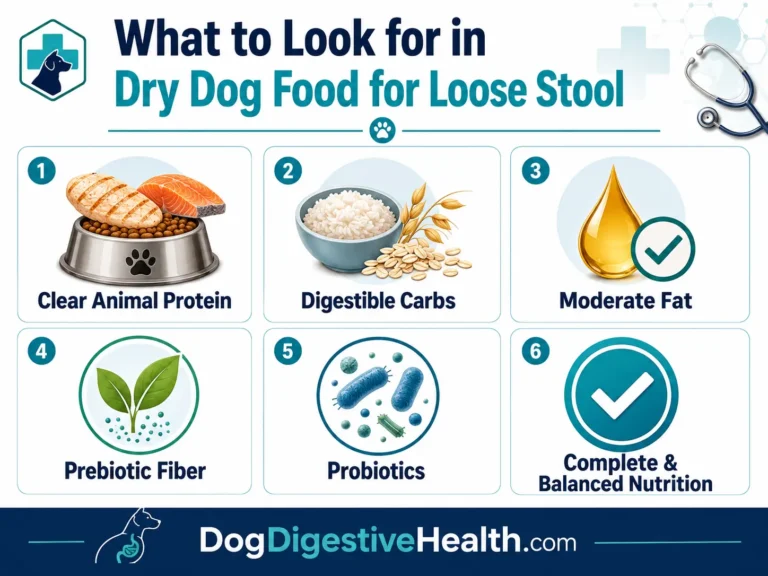
The ingredient list does not tell the whole story, but it still matters. For dogs with sensitive stomachs and loose stool, look for ingredients and formula features that support digestibility, stool quality, and consistent feeding.
Clear Animal Protein Source
A clear animal protein source makes it easier to track tolerance. Chicken, salmon, turkey, lamb, duck, and hydrolyzed proteins can all be appropriate depending on the dog. The goal is not to find the best protein for every dog. The goal is to find the protein your dog digests well.
If your dog has been eating chicken-based food and stool remains loose, a salmon, turkey, lamb, or duck formula may be worth discussing. If your dog reacts to many proteins, a veterinary hydrolyzed protein diet may be more appropriate.
Digestible Carbohydrates Like Rice, Oatmeal, Barley, Potato, or Sweet Potato
Rice, oatmeal, barley, potato, and sweet potato are commonly used in sensitive digestion formulas. None of these is perfect for every dog. What matters is the full formula, the dog’s tolerance, and whether the food is complete and balanced for the correct life stage.
Moderate Fat Level for Sensitive Digestion
Some dogs tolerate normal fat levels well. Others develop loose stool from rich foods. If your dog’s stool worsens after fatty treats, table scraps, greasy chews, or high-fat kibble, a lower-fat digestive dry food may be worth discussing with your veterinarian.
Probiotic Fiber for Stool Quality
Prebiotic fiber helps support beneficial gut bacteria. Ingredients such as beet pulp, chicory root, fructooligosaccharides, psyllium, and other fibers may appear in digestive formulas. Balanced fiber can be more useful than randomly adding pumpkin, rice, or supplements without a plan.
Probiotics for Gut Microbiome Support
Probiotics may support gut health in some dogs, but not all probiotic claims are equal. Look for reputable brands, clear formulation logic, and consistent feeding. Do not assume probiotics alone will fix chronic loose stool.
Complete and Balanced Formula for the Right Life Stage
For daily feeding, the food should be complete and balanced for your dog’s life stage unless your veterinarian prescribes a therapeutic diet. Puppies, adults, seniors, small breeds, and large breeds may need different nutritional profiles.
Simple, Consistent Feeding Without Too Many Extras
Even the best dry dog food can fail if the dog gets too many extras. During a food trial, avoid table scraps, rich treats, bones, chews, flavored toppers, and frequent food rotation. You cannot judge whether a dry food is helping if the diet changes every day.
What Dry Dog Foods Should You Avoid for Sensitive Stomach and Loose Stool?
Some foods are not automatically bad, but they can be poor choices for dogs with loose stool and sensitive digestion.
Be careful with:
- Very high-fat dry foods.
- Foods with many animal proteins when sensitivity is suspected.
- Grain-free diets chosen only because of marketing.
- Boutique exotic-protein diets without strong quality-control transparency.
- Dry food without a clear life-stage statement.
- Constant flavor rotation.
- Sudden food switches.
- Heavy toppers and rich treats.
- Kibble mixed with random supplements without a plan.
- “All natural” claims that do not explain digestibility, fiber, or stool support.
The biggest mistake owners make is switching too often. A dog with sensitive digestion needs consistency, not a new food every few days.
How to Switch Dry Dog Food Without Making Loose Stool Worse
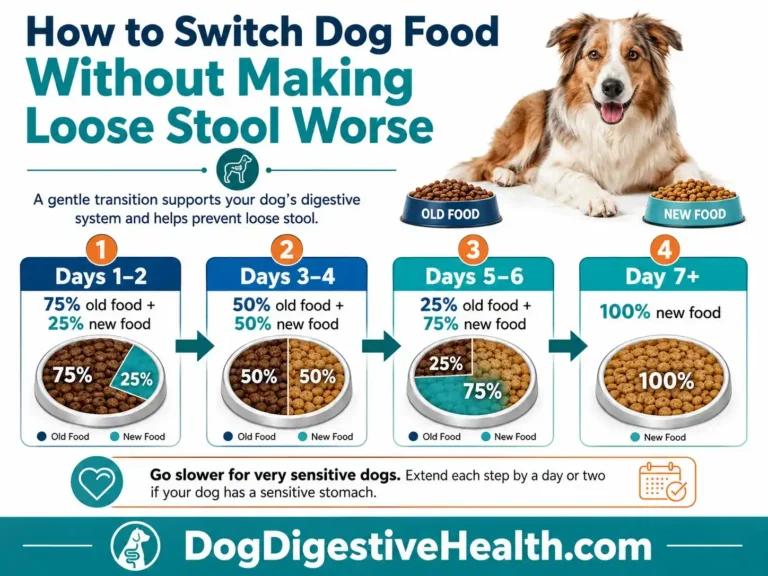
A slow transition is important. Switching too fast can cause loose stool even when the new food is actually better.
Use this basic transition schedule unless your veterinarian gives different instructions:
Days | Old Food | New Food |
Days 1–2 | 75% | 25% |
Days 3–4 | 50% | 50% |
Days 5–6 | 25% | 75% |
Day 7 onward | 0% | 100% |
Sensitive dogs may need 10–14 days. During the transition, keep everything else stable. Do not add new treats, toppers, bones, chews, supplements, or table food.
If the stool becomes watery, bloody, very frequent, or comes with vomiting, weakness, appetite loss, or dehydration, contact your veterinarian.
Best Dry Dog Food for Sensitive Stomach and Loose Stool by Need
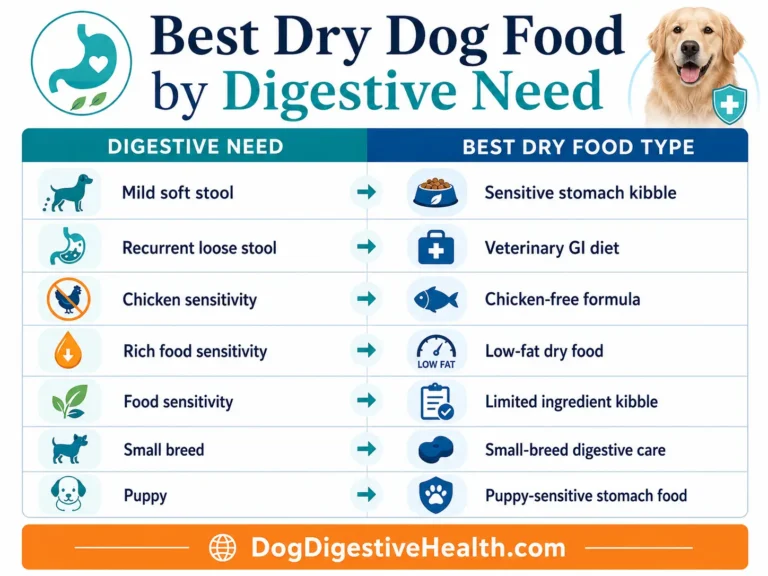
Dog’s Main Need | Best Dry Food Type |
Mild loose stool | Sensitive stomach dry dog food |
Recurrent loose stool | Veterinary gastrointestinal dry dog food |
Stool worsens with fatty foods. | Low-fat digestive support dry food |
Chicken may not be tolerated. | Chicken-free salmon, turkey, lamb, or duck dry food |
Complex formulas seem to cause problems. | Limited ingredient dry dog food |
Sensitive stomach plus itchy skin | Salmon and rice or sensitive skin and stomach dry food |
Soft stool needing stool support | Fiber-supported dry dog food |
Small dog with soft stool | Small-breed digestive care dry food |
Puppy with sensitive digestion | Puppy-sensitive stomach dry food |
Senior dog with new loose stool | Vet check plus senior-appropriate digestive food |
Chronic digestive disease | Veterinarian-guided therapeutic dry food |
Possible food-responsive digestive disease | Veterinarian-supervised diet trial |
Final Verdict: What Is the Best Dry Dog Food for Sensitive Stomach & Loose Stool?
The best dry dog food for sensitive stomachs & loose stool depends on your dog’s pattern.
For mild soft stool in an otherwise healthy adult dog, a high-quality sensitive stomach dry dog food is usually the best first step. For dogs that may not tolerate chicken, salmon, and rice, or chicken-free limited-ingredient dry food may be more useful. For dogs whose stool gets worse with rich food, a low-fat digestive dry food may be the smarter choice. For dogs that need stool consistency support, fiber-supported dry food may help.
For recurrent loose stool, stool urgency, chronic digestive upset, or repeated failure on over-the-counter food, a veterinary gastrointestinal dry diet is usually the safer and more medically appropriate option.
The smartest approach is not to chase random products. Choose one logical dry food category, transition slowly, remove diet noise, track stool quality, and involve a veterinarian if the problem is persistent, severe, or keeps coming back.
Medical Disclaimer
This article is for educational purposes only and does not replace veterinary advice, diagnosis, or treatment. If your dog has persistent loose stool, bloody diarrhea, vomiting, weakness, dehydration, weight loss, poor appetite, or any ongoing digestive problem, consult a licensed veterinarian before changing food or starting supplements.
Frequently Asked Questions(FAQs)
1. What is the best dry dog food for sensitive stomach and loose stool?
The best dry dog food is usually a highly digestible sensitive-stomach kibble with a clear protein source, moderate fat, and fiber support. Dogs with recurring loose stool may need a veterinary gastrointestinal diet.
2. Can dry dog food help firm up dog stool?
Yes, the right dry dog food can help firm stool if the problem is related to poor digestibility, low fiber balance, food sensitivity, or high fat intake.
3. Is salmon dry dog food good for sensitive stomach?
Salmon dry dog food can be a good option for dogs that do not tolerate chicken well. Salmon and rice formulas are commonly used for sensitive digestion and skin support.
4. Is chicken-free dog food better for loose stool?
Chicken-free dog food may help if your dog seems sensitive to chicken. However, chicken is not bad for all dogs, so the best choice depends on your dog’s individual tolerance.
5. Is low-fat dry dog food good for loose stool?
Low-fat dry dog food may help dogs whose stool gets worse after fatty treats, rich foods, or high-fat kibble. Dogs with pancreatitis or chronic digestive issues should be managed by a veterinarian.
6. How long does dry dog food take to improve loose stool?
Some dogs improve within a few days, while others may need one to two weeks after a slow food transition. Sudden food changes can make loose stool worse.
7. When should I call a vet for loose stool?
Call a vet if loose stool lasts more than 48 hours, becomes watery or bloody, or comes with vomiting, weakness, dehydration, poor appetite, weight loss, or abdominal pain.
References
- Heilmann, R. M., Jergens, A. E., Kathrani, A., Allenspach, K., Salavati, S., Priestnall, S. L., Dandrieux, J. R. S., & O’Connor, A. M. (2026). ACVIM-endorsed statement: Consensus statement and systematic review on guidelines for the diagnosis and treatment of chronic inflammatory enteropathy in dogs. Journal of Veterinary Internal Medicine, 40(1), aalaf017. DOI: 10.1093/jvimsj/aalaf017
- Sun, J., Gu, X., Zhang, H., Zhao, L., Wang, J., Wang, X., Tao, H., Wang, Z., & Han, B. (2025). Application of probiotics in cats and dogs: Benefits and mechanisms. Veterinary Sciences, 12(10), 1008. DOI: 10.3390/vetsci12101008
- Dupouy-Manescau, N., Méric, T., Sénécat, O., Drut, A., Valentin, S., Leal, R. O., & Hernandez, J. (2024). Updating the classification of chronic inflammatory enteropathies in dogs. Animals, 14(5), 681. DOI: 10.3390/ani14050681
- Yang, Q., & Wu, Z. (2023). Gut probiotics and health of dogs and cats: Benefits, applications, and underlying mechanisms. Microorganisms, 11(10), 2452. DOI: 10.3390/microorganisms11102452
Fritsch, D. A., Wernimont, S. M., Jackson, M. I., MacLeay, J. M., & Gross, K. L. (2022). A prospective multicenter study of the efficacy of a fiber-supplemented dietary intervention in dogs with chronic large bowel diarrhea. BMC Veterinary Research, 18, 244. DOI: 10.1186/s12917-022-03302-8