
Best Dog Food for Chronic Diarrhea in Dogs
Written by: Dr. Akram Khan, DVM
Medically Reviewed by: Dr. Khalid Mehmood, PhD (Assistant Professor in Clinical Veterinary Medicine)
Last updated on September 17, 2026
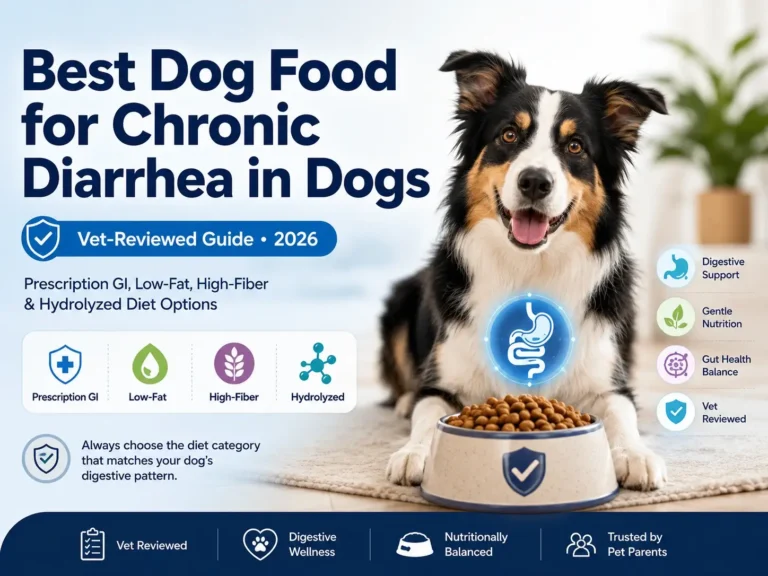
Choosing the best dog food for chronic diarrhea in dogs is not as simple as picking a popular “sensitive stomach” formula. Many dog owners search for what to feed a dog with chronic diarrhea, but the right answer depends on the dog’s digestive pattern, health history, and diet response. Some dogs may need prescription dog food for chronic diarrhea, while others may do better with low-fat dog food for diarrhea, high-fiber gastrointestinal food, or hydrolyzed protein dog food for chronic diarrhea when food sensitivity is suspected. The goal is not to buy the most popular bag; it is to choose the food category that actually matches your dog’s long-term stool problem.
Quick Answer:
The best dog food for chronic diarrhea in dogs is usually a veterinarian-recommended gastrointestinal diet, such as a prescription GI formula, low-fat dog food, high-fiber GI food, or hydrolyzed protein diet. The right choice depends on whether the dog’s diarrhea is fat-sensitive, fiber-responsive, food-related, or linked to a chronic digestive condition. For ongoing diarrhea, avoid random food switching and ask your veterinarian which diet category fits your dog before buying.
Chronic diarrhea is frustrating because it rarely improves with guesswork. One dog may improve on a low-fat gastrointestinal diet, while another may need a hydrolyzed protein diet or a strict novel protein trial. That is why the “best” food is not always the same for every dog.
Recent veterinary guidance continues to support diet trials as an important part of managing chronic inflammatory enteropathy and long-term gastrointestinal signs in dogs (Heilmann, R. M., et al. 2026). The smarter approach is to match the food to the dog’s digestive pattern instead of switching between random brands.
Best Dog Food Types for Dogs With Chronic Diarrhea
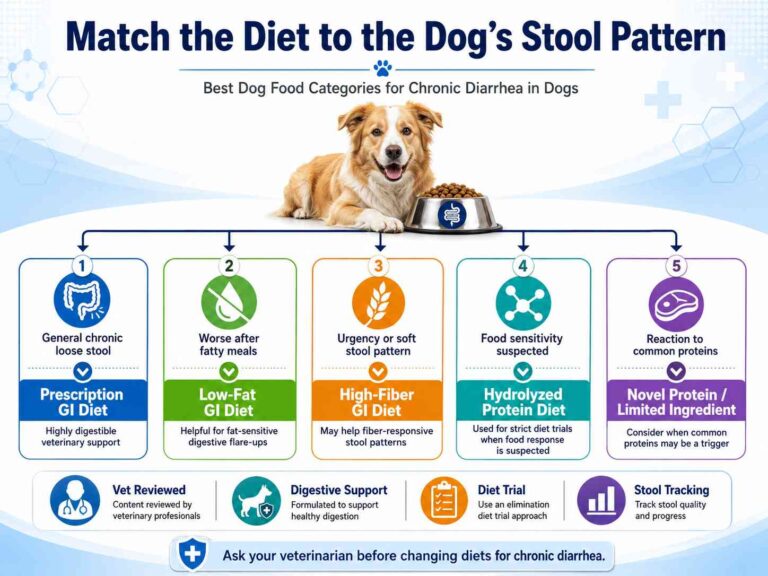
Before buying any food, it helps to understand the main diet categories used for chronic diarrhea. This prevents one of the most common mistakes: treating every case of chronic diarrhea the same way.
Dog’s Situation | Best Food Type to Discuss With Your Vet | Common Examples | Prescription Needed? |
Chronic loose stool with general digestive sensitivity | Prescription gastrointestinal dog food | Hill’s Prescription Diet i/d, Royal Canin Gastrointestinal, Purina EN Gastroenteric | Usually yes |
Diarrhea that worsens after fatty meals | Low-fat gastrointestinal dog food | Hill’s i/d Low Fat, Royal Canin Gastrointestinal Low Fat, Purina EN Low Fat | Usually yes |
Loose stool that may improve with fiber | High-fiber gastrointestinal dog food | Royal Canin Gastrointestinal High Fiber, Hill’s Gastrointestinal Biome | Often yes |
Suspected food-responsive chronic enteropathy | Hydrolyzed protein dog food | Royal Canin Hydrolyzed Protein, Hill’s z/d, Purina HA Hydrolyzed | Usually yes |
Possible food intolerance or reaction to common proteins | Limited-ingredient or novel protein diet | Duck, rabbit, venison, fish, or other true novel protein formulas | Sometimes |
Mild recurring soft stool without major warning signs | OTC sensitive stomach dog food | Purina Pro Plan Sensitive Skin & Stomach, Hill’s Science Diet Perfect Digestion | No |
Several failed diet changes | Structured veterinary diet trial | Hydrolyzed, novel protein, low-fat, high-fiber, or elemental diet | Vet-guided |
The key is not to buy every “digestive care” food you see. The key is to choose the food category that fits your dog’s actual problem. Chronic enteropathy research increasingly emphasizes diet response and careful classification of dogs based on how they respond to treatment (Dupouy-Manescau, N., et al. 2024).
Best Prescription Dog Food for Chronic Diarrhea in Dogs
Prescription gastrointestinal dog food is often one of the strongest categories to discuss with your veterinarian. These diets are usually more controlled than regular commercial sensitive-stomach foods and are designed for digestive support under veterinary guidance.
A good prescription GI diet may include highly digestible ingredients, adjusted fat levels, prebiotic fibers, soluble and insoluble fiber blends, omega-3 fatty acids, electrolytes, hydrolyzed proteins, or other digestive-support features depending on the formula.
The important point is this: prescription GI food is not one single type of food. A standard gastrointestinal formula is different from a low-fat GI formula. A high-fiber GI diet is different from a hydrolyzed protein diet. Choosing the wrong category can waste time and keep your dog’s stool unstable.
When Should You Buy Prescription GI Dog Food for Chronic Diarrhea?
Ask your veterinarian about prescription gastrointestinal dog food if your dog has:
- Chronic loose stool that keeps returning
- Repeated soft stool despite food changes
- Diarrhea that improves for a short time and then comes back
- Poor stool quality with weight changes
- Suspected chronic enteropathy
- Previous failure on OTC sensitive stomach dog food
- Need for a strict, controlled diet trial
- History of digestive disease requiring long-term feeding control
Veterinary consensus guidance supports diet as a central part of treatment evaluation in dogs with chronic inflammatory enteropathy, especially before moving too quickly to other therapies in clinically stable dogs (Heilmann, R. M., et al. 2026).
Best Prescription Gastrointestinal Dog Food Options for Chronic Diarrhea
Common prescrziption gastrointestinal dog food options include:
- Hill’s Prescription Diet i/d Digestive Care
- Hill’s Prescription Diet i/d Low Fat
- Hill’s Prescription Diet Gastrointestinal Biome
- Royal Canin Veterinary Diet Gastrointestinal
- Royal Canin Gastrointestinal Low Fat
- Royal Canin Gastrointestinal High Fiber
- Purina Pro Plan Veterinary Diets EN Gastroenteric
- Purina Pro Plan Veterinary Diets EN Gastroenteric Low Fat
These formulas should not be treated as interchangeable. Hill’s i/d Low Fat is not the same buying decision as Royal Canin Gastrointestinal High Fiber. Purina EN Gastroenteric is not the same as Purina HA Hydrolyzed. The right choice depends on whether your dog needs high digestibility, fat restriction, fiber support, hydrolyzed protein, or another strategy.
Hill’s Prescription Diet i/d for Dogs With Chronic Diarrhea
Hill’s Prescription Diet i/d Digestive Care is a common veterinary gastrointestinal dog food option for dogs that need general digestive support. It is usually considered when the goal is to feed a highly digestible therapeutic diet instead of a standard maintenance food.
Is Hill’s i/d Good for Chronic Diarrhea in Dogs?
Hill’s i/d may be useful for some dogs with chronic diarrhea when a veterinarian wants a broad gastrointestinal support diet. It may be considered when the dog has poor tolerance of regular commercial food, recurring loose stool, or digestive sensitivity that needs a more controlled formula.
Best For
Hill’s i/d Digestive Care may be worth discussing for dogs with:
- General digestive sensitivity
- Chronic loose stool needing a controlled GI diet
- Poor tolerance of regular commercial dog food
- Need for a veterinary digestive-care formula
- Recovery after digestive upset under vet direction
When to Avoid or Use With Caution
Hill’s i/d Digestive Care may not be the best first choice if your dog has:
- Known pancreatitis history
- Strong fat sensitivity
- Suspected food allergy
- Repeated relapse on standard GI diets
- Need for hydrolyzed protein
- Need for higher fiber
In those cases, a more targeted formula may make more sense.
Hill’s Prescription Diet i/d Low Fat for Chronic Diarrhea
Hill’s i/d may be useful for some dogs with chronic diarrhea when a veterinarian wants a broad gastrointestinal support diet. It may be considered when the dog has poor tolerance of regular commercial food, recurring loose stool, or digestive sensitivity that needs a more controlled formula.
Best For
Hill’s i/d Digestive Care may be worth discussing for dogs with:
- General digestive sensitivity
- Chronic loose stool needing a controlled GI diet
- Poor tolerance of regular commercial dog food
- Need for a veterinary digestive-care formula
- Recovery after digestive upset under vet direction
When to Avoid or Use With Caution
Hill’s i/d Digestive Care may not be the best first choice if your dog has:
- Known pancreatitis history
- Strong fat sensitivity
- Suspected food allergy
- Repeated relapse on standard GI diets
- Need for hydrolyzed protein
- Need for higher fiber
In those cases, a more targeted formula may make more sense.
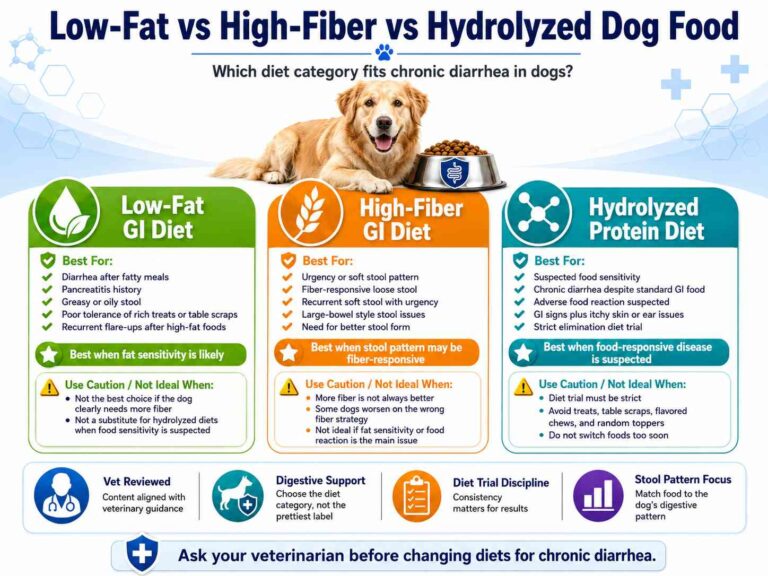
Is Low-Fat Dog Food Better for Chronic Diarrhea?
Low-fat dog food can be better for chronic diarrhea when the dog’s digestive system struggles with fat. This may happen in dogs with fat-sensitive diarrhea, pancreatitis history, greasy stool, or digestive flare-ups after rich meals.
Dietary fat level is not a small detail in dogs with chronic digestive problems. Dogs with certain chronic enteropathy patterns may respond better to reduced-fat, highly digestible diets (Heilmann, R. M., et al. 2026).
Best For
Hill’s i/d Low Fat may be a better option to discuss for dogs with:
- Chronic diarrhea after fatty meals
- Pancreatitis history
- Greasy or oily stool
- Poor tolerance of rich treats
- Recurrent digestive flare-ups after high-fat foods
- Need for highly digestible low-fat food
When to Avoid or Use With Caution
Do not buy low-fat dog food just because “low fat” sounds healthier. Some dogs need more fiber. Some need hydrolyzed protein. Some need a novel protein diet. The best food is the one that matches the dog’s case, not the one with the most attractive claim on the label.
Hill’s Gastrointestinal Biome for Chronic Loose Stool
Hill’s Prescription Diet Gastrointestinal Biome is more focused on stool quality, fiber strategy, and gut microbiome support. This type of formula may be considered when a dog has recurring stool-quality problems and may benefit from a more fiber-focused gastrointestinal diet.
Is Hill’s Gastrointestinal Biome Good for Chronic Diarrhea?
Hill’s Gastrointestinal Biome may be useful for some dogs with chronic loose stool, especially when stool quality and fiber response are major concerns. It is not automatically the right choice for every dog with diarrhea, but it may be worth discussing with a veterinarian when fiber and gut microbiome support are part of the feeding plan.
Best For
Hill’s Gastrointestinal Biome may be worth discussing for dogs with:
- Recurring soft stool
- Stool-quality instability
- Possible fiber-responsive loose stool
- Need for prebiotic fiber support
- Chronic digestive sensitivity where fiber strategy matters
Gut microbiome and dietary fiber are important parts of chronic digestive health because they relate directly to stool quality and digestive response. Recent chronic enteropathy research also places increasing attention on dysbiosis and microbiota-related modulation, especially as older treatment classifications continue to evolve (Dupouy-Manescau, N., et al. 2024).
When to Avoid or Use With Caution
Do not assume a fiber-focused food is right for every dog. Some dogs need lower fat. Some dogs need hydrolyzed protein. Some dogs with poor appetite, weight loss, vomiting, or severe malabsorption need closer veterinary management before food selection.
Royal Canin Gastrointestinal Dog Food for Chronic Diarrhea
Royal Canin Veterinary Diet Gastrointestinal is another major prescription GI dog food category for chronic diarrhea. It is usually considered when a dog needs a veterinary digestive-support diet with high digestibility and controlled formulation.
Is Royal Canin Gastrointestinal Good for Dogs With Chronic Diarrhea?
Royal Canin Gastrointestinal may be a useful option for dogs needing prescription digestive support, especially when the veterinarian wants a general GI formula before moving to more specialized options like low-fat, high-fiber, or hydrolyzed diets.
Best For
Royal Canin Gastrointestinal may be suitable to discuss for dogs needing:
- Prescription digestive support
- Highly digestible nutrition
- Controlled GI diet trial
- Standard GI formula before moving to low-fat, high-fiber, or hydrolyzed options
When to Avoid or Use With Caution
If your dog has pancreatitis history, severe fat sensitivity, repeated failure on standard GI diets, or suspected food-responsive enteropathy, standard Royal Canin Gastrointestinal may not be targeted enough. In those cases, Royal Canin Gastrointestinal Low Fat, Gastrointestinal High Fiber, Hydrolyzed Protein, or another therapeutic diet may be a better discussion.
Royal Canin Gastrointestinal Low Fat for Dogs With Chronic Diarrhea
Royal Canin Gastrointestinal Low Fat is a key option in the low-fat gastrointestinal dog food category. This type of formula is commonly considered when fat digestion is a concern.
When Is Royal Canin Low Fat GI Food a Better Choice?
Royal Canin Gastrointestinal Low Fat may be a better choice when chronic diarrhea appears connected to fat sensitivity. Dogs that develop loose stool after fatty meals, rich treats, table scraps, or high-fat canned foods may need a lower-fat GI formula.
Best For
Royal Canin Gastrointestinal Low Fat may be discussed for dogs with:
- Fat-sensitive chronic diarrhea
- Pancreatitis history
- Loose stool after rich food
- Greasy stool
- Need for digestive support with fat restriction
- Difficulty tolerating standard GI diets
When to Avoid or Use With Caution
Low-fat does not automatically mean hypoallergenic. If the dog’s chronic diarrhea is driven by food-responsive enteropathy or adverse food reaction, a hydrolyzed protein or strict novel protein diet may be more appropriate. A 2025 multicenter study supports the importance of hydrolyzed diet trials and additional dietary trials in dogs with chronic enteropathy, including some dogs that do not respond to the first approach (Rodrigues, S. D., et al. 2025).
Royal Canin Gastrointestinal High Fiber for Chronic Loose Stool
Royal Canin Gastrointestinal High Fiber is a more targeted option for dogs that may need fiber-responsive stool support.
Is High-Fiber Dog Food Good for Chronic Diarrhea?
High-fiber dog food may help some dogs with chronic loose stool, especially when the problem is fiber-responsive. It may be considered when stool form, urgency, and large-bowel style loose stool are part of the pattern.
But high fiber is not the answer for every dog. Some dogs with chronic diarrhea need low-fat food. Others need hydrolyzed protein or a more digestible formula.
Best For
Royal Canin Gastrointestinal High Fiber may be discussed for dogs with:
- Chronic loose stool that may respond to fiber
- Large-bowel style stool patterns
- Recurrent soft stool with urgency
- Stool quality that improves when fiber is added
- Need for intestinal transit support
When to Avoid or Use With Caution
Do not throw high fiber at every diarrhea case. Some dogs need low-fat food. Some need hydrolyzed protein. Some need highly digestible, lower-residue feeding. If you choose high fiber blindly, you may make stool worse or delay the correct diet trial.
Purina Pro Plan EN Gastroenteric for Dogs With Chronic Diarrhea
Purina Pro Plan Veterinary Diets EN Gastroenteric is another commonly discussed veterinary GI diet. It is designed for digestive support and is often used in dogs needing highly digestible nutrition.
Is Purina EN Good for Chronic Diarrhea in Dogs?
Purina EN Gastroenteric may be helpful for some dogs with chronic diarrhea when a veterinarian wants a highly digestible prescription GI diet. It can be a reasonable option to discuss when the dog needs digestive support but does not clearly need a strict hydrolyzed protein diet.
Best For
Purina EN Gastroenteric may be discussed for dogs needing:
- Highly digestible GI nutrition
- Prescription digestive support
- Prebiotic fiber support
- Controlled feeding during chronic loose stool
- Wet or dry GI feeding options, depending on availability
When to Avoid or Use With Caution
If a dog is suspected of having food-responsive enteropathy or adverse food reaction, Purina HA Hydrolyzed may be a more relevant discussion than standard Purina EN Gastroenteric.
Best Low-Fat Dog Food for Chronic Diarrhea in Dogs
Low-fat gastrointestinal dog food deserves its own section because many owners ignore fat content and keep buying the wrong food.
A dog can be eating an expensive food and still have chronic loose stool if the fat level is too high for that individual dog. This is especially true when the dog reacts badly to rich toppers, fatty treats, high-fat canned diets, cheese, table scraps, or oily foods.
When Should You Buy Low-Fat Dog Food for Diarrhea?
Ask your veterinarian about low-fat GI dog food if your dog has:
- Chronic diarrhea after fatty meals
- Pancreatitis history
- Greasy or oily stool
- Digestive flare-ups after table scraps
- Poor tolerance of regular canned dog food
- Loose stool after rich toppers
- Need for controlled fat intake
Best Low-Fat GI Dog Food Options
Common low-fat GI options include:
- Hill’s Prescription Diet i/d Low Fat
- Royal Canin Gastrointestinal Low Fat
- Purina Pro Plan Veterinary Diets EN Gastroenteric Low Fat
- Royal Canin Gastrointestinal Low Fat + Hydrolyzed Protein
The last option is important because some dogs may need both fat restriction and hydrolyzed protein. That is a much more specific buying decision than simply choosing “sensitive stomach food.”
What to Check Before Buying Low-Fat Dog Food
Before buying low-fat gastrointestinal dog food, check:
- Fat level
- Calories per cup or can
- Whether fat is listed on a dry matter or as-fed basis
- Whether the diet is complete and balanced
- Whether it is prescription-only
- Whether the protein source is intact or hydrolyzed
- Whether the food includes prebiotics or fiber support
- Whether the food is appropriate for your dog’s life stage
Do not compare wet food and dry food using the front-label percentages alone. Moisture changes the numbers. If you compare food incorrectly, you may think one diet is lower fat when it is not.
Best High-Fiber Dog Food for Chronic Loose Stool in Dogs
High-fiber gastrointestinal dog food can be helpful, but it is often overused by owners who assume “more fiber” always means better stool. That is not how veterinary nutrition works.
When Should You Buy High-Fiber Dog Food for Diarrhea?
Ask your veterinarian about high-fiber GI food if your dog has:
- Chronic loose stool that improves with fiber
- Soft stool with urgency
- Possible fiber-responsive diarrhea
- Recurrent stool inconsistency
- Large-bowel style stool problems
- Need for better stool form
Best High-Fiber GI Dog Food Options
Common high-fiber or fiber-focused GI options include:
- Royal Canin Gastrointestinal High Fiber
- Hill’s Prescription Diet Gastrointestinal Biome
- Other veterinary fiber-responsive GI formulas available in your region
Fiber Ingredients to Look for in Dog Food
Useful fiber-related ingredients include:
- Psyllium
- Beet pulp
- Soluble fiber
- Insoluble fiber
- Prebiotic fiber
- Inulin
- Fructooligosaccharides
- Cellulose
- Pumpkin fiber
- Mixed fiber blends
The exact fiber strategy matters more than the marketing claim. If your dog has chronic diarrhea and has already failed several foods, you need a structured veterinary diet trial, not random pumpkin and guesswork.
Best Hydrolyzed Protein Dog Food for Chronic Diarrhea
Hydrolyzed protein dog food is one of the most important options for dogs with chronic diarrhea when food-responsive enteropathy or adverse food reaction is suspected.
Hydrolyzed proteins are broken down into smaller fragments. The goal is to reduce immune recognition of intact dietary proteins and make the diet more suitable for controlled feeding trials. This is not the same as buying a regular limited-ingredient food from the pet store.
When Should You Buy Hydrolyzed Dog Food for Chronic Diarrhea?
Ask your veterinarian about hydrolyzed protein dog food if your dog has:
- Chronic diarrhea despite standard GI food
- Suspected food-responsive enteropathy
- Suspected adverse food reaction
- Recurring loose stool after common proteins
- GI signs plus itchy skin or ear issues
- Multiple failed commercial diets
- Need for a strict elimination diet trial
Diet response remains an important part of classifying chronic enteropathy in dogs, and food-responsive disease may be underestimated if additional diet trials are not attempted before moving to other treatments (Dupouy-Manescau, N., et al. 2024).
Best Hydrolyzed Protein Dog Food Options
Common hydrolyzed protein options include:
- Royal Canin Hydrolyzed Protein
- Hill’s Prescription Diet z/d
- Purina Pro Plan Veterinary Diets HA Hydrolyzed
- Royal Canin Gastrointestinal Low Fat + Hydrolyzed Protein
- Other veterinary hydrolyzed diets available by region
Why Hydrolyzed Protein Diets May Help Chronic Diarrhea
A 2023 randomized controlled trial found that dietary change supported long-term remission in dogs with chronic enteropathy, and hydrolyzed fish diets supported clinical recovery and remission in dogs with protein-losing enteropathy in that study population (Simpson, K. W., et al. 2023).
That does not mean every dog with diarrhea should immediately eat hydrolyzed food. It means hydrolyzed diets are a serious therapeutic tool when the dog’s case fits.
Mistakes That Can Ruin a Hydrolyzed Diet Trial
A hydrolyzed diet trial can fail because of poor discipline, not because the diet is wrong.
Avoid:
- Regular treats
- Table scraps
- Flavored chews
- Non-approved dental sticks
- Flavored medication
- Random toppers
- Protein-based supplements
- Switching foods too soon
If your dog is on a hydrolyzed diet trial, everything entering the mouth matters.
Best Limited-Ingredient Dog Food for Chronic Diarrhea
Limited-ingredient and novel protein dog foods may help some dogs with chronic diarrhea, especially when food intolerance or food-responsive enteropathy is suspected. But this category is messy because many OTC limited-ingredient foods are not strict enough for medical diet trials.
When Should You Buy Limited-Ingredient Dog Food?
Ask your veterinarian about limited-ingredient or novel protein food if your dog has:
- Recurring diarrhea after common proteins
- Suspected food intolerance
- Previous exposure to chicken, beef, lamb, and turkey
- Chronic loose stool plus skin or ear problems
- Need for a simpler ingredient profile
- A case where hydrolyzed food is not chosen first
Best Novel Protein Options for Chronic Diarrhea
Possible novel proteins may include:
- Duck
- Rabbit
- Venison
- Fish
- Kangaroo, where available
- Insect protein, where regionally available and nutritionally appropriate
A novel protein is only “novel” if your dog has not eaten it before. If your dog has eaten duck treats for years, duck is not novel.
What to Avoid in Limited-Ingredient Dog Food
Avoid limited-ingredient foods that include:
- Multiple animal proteins
- Vague animal digest
- High fat levels
- Unclear flavoring sources
- Frequent ingredient changes
- Poor nutritional adequacy information
- No clear life-stage statement
For a dog with true chronic diarrhea, an OTC limited-ingredient diet may be too loose unless your veterinarian approves it as part of a controlled plan.
Best OTC Sensitive Stomach Dog Food for Mild Chronic Soft Stool
OTC sensitive stomach dog food has a place, but it is not magic. It may help mild recurring soft stool, but it often fails when diarrhea is truly chronic.
When Is OTC Sensitive Stomach Food Enough?
An OTC sensitive stomach food may be reasonable when:
- Stool is only mildly soft
- The dog is otherwise bright and eating well
- There is no weight loss
- There is no vomiting
- There is no blood or mucus
- The dog is not a puppy, senior, or medically fragile
- The issue is occasional rather than persistent
- Your veterinarian does not suspect a deeper GI disorder
When Is OTC Dog Food Not Enough for Chronic Diarrhea?
OTC sensitive stomach food is usually not enough when:
- Diarrhea keeps returning
- Loose stool continues for weeks
- The dog loses weight
- Appetite changes
- Vomiting occurs
- Stool contains blood or mucus
- Several diets have already failed
- Pancreatitis, chronic enteropathy, or food-responsive disease is suspected
At that point, buying another shiny bag of “gentle digestion” food is not a plan. It is delay.
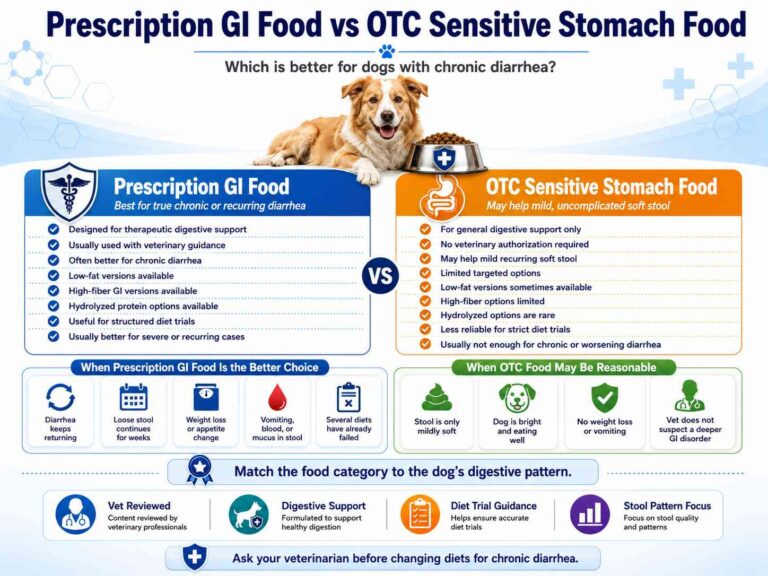
Prescription GI Dog Food vs Sensitive Stomach Dog Food: Which Is Better?
Feature | Prescription Gastrointestinal Dog Food | OTC Sensitive Stomach Dog Food |
Designed for therapeutic digestive support | Yes | Sometimes |
Veterinary supervision | Usually required | Not required |
Better for chronic diarrhea | Often yes | Only mild cases |
Low-fat versions available | Yes | Sometimes |
High-fiber GI versions available | Yes | Limited |
Hydrolyzed protein options available | Yes | Rare |
Useful for structured diet trials | Yes | Less reliable |
Better for severe or recurring cases | Usually | Usually not |
If your dog has chronic diarrhea, prescription GI food is often the stronger buying category. OTC food may be useful for mild cases, but it should not be treated as equal to a veterinary therapeutic diet.
Wet vs Dry Dog Food for Chronic Diarrhea: Which Should You Buy?
Both wet and dry gastrointestinal dog food can be useful. The better choice depends on appetite, hydration needs, stool response, calorie needs, cost, and veterinary recommendation.
When to Buy Dry GI Dog Food
Dry GI dog food may be better if:
- Your dog eats kibble well
- You need easier measuring
- Cost per meal matters
- Long-term feeding is likely
- Storage convenience matters
- You want predictable portions
When to Buy Wet GI Dog Food
Wet GI dog food may be better if:
- Your dog has poor appetite
- Your dog needs softer texture
- Hydration support is helpful
- Medication hiding is needed
- Senior dogs struggle with chewing
- Your dog refuses dry food
Which Is Better for Chronic Diarrhea?
Formula type matters more than wet versus dry. A wet food can be too high in fat. A dry food can be too high in fiber. A low-fat wet food may be better for one dog, while a hydrolyzed dry food may be better for another.
Compare the actual diet category first:
- Low-fat
- High-fiber
- Hydrolyzed
- Highly digestible
- Limited ingredient
- Novel protein
- Standard gastrointestinal
Then compare wet versus dry.
What to Look for in Dog Food for Chronic Diarrhea
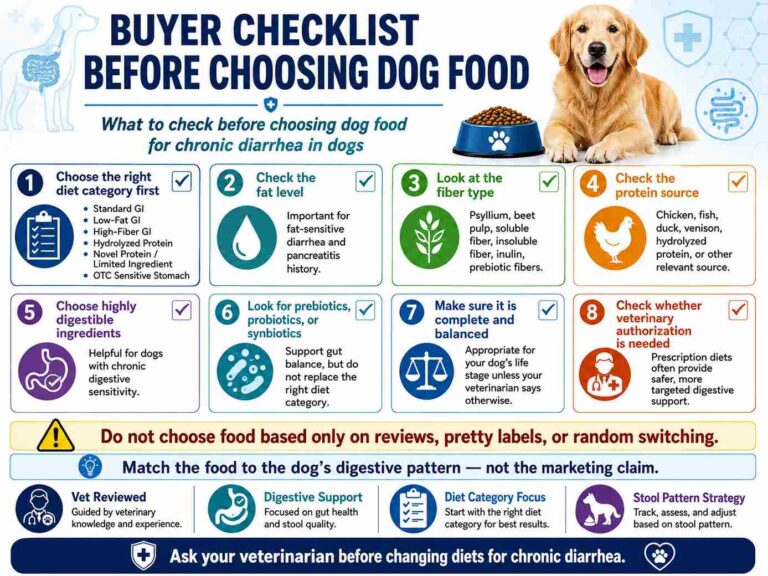
Before buying gastrointestinal dog food for chronic diarrhea, use this checklist.
Choose the Right Diet Category First
The label or veterinary recommendation should make the diet category clear. Is it:
- Standard GI food
- Low-fat GI food
- High-fiber GI food
- Hydrolyzed protein food
- Limited-ingredient food
- Novel protein food
- Sensitive stomach maintenance food
If you cannot identify the category, you are probably buying blindly.
Check the Fat Level
Fat matters for dogs with fat-sensitive diarrhea. Look beyond marketing claims and compare fat properly, especially if choosing between wet and dry food.
Look at the Fiber Type
Fiber can help some dogs and worsen others. Look for fiber-related ingredients such as psyllium, beet pulp, cellulose, soluble fiber, insoluble fiber, inulin, or other prebiotic fibers.
Check the Protein Source
Check whether the food uses chicken, beef, lamb, fish, duck, venison, hydrolyzed soy, hydrolyzed chicken, hydrolyzed fish, or another source. If doing a diet trial, protein history matters.
Choose Highly Digestible Ingredients
Highly digestible dog food is often important for chronic diarrhea because the gastrointestinal tract may not tolerate heavy, rich, or complex formulas well.
Look for Prebiotics, Probiotics, or Synbiotics
Prebiotics and probiotics may support gut balance, but they are not substitutes for the right diet. Current guidance suggests these may help alongside diet or other treatment, but they should not distract from the main feeding strategy (Heilmann, R. M., et al. 2026).
Make Sure the Food Is Complete and Balanced
Make sure the food is complete and balanced for your dog’s life stage unless your veterinarian specifically tells you it is for short-term or supplemental feeding only.
Check Whether Veterinary Authorization Is Needed
If a product needs veterinary authorization, do not see that as a problem. For chronic diarrhea, veterinary oversight is a safety feature.
What Dog Food Should You Avoid for Chronic Diarrhea?
This section is where many owners need to be more honest. Chronic diarrhea is not the time for random food experiments.
Avoid High-Fat Dog Food
High-fat foods can worsen diarrhea in dogs that are fat-sensitive. Avoid rich canned foods, fatty toppers, bacon, sausage, cheese-heavy snacks, oily leftovers, and high-fat treats unless your vet approves them.
Avoid Random Grain-Free Dog Food Without a Medical Reason
Grain-free is not a treatment for chronic diarrhea. Some dogs tolerate grain-free diets. Others do not. The buying decision should be based on digestibility, fat level, fiber profile, protein type, and veterinary guidance.
Avoid Switching Between Multiple Foods
Changing food every few days destroys the diet trial. You will not know what helped, what failed, or what made things worse.
Avoid Rich Toppers and Table Scraps
Toppers can ruin stool consistency and confuse the diet response. Even “healthy” toppers can add fat, sodium, fiber, or extra proteins.
Avoid Long-Term Unbalanced Homemade Diets
Boiled chicken and rice may be used short-term when advised, but it is not a complete long-term plan for chronic diarrhea. Long-term unbalanced feeding can create nutritional problems.
Avoid Buying Dog Food Based Only on Reviews
A review saying “this fixed my dog’s diarrhea” does not tell you whether your dog needs low-fat food, hydrolyzed protein, high fiber, or a prescription GI diet.
Best Dog Food for Chronic Diarrhea in Dogs: Comparison Table
Product / Food Type | Best For | Key Buying Feature | Prescription Needed? | Use Caution If |
Hill’s Prescription Diet i/d | General digestive support | Highly digestible GI formula | Usually yes | Dog needs low-fat or hydrolyzed food |
Hill’s i/d Low Fat | Fat-sensitive diarrhea | Lower-fat GI support | Usually yes | Dog needs high fiber or novel protein instead |
Hill’s Gastrointestinal Biome | Stool-quality support | Fiber and microbiome focus | Usually yes | Dog poorly tolerates fiber |
Royal Canin Gastrointestinal | General GI support | Prescription digestive formula | Usually yes | Fat-sensitive or food-reactive dog |
Royal Canin GI Low Fat | Fat-sensitive GI signs | Low-fat digestive support | Usually yes | Dog needs hydrolyzed-only trial |
Royal Canin GI High Fiber | Fiber-responsive loose stool | Higher fiber strategy | Usually yes | Dog worsens on high fiber |
Royal Canin Hydrolyzed Protein | Food-responsive enteropathy | Hydrolyzed protein | Usually yes | Trial discipline is poor |
Royal Canin GI Low Fat + Hydrolyzed Protein | Fat sensitivity plus food-response concern | Low fat + hydrolyzed protein | Usually yes | Use only with vet guidance |
Purina EN Gastroenteric | Digestive support | Highly digestible GI diet | Usually yes | Dog needs strict hydrolyzed diet |
Purina HA Hydrolyzed | Suspected food reaction | Hydrolyzed protein | Usually yes | Not for casual switching |
Hill’s z/d | Adverse food reaction trial | Hydrolyzed protein | Usually yes | Treats/toppers cannot be controlled |
OTC Sensitive Stomach Food | Mild recurring soft stool | Easy access | No | True chronic diarrhea |
Which Dog Food Should You Buy for Chronic Diarrhea?
Buy Prescription GI Dog Food If…
Buy or discuss a prescription gastrointestinal diet if your dog has chronic loose stool, recurring diarrhea, poor tolerance of regular food, or needs a controlled digestive-support formula.
Buy Low-Fat Dog Food If…
Buy or discuss low-fat gastrointestinal dog food if diarrhea worsens after fatty foods, rich treats, table scraps, or high-fat canned diets. This is especially important for dogs with pancreatitis history or suspected fat-sensitive digestion.
Buy High-Fiber Dog Food If…
Buy or discuss high-fiber gastrointestinal dog food if your dog’s stool pattern may be fiber-responsive, especially if stool improves with fiber support or has large-bowel characteristics.
Buy Hydrolyzed Protein Dog Food If…
Buy or discuss hydrolyzed protein dog food if your dog has chronic diarrhea despite standard GI diets, suspected food-responsive enteropathy, adverse food reaction, or repeated failure on common proteins.
Buy Limited-Ingredient Dog Food If…
Buy or discuss limited-ingredient or novel protein food if your dog may be reacting to common proteins and needs a simpler protein profile.
Buy OTC Sensitive Stomach Dog Food If…
Buy an OTC sensitive stomach food only if the case is mild, occasional, and not medically complicated. If diarrhea is chronic, repeated, or worsening, OTC food is not enough.
How to Feed GI Dog Food for Chronic Diarrhea
The right food can still fail if you feed it badly.
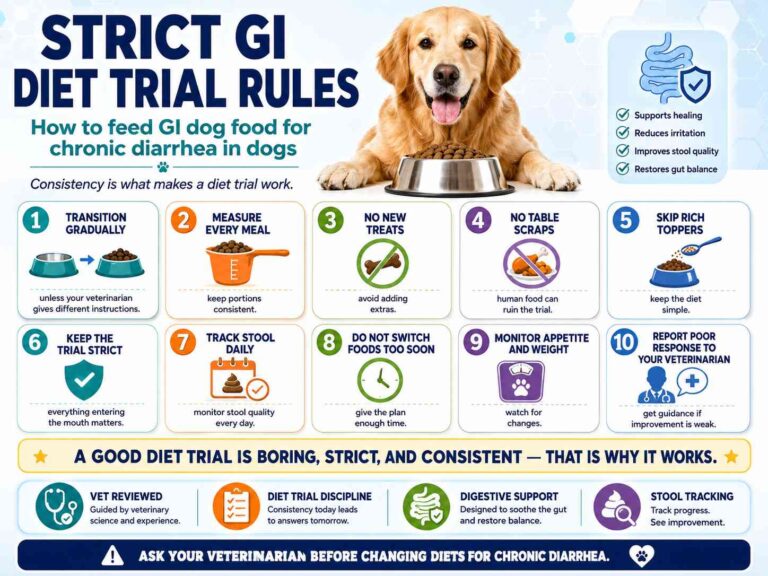
Follow these rules:
- Transition gradually unless your veterinarian gives different instructions.
- Measure every meal.
- Do not add new treats.
- Avoid table scraps completely.
- Do not add rich toppers.
- Keep the diet trial strict.
- Track stool quality daily.
- Do not switch foods too soon.
- Monitor appetite and weight.
- Report poor response to your veterinarian.
A good diet trial is boring, strict, and consistent. That is exactly why it works.
Medical Disclaimer
This article is for educational purposes only and does not replace advice, diagnosis, or treatment from a licensed veterinarian. Always consult your veterinarian before changing your dog’s diet, especially if diarrhea is chronic, severe, or linked to another health condition.
Frequently Asked Questions(FAQs)
1. What is the best dog food for chronic diarrhea in dogs?
The best dog food for chronic diarrhea in dogs is usually a veterinarian-recommended gastrointestinal diet. Some dogs need low-fat food, some need high-fiber food, and others may need hydrolyzed protein or a prescription GI formula.
2. Is prescription dog food better for chronic diarrhea?
Prescription dog food is often better for true chronic diarrhea because it is more targeted than regular sensitive stomach food. It may help dogs that need controlled fat, fiber, digestibility, or protein sources.
3. Is low-fat dog food good for chronic diarrhea?
Low-fat dog food may help dogs whose diarrhea worsens after fatty meals, rich treats, table scraps, or high-fat canned food. It is especially worth discussing with a vet if your dog has a history of pancreatitis or fat sensitivity.
4. Is hydrolyzed protein dog food good for chronic diarrhea?
Hydrolyzed protein dog food may help when chronic diarrhea is linked to food sensitivity or food-responsive digestive problems. It works best as part of a strict diet trial with no extra treats or table scraps.
5. Is high-fiber dog food good for chronic loose stool?
High-fiber dog food can help some dogs with fiber-responsive loose stool, but it is not right for every case. Some dogs need low-fat, hydrolyzed, or highly digestible food instead.
6. Can sensitive stomach dog food help chronic diarrhea?
Sensitive stomach dog food may help mild recurring soft stool, but it may not be enough for true chronic diarrhea. If diarrhea keeps returning, a prescription gastrointestinal diet may be a better option.
7. Should I buy wet or dry dog food for chronic diarrhea?
Both wet and dry GI dog food can work. The better choice depends on your dog’s appetite, hydration needs, stool response, and veterinary recommendation.
Final Recommendation: What Is the Best Dog Food for Chronic Diarrhea in Dogs?
For chronic diarrhea, do not buy dog food based on the prettiest label, the most dramatic review, or the most popular product list. Buy based on diet category.
The strongest buying path is:
- Start with veterinary guidance.
- Choose a prescription GI diet if general digestive support is needed.
- Choose a low-fat GI diet if fat sensitivity is likely.
- Choose a high-fiber GI diet if the stool pattern is fiber-responsive.
- Choose a hydrolyzed protein diet if food-responsive enteropathy is suspected.
- Choose a limited-ingredient or novel protein diet only when the protein history makes sense.
- Use OTC sensitive stomach food only for mild, uncomplicated cases.
The best dog food for chronic diarrhea in dogs is not one universal product. It is the diet that matches your dog’s digestive pattern, is fed consistently, and is monitored properly.
References
- Heilmann, R. M., Jergens, A. E., Kathrani, A., Allenspach, K., Salavati Schmitz, S., Priestnall, S. L., Dandrieux, J. R. S., & O’Connor, A. M. (2026). ACVIM-endorsed statement: Consensus statement and systematic review on guidelines for the diagnosis and treatment of chronic inflammatory enteropathy in dogs. Journal of Veterinary Internal Medicine, 40(1), aalaf017. doi: 10.1093/jvimsj/aalaf017
- Rodrigues, S. D., Mendoza, B., Dias, M. J., Santos, N. S., Hebert, M., Bettin, E., Signorelli, F., Procoli, F., Hernandez, J., & Leal, R. O. (2025). Association of diet with treatment response in dogs with chronic enteropathy: A retrospective multicenter study. Journal of Veterinary Internal Medicine, 39(3), e70071. doi: 10.1111/jvim.70071
- Dupouy-Manescau, N., Méric, T., Sénécat, O., Drut, A., Valentin, S., Leal, R. O., & Hernandez, J. (2024). Updating the classification of chronic inflammatory enteropathies in dogs. Animals, 14(5), 681. doi: 10.3390/ani14050681
- Simpson, K. W., Miller, M. L., Loftus, J. P., Rishniw, M., Frederick, C. E., & Wakshlag, J. J. (2023). Randomized controlled trial of hydrolyzed fish diets in dogs with chronic enteropathy. Journal of Veterinary Internal Medicine, 37(6), 2334–2343. doi: 10.1111/jvim.16844