
Why Is My Dog’s Poop Soft or Watery? Stool Chart Explained
Written by: Dr. Muhammad Ihsan Ullah, PhD
Medically Reviewed by: Dr. Zaheer Hussain, PhD
Last updated on October 19, 2026
Many dog owners become concerned when they notice changes in their pet’s stool and start asking veterinarians “dog poop consistency chart,” “why is my dog’s poop soft or watery,” or “what does dog stool mean” to understand what’s normal and what’s not. A dog poop consistency chart—also known as a fecal score chart—helps you evaluate stool texture, shape, and moisture in a simple, standardised way, making it easier to identify early signs of digestive issues and know when to monitor or seek veterinary advice.
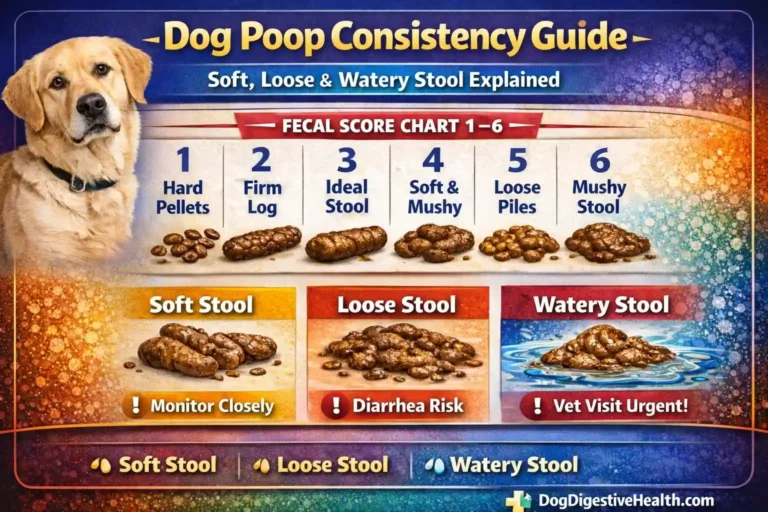
How veterinarians use a dog poop consistency chart
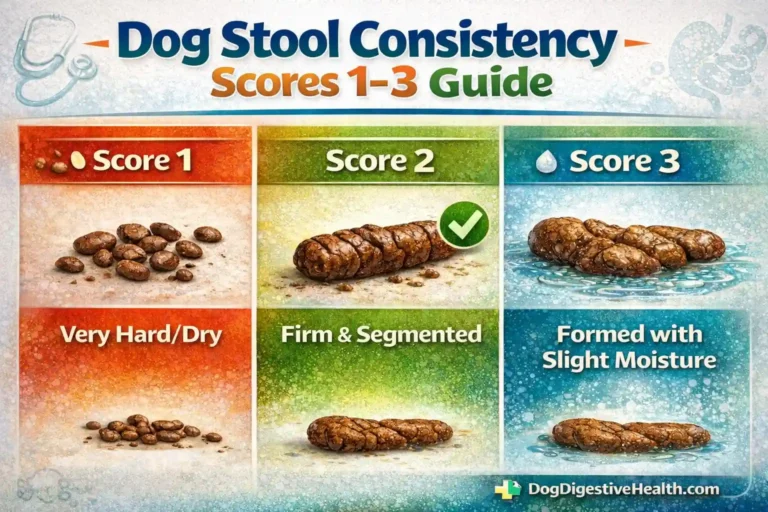
A fecal scoring system ranks stool from Score 1 (very hard) to Score 7 (watery/liquid). It focuses on stool consistency (firmness + moisture + ability to hold shape), not color.
Best practice for accurate scoring:
- Look at the shape (log vs. piles vs. puddle).
- Do the pick-up test (does it lift cleanly or smear/leave residue?).
- If stool is mixed (part formed + part loose), record the higher/worse score for that bowel movement.
- Track the score for 3–5 days to spot trends, not one-off changes.
Dog poop consistency chart (fecal score 1–7)
Typical healthy target: Score 2–3 (formed, log-like, easy to pick up, minimal residue).
Score 1 — Very hard/dry (pellets)
Looks like hard pellets or crumbly, dry pieces.
Meaning: stool contains too little moisture and is over-firm.
Score 2 — Firm, segmented stool
Looks like log-shaped, segmented, pliable, and clean pickup.
Meaning: commonly considered ideal stool consistency.
Score 3 — Formed log with slight moisture
Looks like a smooth or lightly moist log; holds shape well.
Meaning: still within a normal range for many dogs.
What “soft” dog poop means (fecal score 4)
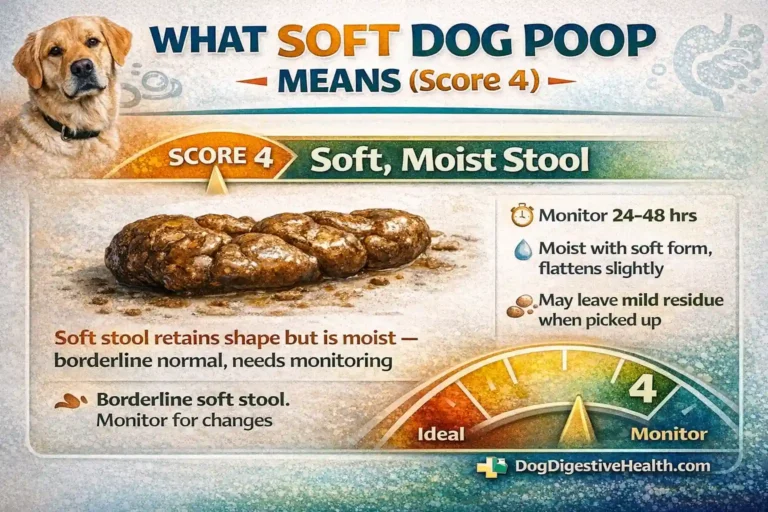
Score 4 — Soft, moist stool that retains shape
Looks like:
- Soft log with rounded edges
- May flatten slightly
- Often leaves mild residue when picked up
Meaning (what this stool consistency indicates):
Soft stool usually means more water is staying in the stool than normal, but the gut is still forming structure. This is the borderline zone—not fully diarrhea, but no longer ideal.
How to interpret it:
- If Score 4 happens once and returns to Score 2–3 within 24–48 hours, it may be a short wobble.
- If Score 4 repeats beyond ~48 hours or becomes the new baseline, it signals reduced stool consolidation and deserves closer monitoring.
What “loose” (mushy/pudding-like) dog poop means
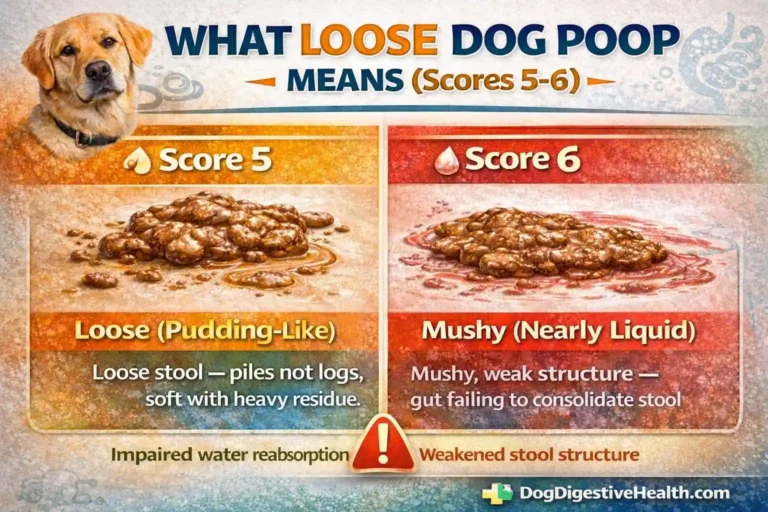
Score 5 — Very soft stool (piles, not logs)
Looks like:
- Loses log shape
- Forms piles instead of logs
- Smears heavily; obvious residue on pickup
Meaning:
Loose stool reflects impaired water reabsorption and weakened stool structure. Practically, this is often treated as diarrhea-range looseness, even if it isn’t fully liquid.
Score 6 — Mushy, nearly liquid stool
Looks like:
- Shapeless mass that spreads
- Thick, soup-like texture
- Heavy smearing
Meaning:
At this stage, the stool is barely formed. The gut is failing to consolidate stool effectively, and dehydration risk increases as consistency approaches liquid.
What “watery” dog poop means (fecal score 7)
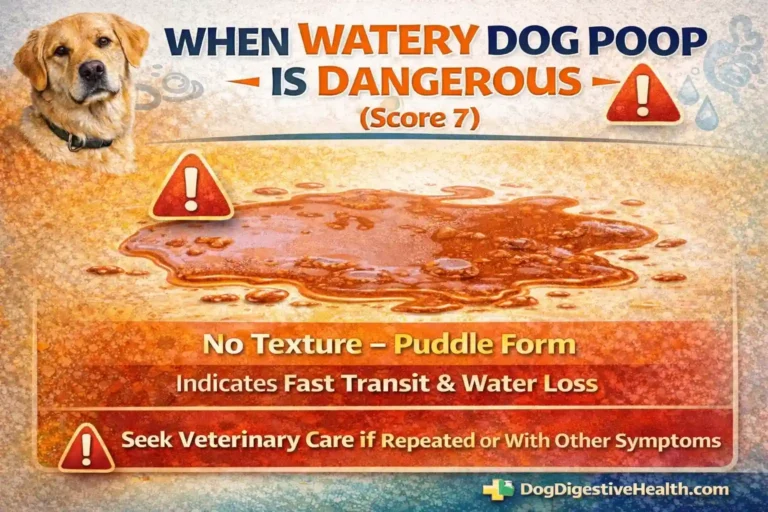
Score 7 — Watery or liquid stool (puddle)
Looks like:
- Complete puddle formation
- No texture or shape
- Impossible to pick up cleanly
Meaning:
Watery stool indicates intestinal contents are moving faster than fluid can be absorbed. This is the highest dehydration-risk consistency category.
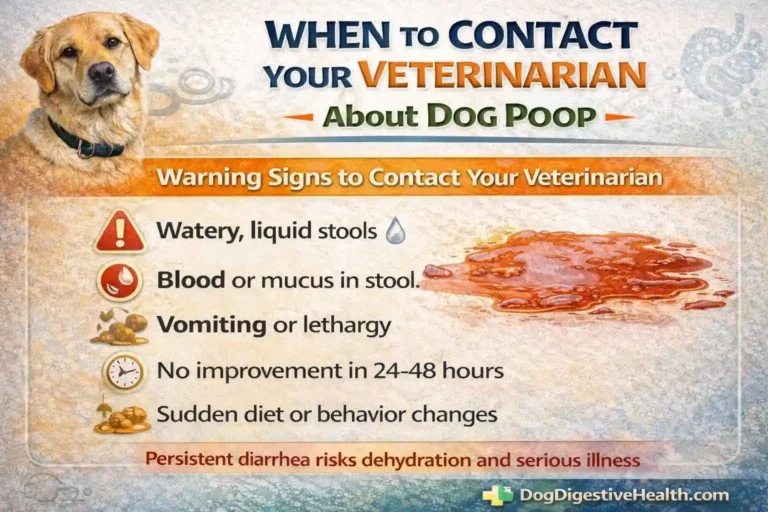
Same-day vet advice is strongly recommended if watery stool occurs with:
- repeated vomiting, marked lethargy, collapse
- dehydration signs (tacky gums, weakness, sunken eyes)
- blood or black/tarry stool
- puppies, seniors, or dogs with chronic disease
Interpreting stool patterns using fecal score trends
Fecal scoring becomes powerful when you track patterns:
- Improving trend: 6 → 5 → 4 → 3 suggests recovery of water regulation and stool structure.
- Worsening trend: 3 → 4 → 5 suggests stool destabilization and rising urgency.
- Mixed stools: record the worst score for that bowel movement.
- Tracking tip: Use consistent scoring (and photos if helpful) so different family members record stools the same way.
Medical Disclaimer
This content is for education only and does not replace veterinary care. Contact a licensed veterinarian promptly if your dog has persistent diarrhea, dehydration signs, repeated vomiting, blood/black stool, or severe lethargy, or if your dog is a puppy, senior, or has a chronic disease.
Frequently Asked Questions(FAQs)
1) What is the normal fecal score for dogs?
Most healthy dogs are typically Score 2–3 (formed, easy to pick up).
2) Is soft dog poop considered diarrhea?
Score 4 is usually not fully diarrhea, but persistent softness can be an early warning.
3) What does pudding-like dog poop mean?
Score 5 often means stool has lost structure and is in a diarrhea-range consistency.
4) When is watery dog poop dangerous?
Score 7 is high-risk for dehydration, especially with vomiting, lethargy, blood, or in puppies/seniors.
5) Can fecal score change between bowel movements?
Yes—single changes can happen, but trends over 24–72 hours are more meaningful.
6) How do I score mixed stool (formed + loose)?
Record the higher/worse score seen in that bowel movement.
References
- Nestlé Purina PetCare. (2020). Nestlé Purina Fecal Scoring System. University of Missouri Veterinary Health Center.
- World Small Animal Veterinary Association. (2025). Five Steps of Canine Acute Diarrhea Treatment.
- Jessen, L. R., et al. (2024). European Network for Optimization of Veterinary Antimicrobial Treatment (ENOVAT) guideline: Recommendations for antimicrobial and probiotic treatment of canine acute diarrhoea. The Veterinary Journal.
- Chauvel, C., et al. (2025). Validation of photographic fecal scoring in puppies. Preventive Veterinary Medicine.
- Montserrat-Malagarriga, M., et al. (2024). Fiber source effects on fecal quality and digestive function in dogs. Animals.