
Best Low-Fat Dog Food for Pancreatitis in Dogs
Written by: Dr. Akram Khan, DVM
Veterinary review by: Dr. Khalid Mehmood, PhD (Assistant Professor in Clinical Veterinary Medicine)
Last medically reviewed: September 05, 2026
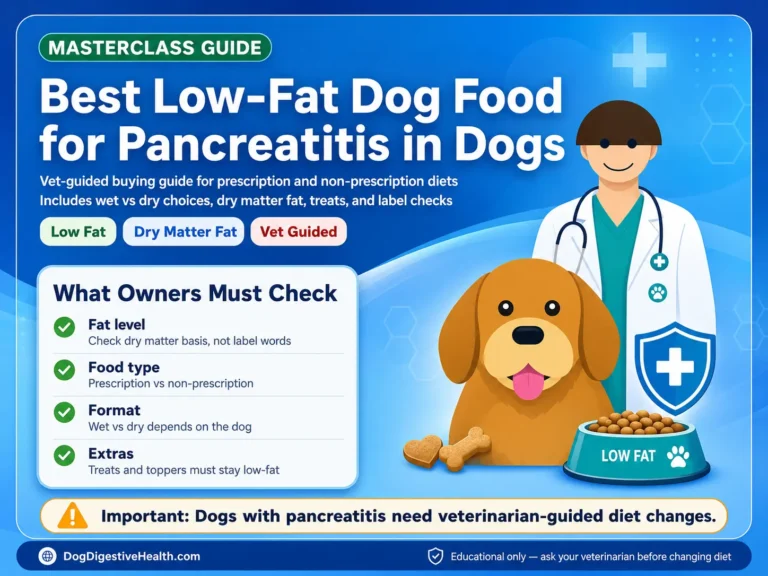
Choosing the best low-fat dog food for pancreatitis in dogs can feel confusing because owners often search for answers like what to feed a dog with pancreatitis, whether prescription low-fat dog food for pancreatitis is better than non-prescription options, and whether wet or dry dog food is better for pancreatitis. The safest choice usually depends on your dog’s diagnosis, fat tolerance, body weight, appetite, other medical conditions, and your veterinarian’s advice—not just the words “low fat” or “sensitive stomach” on the label.
What Is the Best Low-Fat Dog Food for Pancreatitis in Dogs?
The best low-fat dog food for pancreatitis in dogs is usually a veterinary low-fat gastrointestinal diet recommended by a veterinarian. Common options include Hill’s Prescription Diet i/d Low Fat, Royal Canin Gastrointestinal Low Fat, Purina Pro Plan Veterinary Diets EN Gastroenteric Low Fat, and Blue Buffalo GI Low Fat. The right choice depends on your dog’s fat tolerance, medical history, body weight, appetite, and whether the diet’s fat level is appropriate on a dry matter basis.
Best Low-Fat Dog Food for Pancreatitis in Dogs: Quick Comparison
Food | Type | Best For | Prescription Needed? | Main Buying Note |
Hill’s Prescription Diet i/d Low Fat | Veterinary dry/wet diet | Dogs needing strict low-fat digestive support | Yes. | Strong prescription option for adult dogs |
Royal Canin Gastrointestinal Low Fat | Veterinary dry/wet diet | Dogs needing fat-restricted GI support | Yes. | Choose the exact “Low Fat” formula. |
Purina Pro Plan Veterinary Diets EN Gastroenteric Low Fat | Veterinary dry/wet diet | Adult dogs needing low-fat GI support | Yes. | Check maximum crude fat and moisture |
Blue Buffalo Natural Veterinary Diet GI Low Fat | Veterinary dry/wet diet | Dogs with trouble digesting fat | Yes. | Verify current label and protein sources. |
SquarePet VFS Digestive Support Low Fat | Non-prescription dry food | Stable dogs needing a lower-fat option | No | Use only after veterinary approval. |
Important: Dog food formulas can change. Before buying or recommending any food, check the current guaranteed analysis, calories, ingredients, life-stage statement, and feeding instructions directly from the package, manufacturer, or veterinarian.
What Is the Best Dog Food for Dogs With Pancreatitis?
For many dogs with pancreatitis, the best food is a low-fat gastrointestinal diet that is easy to digest and chosen with veterinary guidance. Dogs with pancreatitis often need a diet that reduces unnecessary fat load while still providing enough calories, protein, vitamins, minerals, and digestive support.
Low-fat gastrointestinal diets are frequently recommended in the nutritional management of pancreatitis in dogs, especially during initial management and for dogs with recurrent episodes (Cridge, H., et al. 2024).
The best food is not always the cheapest food, the most popular food, or the food with the most reviews. It is the food that fits your dog’s actual medical situation.
A dog recovering from one mild episode may need a different diet than a dog with chronic pancreatitis, diabetes, obesity, high triglycerides, inflammatory bowel disease, kidney disease, or food intolerance. This is why pancreatitis diets should not be chosen by label claims alone.
How to Choose Low-Fat Dog Food for a Dog With Pancreatitis
Good dog food for pancreatitis should usually be:
- Low in fat
- Highly digestible
- Complete and balanced for the dog’s life stage
- Calorie-appropriate
- Consistent from meal to meal
- Suitable for the dog’s other health conditions
- Approved by the veterinarian managing the case
The biggest mistake owners make is choosing dog food based on marketing words instead of nutrient data. A food may say “healthy weight,” “light,” “lean,” “reduced fat,” or “sensitive stomach” and still be too fatty for a pancreatitis-prone dog.
A second mistake is choosing canned food because the fat number looks low on the label. Wet food contains much more moisture than dry food, so the label percentage can be misleading unless you calculate fat on a dry matter basis.
Dogs with pancreatitis may also have other medical conditions that change the nutrition plan. When multiple diseases occur at the same time, nutrition decisions may need to be adjusted based on the most urgent or most clinically important condition (Cridge, H., et al. 2024).
How Much Fat Should Dog Food Have for Pancreatitis?
There is no single fat percentage that is perfect for every dog with pancreatitis. Some dogs need very strict fat restriction. Others may tolerate a moderate low-fat diet after recovery. Dogs with recurrent pancreatitis, high triglycerides, obesity, diabetes, or repeated flare-ups often need tighter fat control.
As a practical buying rule, many pancreatitis-focused diets are selected around 10% fat on a dry matter basis or lower, especially for dogs with recurrent fat sensitivity. Some dogs may need stricter limits, while others may tolerate a different level under veterinary supervision.
The better question is not simply:
“Is this dog food low-fat?”
The better question is:
“Is this dog food low-fat enough for my dog’s pancreatitis history, body condition, lab results, appetite, and veterinary plan?”
That distinction matters. A food can be lower in fat than regular dog food but still not low enough for a dog with pancreatitis.
How to Calculate Dry Matter Fat in Dog Food
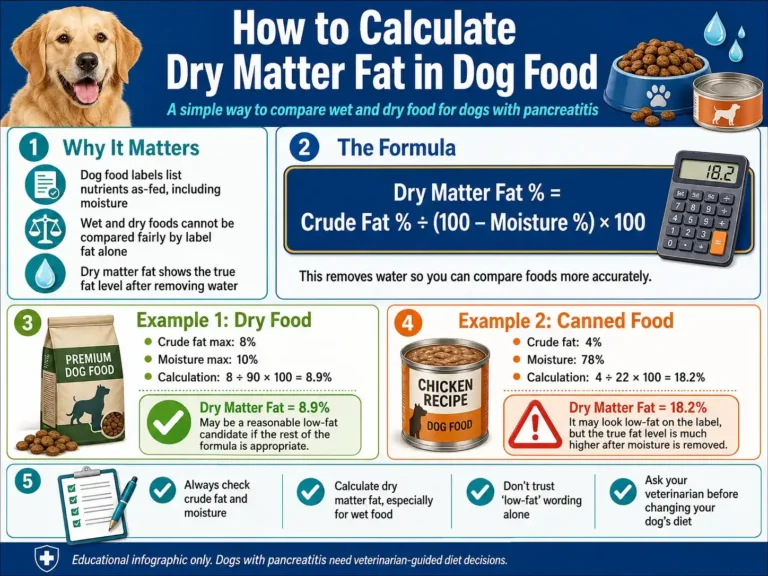
Dog food labels usually show nutrients on an as-fed basis. That means the numbers include moisture. Because wet food and dry food contain very different amounts of water, you cannot compare them fairly by looking only at the label percentage.
Use this formula:
Dry matter fat % = crude fat % ÷ (100 − moisture %) × 100
Example for dry food:
- Crude fat max: 8%
- Moisture max: 10%
Calculation:
8 ÷ 90 × 100 = 8.9% dry matter fat
That food may be a reasonable low-fat candidate if the rest of the formula is appropriate.
Example for canned food:
- Crude fat: 4%
- Moisture: 78%
Calculation:
4 ÷ 22 × 100 = 18.2% dry matter fat
This canned food may look low-fat on the label, but after moisture is removed, the fat level may be much higher than expected.
Why Wet Dog Food Labels Can Be Misleading for Pancreatitis
Wet food can be helpful for some dogs with pancreatitis, especially dogs with poor appetite, dental problems, older age, or hydration concerns. But wet food is also where many owners misread the label.
A canned food showing 3% or 4% crude fat may look low-fat at first glance. But because canned food is mostly moisture, that number does not tell the full story.
Before choosing wet low-fat dog food for pancreatitis, check:
- Crude fat percentage
- Moisture percentage
- Dry matter fat
- Calories per can
- Whether the food is complete and balanced
- Whether it is a veterinary diet or a regular food
- Whether your veterinarian approves it
For pancreatitis-prone dogs, the safest wet food is usually the canned version of a veterinary low-fat gastrointestinal diet recommended by your veterinarian.
Best Prescription Low-Fat Dog Food for Pancreatitis
Prescription low-fat dog foods are often the safest starting point for dogs with diagnosed pancreatitis, recurrent pancreatitis, fat-sensitive digestive disease, hyperlipidemia, or a history of severe flare-ups.
These foods are designed for medical nutritional support and should be used under veterinary supervision. They are not automatically perfect for every dog, but they usually provide a more controlled and medically appropriate starting point than guessing with regular dog food.
Hill’s Prescription Diet i/d Low Fat for Dogs With Pancreatitis
Hill’s Prescription Diet i/d Low Fat is one of the most commonly used veterinary low-fat gastrointestinal diets for dogs. It is designed for adult dogs needing low-fat digestive support.
Best for:
- Adult dogs needing strict low-fat digestive support
- Dogs with fat-sensitive gastrointestinal issues
- Dogs needing long-term digestive support under veterinary supervision
- Owners who want a widely recognized veterinary diet option
Why it may be useful:
- Veterinary therapeutic diet
- Low-fat digestive formula
- Highly digestible
- Available in dry and wet formats in many markets
- Often used for dogs needing controlled fat intake
Buyer caution:
Hill’s i/d Low Fat is a therapeutic diet, not a general “healthy dog food.” It should be used with veterinary guidance. It may not be suitable for puppies, pregnant dogs, nursing dogs, or dogs with certain other health conditions unless specifically approved by a veterinarian.
Royal Canin Gastrointestinal Low Fat for Dogs With Pancreatitis
Royal Canin Gastrointestinal Low Fat is another major veterinary diet used for dogs needing fat restriction and digestive support.
Best for:
- Dogs needing a fat-restricted veterinary GI formula
- Dogs with fat digestion problems
- Dogs needing digestive support with controlled fat
- Owners whose veterinarian recommends Royal Canin GI Low Fat
Why it may be useful:
- Veterinary formula
- Designed for dogs needing reduced fat intake
- Highly digestible
- Includes digestive-support nutrients
- Available in dry and wet formats in many regions
Buyer caution:
Do not confuse Royal Canin Gastrointestinal Low Fat with standard Royal Canin Gastrointestinal formulas. The words “low fat” are important. A regular GI formula may not provide the same fat restriction.
Purina Pro Plan Veterinary Diets EN Low Fat for Pancreatitis
Purina Pro Plan Veterinary Diets EN Gastroenteric Low Fat is a veterinary diet formulated for dogs needing low-fat gastrointestinal support.
Best for:
- Adult dogs needing low-fat GI support
- Dogs requiring a prescription digestive diet
- Dogs whose veterinarian recommends Purina EN Low Fat
- Owners who want a major veterinary diet brand
Why it may be useful:
- Veterinary diet
- Low-fat gastrointestinal positioning
- Available in dry and wet formats
- Useful for dogs needing controlled fat and digestive support
- Often considered alongside Hill’s and Royal Canin options
Buyer caution:
Check the current label carefully. Some foods list crude fat as a minimum and maximum. For pancreatitis-prone dogs, the maximum crude fat and moisture values are especially useful when estimating dry matter fat.
Blue Buffalo GI Low Fat Dog Food for Pancreatitis-Prone Dogs
Blue Buffalo Natural Veterinary Diet GI Low Fat is a veterinary-exclusive diet made for dogs that have trouble digesting fat.
Best for:
- Dogs needing a veterinary low-fat GI formula
- Dogs that do well with fish-based formulas
- Dogs needing digestive support with prebiotic fibers
- Owners looking for an alternative to Hill’s, Royal Canin, or Purina veterinary diets
Why it may be useful:
- Veterinary-exclusive formula
- Reduced-fat digestive support
- Contains digestive-support ingredients
- May suit some dogs that need a different protein profile
- Designed for dogs with difficulty digesting fat
A veterinary gastrointestinal low-fat diet was evaluated in dogs treated with metronidazole, showing that low-fat GI formulas are part of ongoing veterinary nutrition research and not just marketing language (Belchik, S. E., et al. 2024).
Buyer caution:
Do not assume a formula is chicken-free just because the front label highlights fish or another protein. Always read the full ingredient list and verify the current label.
Best Non-Prescription Low-Fat Dog Food for Pancreatitis-Prone Dogs
Non-prescription low-fat dog food can be useful in selected cases, but it is not the safest default for dogs with diagnosed or recurrent pancreatitis.
Non-prescription low-fat dog food may be considered when:
- The dog is stable
- The dog is not in an active pancreatitis episode
- The veterinarian agrees prescription food is not required
- The food’s dry matter fat is appropriate
- The food is complete and balanced
- Treats, toppers, and table scraps are controlled
Non-prescription low-fat food is a poor choice when:
- The dog is actively sick
- The dog is vomiting
- The dog is refusing food
- The dog has repeated pancreatitis flare-ups
- The dog also has diabetes, hyperlipidemia, IBD, EPI, kidney disease, or food allergy concerns
- The owner is choosing based only on price
Recent experimental research suggests that dietary fat management in acute pancreatitis may be more complex than older assumptions, but this does not mean owners should feed high-fat foods to dogs with naturally occurring or recurrent pancreatitis (Kanyorszky, E. T., et al. 2025). For pet dogs with real-world disease, the safer decision remains veterinarian-guided feeding.
SquarePet VFS Digestive Support Low Fat Dog Food Review
SquarePet VFS Digestive Support Low Fat is a non-prescription low-fat option often considered by owners who want an over-the-counter food.
Best for:
- Stable adult dogs needing a lower-fat non-prescription option
- Dogs whose veterinarian approves a non-prescription diet
- Owners who need a lower-cost option after medical stabilization
- Dogs that tolerate fish-based formulas
Why it may be useful:
- Non-prescription
- Formulated for digestive support
- Often discussed as a lower-fat choice
- May be easier to access than prescription diets
- Can be considered for selected stable dogs after veterinary approval
Buyer caution:
Non-prescription does not mean medically safe for every pancreatitis dog. If your dog has had recurrent pancreatitis, hospitalization, vomiting, dehydration, weight loss, or other diseases, do not switch to non-prescription food without veterinary approval.
Prescription vs Non-Prescription Low-Fat Dog Food for Pancreatitis
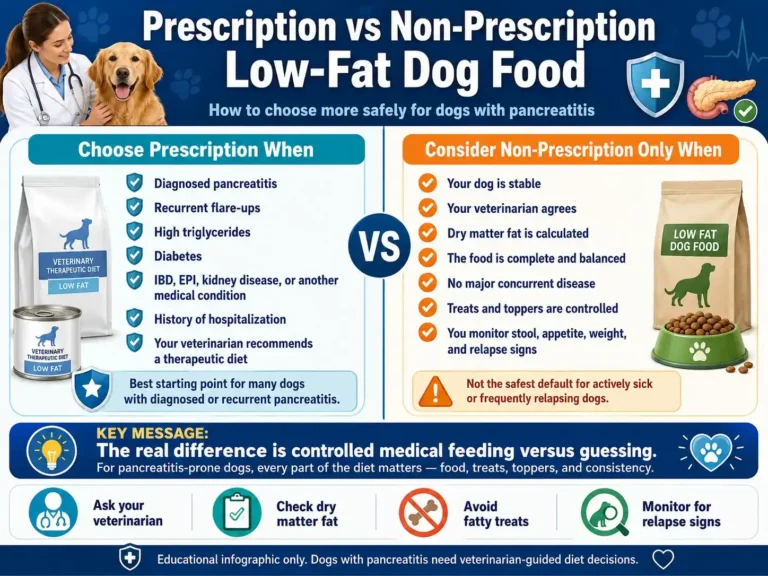
Choose prescription low-fat dog food when:
- Your dog has diagnosed pancreatitis
- Your dog has recurrent flare-ups
- Your dog has high triglycerides
- Your dog has diabetes
- Your dog has IBD, EPI, kidney disease, or another medical condition
- Your dog has needed hospitalization
- Your veterinarian recommends a therapeutic diet
Choose non-prescription low-fat dog food only when:
- Your dog is stable
- Your veterinarian agrees
- You calculate dry matter fat
- The food is complete and balanced
- Your dog has no major concurrent disease
- Treats and toppers are controlled
- You monitor stool, appetite, weight, and relapse signs
The real difference is not simply prescription versus non-prescription. The real difference is controlled medical feeding versus guessing.
Best Wet Low-Fat Dog Food for Dogs With Pancreatitis
Wet low-fat dog food may be helpful when a dog refuses dry food, has dental problems, needs softer texture, or benefits from extra moisture. But it must be chosen carefully.
Wet low-fat dog food may be useful when:
- Your dog refuses dry food
- Your dog needs softer texture
- Your dog needs more moisture
- Your vet recommends a canned therapeutic low-fat diet
- You can verify the dry matter fat
Wet food may be risky when:
- You only check as-fed fat
- The food is rich and meat-heavy
- You mix it with fatty toppers
- You cannot get reliable nutrient data
- Your dog relapses after richer meals
For pancreatitis-prone dogs, the best wet food is usually a veterinarian-recommended canned low-fat gastrointestinal diet.
Best Dry Low-Fat Dog Food for Dogs With Pancreatitis
Dry low-fat dog food is often easier to measure, compare, store, and feed long term. It is also usually more affordable per calorie.
Dry food may be better when:
- Your dog eats kibble comfortably
- You need precise meal measurement
- You want easier storage
- You need lower cost per day
- Your dog needs long-term maintenance
- You want to use kibble pieces as low-fat treats
Dry food may be harder when:
- Your dog has poor appetite
- Your dog has dental disease
- Your dog needs extra hydration
- Your dog does better with softer food
For chronic or recurrent pancreatitis, consistency matters. Switching foods, rotating flavors, adding toppers, and giving random extras can increase the chance of digestive upset.
Best Low-Fat Dog Food for Small Dogs With Pancreatitis
Small dogs need strict portion control because even tiny high-fat treats can become a large part of their daily calories.
A small dog may only need a few hundred calories per day. One piece of cheese, bacon, sausage, peanut butter, or a fatty chew can undo an otherwise careful low-fat plan.
For small dogs with pancreatitis, look for:
- Small kibble size
- Low dry matter fat
- Clear calorie information
- Feeding guidance by body weight
- Low-fat treat compatibility
- No rich toppers
- Easy-to-measure portions
Small dogs are also more likely to be overtreated with “just a bite.” That habit is not harmless in pancreatitis-prone dogs.
Best Low-Fat Dog Food for Senior Dogs With Pancreatitis
Senior dogs often have more than one medical issue. A senior dog with pancreatitis may also have kidney disease, heart disease, dental disease, diabetes, arthritis, muscle loss, or poor appetite.
For senior dogs, choose food based on:
- Fat tolerance
- Digestibility
- Protein needs
- Kidney values
- Body condition score
- Muscle condition
- Calorie needs
- Dental comfort
- Appetite
Nutritional assessment should consider the animal, the diet, feeding management, and environmental factors, especially when disease or age-related risk factors are present (Freeman, L., et al. 2011).
The lowest-fat food is not always automatically the best food. A senior dog also needs enough calories and nutrients to maintain body condition and muscle.
Best Chicken-Free Low-Fat Dog Food for Dogs With Pancreatitis
Some dogs need low-fat food and also have suspected chicken intolerance. This makes food selection harder.
Do not assume a food is chicken-free because the front label says “whitefish,” “salmon,” “turkey,” or “sensitive.” Read the full ingredient list.
Check for:
- Chicken meal
- Poultry by-product meal
- Chicken fat
- Poultry fat
- Chicken liver flavor
- Natural poultry flavor
- Egg, if your dog reacts to egg
For dogs with both pancreatitis and food sensitivity, ask your veterinarian about:
- Hydrolyzed protein diets
- Novel protein diets
- Fish-based low-fat diets
- Therapeutic homemade diets designed by a veterinary nutritionist
A homemade diet may be useful in selected complex cases, but it should be professionally formulated and monitored, not copied from the internet. A published case report described successful nutritional support using a homemade diet in a dog with chronic pancreatitis and suspected concurrent inflammatory bowel disease, but this was a controlled veterinary nutrition case, not a general homemade recipe (Opsomer, H., et al. 2022).
Best Budget Low-Fat Dog Food for Pancreatitis
Budget matters, but cheap food that triggers a flare-up is not cheap.
A pancreatitis relapse can lead to veterinary visits, bloodwork, imaging, hospitalization, fluids, pain medication, anti-nausea medication, and diet changes. The cost of a poor food choice can be much higher than the price difference between diets.
To manage cost safely:
- Compare cost per day, not cost per bag
- Use accurate feeding amounts
- Ask your vet if a non-prescription food is acceptable
- Avoid wasting money on unsafe treats
- Buy larger bags only after tolerance is confirmed
- Do not rotate foods without a reason
- Use approved kibble as treats
Prescription diets are expensive, but for dogs with recurrent pancreatitis, the cost may be justified.
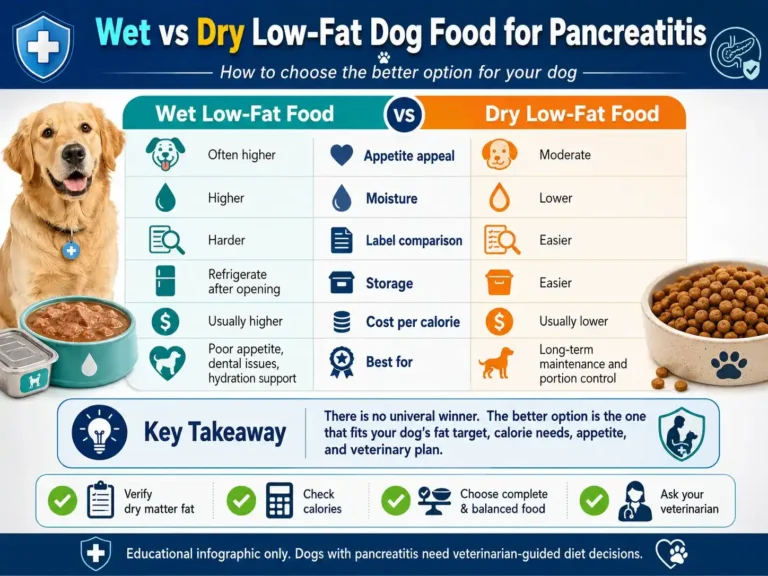
Wet vs Dry Dog Food for Pancreatitis: Which Is Better?
Feature | Wet Low-Fat Food | Dry Low-Fat Food |
Appetite appeal | Often higher | Moderate |
Moisture | Higher | Lower |
Label comparison | Harder | Easier |
Storage | Refrigerate after opening | Easier |
Cost per calorie | Usually higher | Usually lower |
Best for | Poor appetite, dental issues, hydration support | Long-term maintenance and portion control |
There is no universal winner. The better option is the one that fits your dog’s fat target, calorie needs, appetite, and veterinary plan.
Ingredients to Look for in Low-Fat Dog Food for Pancreatitis
A strong low-fat dog food for pancreatitis should not only be low in fat. It should also be digestible, balanced, and appropriate for the dog’s medical situation.
Lean Protein Sources for Dogs With Pancreatitis
Dogs still need protein. Low-fat does not mean low-protein or poor-quality protein.
Common protein sources may include:
- Chicken
- Turkey
- Whitefish
- Egg
- Hydrolyzed protein
- Novel protein, if allergies are suspected
The goal is digestible protein without excessive fat.
Digestible Carbohydrates in Pancreatitis Dog Food
Low-fat diets often use digestible carbohydrate sources to provide energy without relying heavily on fat.
Examples may include:
- Rice
- Potato
- Tapioca
- Barley
- Oats
- Sweet potato
Carbohydrates are not automatically bad. In a pancreatitis diet, they may help reduce reliance on fat as an energy source.
Fiber, Prebiotics, and Probiotics for Digestive Support
Fiber can support stool quality and digestive function, but too much fiber may reduce calorie density or affect tolerance in some dogs.
Some gastrointestinal diets include prebiotics and probiotics to support gut microbial balance. These may be useful for stool quality and digestive resilience, but they do not replace low-fat diet control or veterinary treatment.
Omega-3 Fatty Acids: Helpful or Too Fatty?
Omega-3 fatty acids may support general inflammatory balance. However, owners should not casually add fish oil to a pancreatitis dog because oils add fat.
Supplements should be used only with veterinary approval. Adding oil to a low-fat diet without calculating the total fat intake can quietly ruin the plan.
Foods and Ingredients to Avoid for Dogs With Pancreatitis
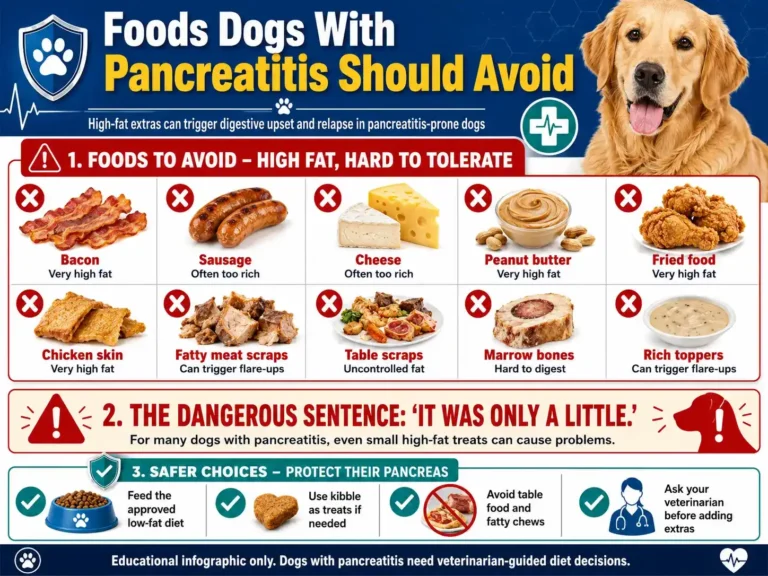
Many dogs relapse not because the main food was wrong, but because the extras were wrong.
Avoid or strictly limit:
Avoid | Why |
Bacon | Very high fat |
Sausage | High fat and often seasoned |
Fatty meat scraps | Can trigger digestive upset |
Chicken skin | Much fattier than lean chicken breast |
Cheese | Small pieces can add significant fat. |
Peanut butter | Often too fatty |
Fried food | High fat and hard to digest |
Table scraps | Uncontrolled fat and seasoning |
Rich toppers | Can ruin a low-fat diet |
Bully sticks | Often too rich |
Marrow bones | High-fat marrow |
Creamy sauces | High-fat plus seasoning risk |
The dangerous sentence is “It was only a little.”
For a small dog with a pancreatitis history, “a little” may be enough to cause a problem.
Best Low-Fat Treats for Dogs With Pancreatitis
Treats are part of the diet. They are not separate.
Safer treatment options may include:
- Pieces of the approved low-fat kibble
- Vet-approved low-fat treats
- Small pieces of carrot, if tolerated
- Small pieces of green bean, if tolerated
- Small pieces of plain lean chicken breast, if approved
- Prescription low-fat treats, if recommended
Avoid:
- Cheese
- Bacon
- Sausage
- Peanut butter
- Bully sticks
- Marrow bones
- Fatty chews
- Meat scraps
- Rich dental treats
For many dogs, using the approved kibble as treats is the safest option. It keeps the diet consistent and prevents accidental fat overload.
How to Transition a Dog to Low-Fat Food Safely
For stable dogs, food transitions are usually gradual. A sudden switch can worsen diarrhea or reduce appetite.
A common transition schedule:
Day | Old Food | New Low-Fat Food |
1–2 | 75% | 25% |
3–4 | 50% | 50% |
5–6 | 25% | 75% |
7 | 0% | 100% |
Do not use this schedule during an active pancreatitis episode unless your veterinarian tells you to. Sick dogs may need a different feeding plan.
How Much Low-Fat Dog Food Should You Feed?
Feeding amount depends on:
- Ideal body weight
- Current body weight
- Body condition score
- Muscle condition score
- Activity level
- Age
- Neuter status
- Calorie density
- Treat intake
- Other diseases
Do not blindly follow the bag. Feeding guides are starting points, not exact prescriptions.
Signs the amount may need adjustment include:
- Weight gain
- Weight loss
- Hunger that becomes unmanageable
- Poor stool quality
- Loss of muscle
- Low energy
- Relapse after meals
Your veterinarian may adjust the amount based on follow-up exams, weight checks, and clinical response.
Low-Fat Dog Food Buyer Checklist for Pancreatitis
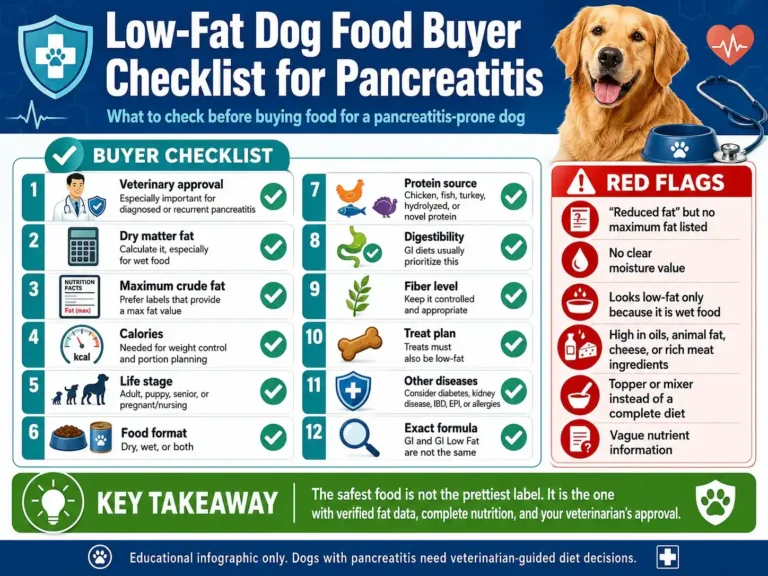
Use this checklist before buying any low-fat dog food for pancreatitis in dogs.
Checkpoint | What to Confirm |
Veterinary approval | Especially for diagnosed or recurrent pancreatitis |
Dry matter fat | Calculate it, especially for wet food. |
Maximum crude fat | Prefer labels that provide a max fat value. |
Calories | Needed for weight control |
Life stage | Adult, puppy, senior, pregnant/nursing |
Food format | Dry, wet, or both |
Protein source | Chicken, fish, turkey, hydrolyzed, novel protein |
Digestibility | GI diets usually prioritize this. |
Fiber level | Controlled and appropriate |
Treat plan | Treats must also be low-fat. |
Other diseases | Diabetes, kidney disease, IBD, EPI, allergies |
Exact formula | GI and GI Low-fat are not the same |
Dog Food Label Red Flags for Pancreatitis-Prone Dogs
Be careful if a product:
- Says “reduced fat” but gives no maximum fat
- Has no clear moisture value
- Looks low-fat only because it is wet food
- Is high in oils, animal fat, cheese, or rich meat ingredients
- Is a topper, mixer, or treat pretending to be a complete diet
- Does not clearly state life-stage adequacy
- Has vague manufacturer nutrient data
- Uses marketing language instead of useful nutrient numbers
For pancreatitis-prone dogs, the best label is not the prettiest label. It is the label that gives enough data to make a safer decision.
Common Mistakes When Buying Dog Food for Pancreatitis
Mistake 1: Choosing “Sensitive Stomach” Food Instead of Low-Fat Food
Sensitive stomach food is not automatically low-fat. Some sensitive stomach foods are moderate or high in fat.
Mistake 2: Comparing Wet and Dry Food Without Dry Matter Fat
Wet food can look low-fat because it contains water. Always calculate dry matter fat before comparing it with dry food.
Mistake 3: Feeding Low-Fat Food but High-Fat Treats
This is one of the biggest causes of failure. Cheese, peanut butter, fatty chews, and table scraps can ruin the diet.
Mistake 4: Switching Dog Food Too Often
Pancreatitis-prone dogs usually need consistency, not variety. Random rotation can make it harder to know what triggered a flare-up.
Mistake 5: Ignoring Calories and Portion Size
Low-fat food can still cause weight gain if overfed. Weight control matters, especially in dogs with metabolic risk.
Mistake 6: Using Homemade Recipes Without Veterinary Guidance
Homemade diets can be useful in complex cases, but only when formulated correctly. Random homemade recipes can be unbalanced or too high in fat.
Medical Disclaimer:
This article is for educational purposes only and is not a substitute for veterinary advice. Always consult your veterinarian before changing your dog’s diet, especially if your dog has pancreatitis or any ongoing health condition.
Frequently Asked Questions(FAQs)
1. What is the best low-fat dog food for pancreatitis in dogs?
The best low-fat dog food for pancreatitis in dogs is usually a veterinarian-recommended low-fat gastrointestinal diet, such as Hill’s i/d Low Fat, Royal Canin Gastrointestinal Low Fat, Purina EN Low Fat, or Blue Buffalo GI Low Fat.
2. Can dogs with pancreatitis eat non-prescription low-fat dog food?
Some stable dogs may eat non-prescription low-fat dog food, but only if a veterinarian approves it. Dogs with active or recurrent pancreatitis usually need stricter dietary control.
3. What fat percentage is best for dogs with pancreatitis?
Many dogs with pancreatitis do better on food around 10% fat on a dry matter basis or lower, but the safest fat level depends on the dog’s condition and veterinary advice.
4. Is wet or dry food better for dogs with pancreatitis?
Neither is always better. Wet food may help picky eaters or dogs needing more moisture, while dry food is easier to measure and feed consistently.
5. What treats are safe for dogs with pancreatitis?
The safest treats are usually pieces of the approved low-fat food or vet-approved low-fat treats. Avoid cheese, bacon, sausage, peanut butter, fatty chews, and table scraps.
6. Can dogs with pancreatitis eat chicken?
Some dogs can eat plain, skinless, lean chicken breast if a veterinarian approves it. Avoid chicken skin, fried chicken, seasoned chicken, and fatty scraps.
7. What foods should dogs with pancreatitis avoid?
Dogs with pancreatitis should avoid high-fat foods such as bacon, sausage, cheese, peanut butter, fried foods, chicken skin, fatty meat scraps, marrow bones, and rich toppers.
Final Verdict: Best Low-Fat Dog Food for Pancreatitis in Dogs
Small dogs with sensitive stomachs need careful portion control. A small dog can get loose stools simply because the owner overfed a rich canned food by a few tablespoons. That does not sound like much, but for a 7-pound dog, it can be a big calorie and fat jump.
The best wet dog food for small dogs with sensitive stomachs should have:
- Small-dog feeding guidelines
- Digestible protein
- Moderate fat
- Controlled calories
- Easy-to-portion texture
- No excessive richness
- Complete and balanced nutrition
- Good palatability without heavy gravy
Small breeds may also be picky, so wet food can help with acceptance. But do not let pickiness train you into constant food switching. That creates digestive chaos. Pick one appropriate food and use measured portions.
Best formats for small dogs include pâté, mousse, tender stew, minced wet food, small cans, or tray portions. Avoid using large-breed or high-calorie canned foods unless you calculate calories correctly.
References
- Cridge, H., Parker, V. J., & Kathrani, A. (2024). Nutritional management of pancreatitis and concurrent disease in dogs and cats. Journal of the American Veterinary Medical Association, 262(6), 834–840. https://doi.org/10.2460/javma.23.11.0641
- Kanyorszky, E. T., Sterczer, Á., Balogh, N., Szilasi, A., Vad, P., & Manczur, F. (2025). Effects of low vs high fat diet in dogs with cerulein-induced acute pancreatitis. Research in Veterinary Science, 197, 105951. https://doi.org/10.1016/j.rvsc.2025.105951
- Belchik, S. E., Oba, P. M., Lin, C.-Y., & Swanson, K. S. (2024). Effects of a veterinary gastrointestinal low-fat diet on fecal characteristics, metabolites, and microbiota concentrations of adult dogs treated with metronidazole. Journal of Animal Science, 102, skae273. https://doi.org/10.1093/jas/skae273
- Opsomer, H., Wichert, B. A., & Liesegang, A. (2022). Homemade diet as nutritional support for a dog suffering from chronic pancreatitis and inflammatory bowel disease. Veterinary Record Case Reports, 10(2), e355. https://doi.org/10.1002/vrc2.355
Freeman, L., Becvarova, I., Cave, N., MacKay, C., Nguyen, P., Rama, B., Takashima, G., Tiffin, R., van Beukelen, P., & Yathiraj, S. (2011). WSAVA nutritional assessment guidelines. Journal of Small Animal Practice, 52(7), 385–396. https://doi.org/10.1111/j.1748-5827.2011.01079.x