
Why Is My Dog Throwing Up Yellow Foam in the Morning?
Written by: Dr. Akram Khan, DVM
Veterinary review by: Dr. Khalid Mehmood, PhD (Assistant Professor in Clinical Veterinary Medicine)
Last medically reviewed: September 13, 2026

Finding yellow, foamy vomit first thing in the morning can be unsettling, especially when your dog seems completely normal afterward. When a dog repeatedly brings up a small amount of yellow or yellow-green fluid before breakfast, one possible explanation is bilious vomiting syndrome (BVS), a condition associated with intermittent or early-morning vomiting of bile after a prolonged period without food (1, 2).
Yellow foam describes the appearance of the vomit; it does not identify the underlying condition. An isolated episode may be minor, but vomiting that repeatedly follows the same early-morning pattern deserves closer attention.
Quick Answer
Yellow foam vomited early in the morning is commonly bile mixed with gastric fluid and mucus. When vomiting occurs repeatedly before breakfast after an overnight fast, and the dog remains well between episodes, bilious vomiting syndrome may be considered. However, timing and appearance alone cannot confirm BVS, and persistent or worsening vomiting should be evaluated by a veterinarian (1, 2).
Why Does My Dog Throw Up Yellow Foam Only in the Morning?
The timing provides an important clue.
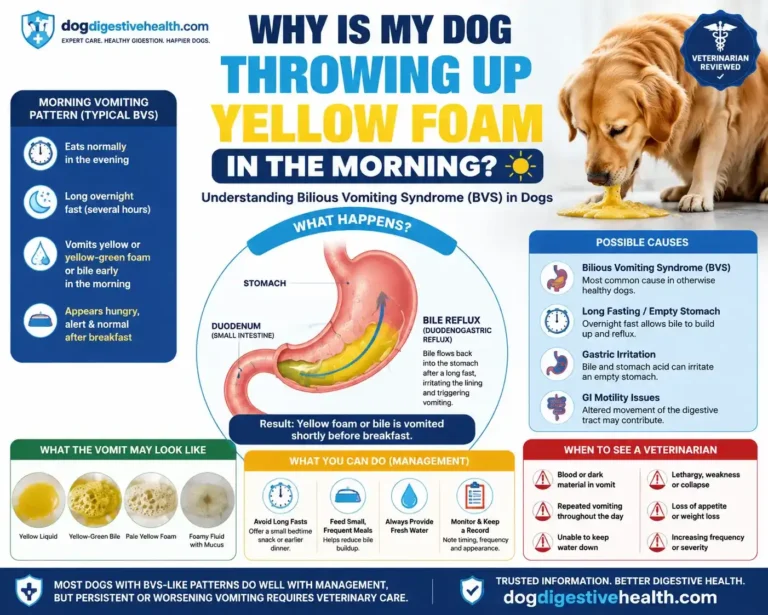
For many dogs, overnight is the longest interval between meals. In dogs with a BVS-like pattern, altered gastrointestinal motility may allow bile-containing fluid from the duodenum, the first part of the small intestine, to move backward into the stomach. This process is called duodenogastric reflux and may irritate the gastric lining enough to trigger vomiting (1, 2).
Because little or no food is present, the vomit may appear as:
- yellow or yellow-green liquid;
- pale yellow foam;
- frothy fluid mixed with mucus; or
- a small amount of bile without visible food.
This can explain why a dog may vomit shortly after waking but eat normally and have no further episodes after breakfast.
An empty stomach alone, however, does not automatically cause vomiting. Most healthy dogs tolerate the overnight interval between meals without difficulty. BVS appears to involve individual susceptibility and gastrointestinal motility rather than fasting being the sole cause.
Why Is My Dog Vomiting Yellow Bile Before Breakfast?
Vomiting shortly before the first meal of the day is a characteristic pattern described in dogs with suspected bilious vomiting syndrome (1).
A typical pattern may involve:
- eating normally in the evening;
- going several hours without food overnight;
- vomiting yellow or yellow-green fluid early the next morning; and
- appearing hungry, alert, and comfortable afterward.
The long dinner-to-breakfast interval may contribute to the problem, but the exact mechanism of BVS is not completely understood.
For this reason, describing morning bile vomiting simply as “too much stomach acid” is medically incomplete. Gastrointestinal motility, reflux of duodenal contents, gastric irritation, meal timing, and individual susceptibility may all be involved (2).
Why Is My Dog Throwing Up Yellow Foam Every Morning but Acting Normal?
A dog that vomits once early in the morning and then becomes bright, hungry, and active can fit a BVS-like pattern.
Normal behavior afterward is reassuring, but it does not prove that recurrent vomiting is harmless. In a retrospective study of 20 dogs diagnosed with BVS, three were subsequently given other diagnoses. The small study highlights why persistent bile vomiting should not automatically be attributed to an empty stomach without considering other explanations (1).
Does the Pattern Resemble Bilious Vomiting Syndrome?
A BVS-like pattern | Features that warrant veterinary attention |
Yellow or yellow-green foam or bile | Blood or dark material in the vomit |
Usually occurs early in the morning | Repeated vomiting throughout the day |
Often occurs before breakfast | Unable to keep water down |
Dog appears well between episodes | Lethargy, weakness, or collapse |
Appetite remains normal | Reduced or absent appetite |
Similar timing from one episode to another | Increasing frequency or severity |
No ongoing diarrhea or weight loss | Persistent diarrhea or unexplained weight loss |
Dog settles afterward | Abdominal pain, distension, or repeated unproductive retching |
This comparison cannot diagnose BVS. A dog may appear well between episodes while still having an underlying gastrointestinal or systemic disorder.
Can an Empty Stomach Make a Dog Vomit Yellow Foam?
A prolonged period without food may contribute to early-morning bile vomiting in susceptible dogs.
Bile is produced by the liver and released into the small intestine as part of normal digestion. With BVS, bile-containing duodenal contents are thought to reflux into the stomach, where they may irritate the gastric mucosa and stimulate vomiting. Altered gastrointestinal motility has also been proposed as an important part of the process (1, 2).
This distinction matters. Overnight fasting may create conditions in which vomiting occurs, but it should not automatically be assumed to be the underlying diagnosis.
Owners should also avoid giving human antacids, acid suppressants, prokinetic drugs, or anti-nausea medicines unless a veterinarian has specifically recommended them for that dog.
Can a Bedtime Meal Help With Morning Bile Vomiting?
For some dogs whose clinical pattern is considered consistent with BVS, shortening the overnight fasting interval may help.
In the published retrospective study, management approaches included more frequent feedings and late-evening meals, sometimes alongside veterinarian-prescribed medications. Twelve of the 20 dogs reportedly improved with treatment, although the study was small and was not a randomized controlled trial (1).
A practical feeding adjustment may involve:
- reserving part of the dog’s normal daily food for later in the evening;
- keeping the total daily calorie intake appropriate;
- maintaining consistent feeding times; and
- recording whether the frequency or timing of vomiting changes.
The goal is to shorten the interval between the final evening meal and breakfast, not simply to add extra calories.
Rich treats are unnecessary and may introduce additional gastrointestinal variables. A late meal should also not be used to repeatedly mask vomiting that has never been medically evaluated.
Should I Worry If My Dog Throws Up Yellow Bile Every Morning?
Vomiting every morning is recurrent vomiting and deserves veterinary attention, even if individual episodes seem mild.
Contact a veterinarian promptly if morning vomiting occurs with:
- repeated vomiting over a short period;
- inability to keep water down;
- lethargy, weakness, or collapse;
- abdominal pain or visible distension;
- repeated retching without producing vomit;
- blood in the vomit;
- black or tar-like stool;
- reduced appetite;
- persistent diarrhea;
- unexplained weight loss; or
- suspected toxin or foreign-object ingestion.
Puppies, senior dogs, and dogs with existing medical conditions generally warrant a lower threshold for veterinary assessment.
A single isolated episode in an otherwise healthy adult dog is different from vomiting yellow bile every morning for several days or weeks.
Is Morning Yellow Vomit Always Bilious Vomiting Syndrome?
No. Bilious vomiting syndrome is a clinical pattern, not a diagnosis that can be made from vomit color alone.
BVS becomes more plausible when yellow or yellow-green bile vomiting repeatedly occurs early in the morning, follows a prolonged period without food, and occurs in a dog that remains clinically well between episodes (1, 2).
Depending on the dog’s history, age, physical examination, and accompanying signs, a veterinarian may recommend blood tests, fecal testing, abdominal imaging, or other investigations before attributing recurrent vomiting to BVS.
Keeping a simple record can help. Note:
- when your dog last ate;
- what time vomiting occurred;
- what the vomit looked like;
- whether breakfast was eaten normally;
- whether vomiting occurred at other times; and
- whether appetite, stool, weight, or activity changed.
A consistent pattern of yellow bile, early-morning timing, a long overnight fasting interval, and otherwise normal behavior can make BVS a reasonable consideration. Persistent vomiting, however, should guide veterinary evaluation rather than replace it.
Medical Disclaimer
This article is for educational purposes only and is not a substitute for veterinary diagnosis or treatment. Contact a veterinarian if your dog has recurrent vomiting, worsening symptoms, or concerning changes in appetite, behavior, hydration, or overall condition.
Frequently Asked Questions (FAQs)
1. Is yellow foam in dog vomit usually bile?
Yes. Yellow or yellow-green foam often contains bile mixed with gastric fluid and mucus, particularly when little or no food is present in the stomach.
2. Why does my dog vomit yellow bile before breakfast?
In some dogs, the long overnight interval between meals may contribute to bile-containing intestinal fluid refluxing into the stomach and triggering early-morning vomiting.
3. Is it normal for a dog to throw up yellow foam every morning?
No. Recurrent morning vomiting should be discussed with a veterinarian, even when your dog seems completely normal afterward.
4. Can a bedtime meal help with morning bile vomiting?
For some dogs with a BVS-like pattern, feeding a small portion of their normal daily food later in the evening may help shorten the overnight fasting interval.
5. When is morning yellow vomiting an emergency?
Seek urgent veterinary care if vomiting occurs with blood, abdominal swelling, repeated unproductive retching, collapse, marked weakness, or inability to keep water down.
References
- Ferguson L, Wennogle SA, Webb CB. Bilious Vomiting Syndrome in Dogs: Retrospective Study of 20 Cases (2002–2012). Journal of the American Animal Hospital Association. 2016;52(3):157–161. doi:10.5326/JAAHA-MS-6300.
- Mott J, Morrison JA, editors. Bilious Vomiting Syndrome. In: Blackwell’s Five-Minute Veterinary Consult Clinical Companion: Small Animal Gastrointestinal Diseases. Wiley; 2019. doi:10.1002/9781119376293.ch50.