
Best Pumpkin Powder for Dogs With Loose Stool
Written by: Dr. Muhammad Ihsan Ullah, PhD
Medically reviewed by: Dr. Khalid Mehmood, PhD (Assistant Professor in Clinical Veterinary Medicine)
Last updated: September 06, 2026
When your dog’s stool suddenly becomes soft, messy, or difficult to pick up, pumpkin powder can seem like an easy solution. It is convenient, shelf-stable, and naturally rich in dietary fiber—but the quality and composition of pumpkin supplements vary widely. The right product may support stool consistency in an otherwise well dog with mild, occasional loose stool; the wrong product, dose, or timing may add gas, worsen diarrhea, or delay needed veterinary care.
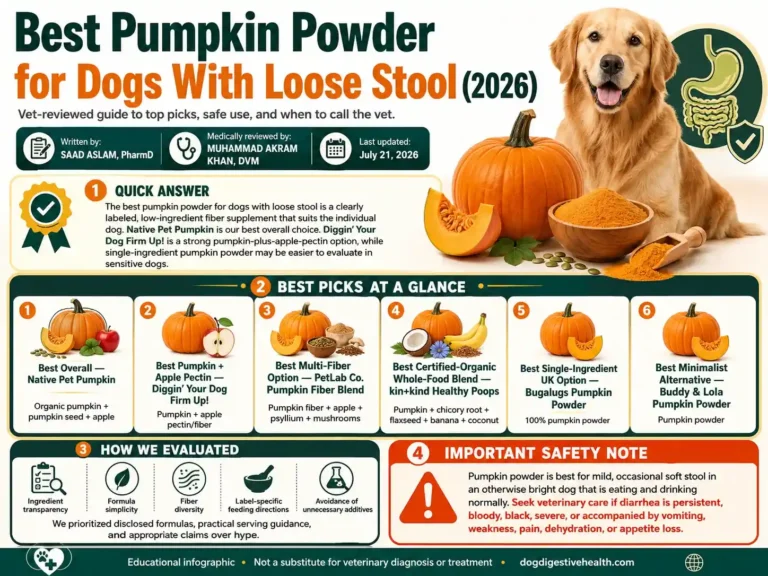
Quick Answer
The best pumpkin powder for dogs with loose stool is a clearly labeled, low-ingredient fiber supplement that suits the individual dog. Native Pet Pumpkin is our best overall choice because it combines organic pumpkin, pumpkin seed, and apple in a relatively simple formula. Diggin’ Your Dog Firm Up! is a strong option for dogs that may benefit from pumpkin and apple pectin, while a single-ingredient pumpkin powder may be easier to evaluate in dogs with sensitive stomachs.
Selected dietary fibers can support fecal bulk and stool consistency, but their effects depend on the fiber source, amount, fermentability, hydration, and the dog’s complete diet (1–3). The available studies do not establish that any commercial pumpkin powder cures canine diarrhea or is superior to veterinary dietary treatment.
Best Picks at a Glance
- Best overall: Native Pet Pumpkin
- Best pumpkin-and-apple-pectin formula: Diggin’ Your Dog Firm Up!
- Best multi-fiber option: PetLab Co. Pumpkin Fiber Blend
- Best certified-organic whole-food blend: Kin+Kind Healthy Poops
- Best single-ingredient UK option: Bugalugs Pumpkin Powder
- Best minimalist alternative: Buddy & Lola Pumpkin Powder
Pumpkin powder is most appropriate for mild, occasional soft stool in an otherwise bright, comfortable dog that is eating and drinking normally. It should not replace veterinary care when diarrhea is persistent, bloody, black, severe, or accompanied by vomiting, weakness, pain, dehydration, or appetite loss.
How We Evaluated Pumpkin Powder for Dog Loose Stools
We assessed products according to factors that matter clinically and practically—not simply popularity, review count, or marketing language.
Ingredient transparency
The complete formula should be easy to find. We favored products that clearly identify their dietary fiber sources, such as pumpkin, apple pectin, psyllium husk, chicory root, or flaxseed.
Formula simplicity
A short ingredient list is easier to assess when a dog has a sensitive stomach. More ingredients may offer a broader fiber profile, but they also create more possible triggers if gas, discomfort, itching, or worsening stool develops.
Fiber diversity
Different fibers behave differently in the gastrointestinal tract. Some hold water or form a gel, some add fecal bulk, and some are fermented by intestinal microorganisms. A balanced blend may suit one dog, while a pure pumpkin powder may be more tolerable for another.
Label-specific feeding directions
Concentration and scoop size vary substantially between products. A tablespoon of canned pumpkin is not equivalent to a tablespoon of dehydrated pumpkin powder, and one brand’s scoop should never be used to estimate another brand’s serving.
Avoidance of unnecessary additives
We favored products without added sugars, artificial colors, dessert-style spices, or poorly explained proprietary ingredients. “Natural,” “human grade,” and “vet recommended” can be useful context, but these phrases do not replace a complete label or reliable evidence.
Appropriate claims
Pumpkin powder may support digestion and stool quality. It is not a substitute for examination, diagnostic testing, fluids, medication, parasite treatment, or a therapeutic gastrointestinal diet when those interventions are needed.
Product Comparison
Product | Best use | Main listed ingredients | Formula type |
Native Pet Pumpkin | Best overall | Organic pumpkin, pumpkin seed, apple | Simple three-ingredient blend |
Digging Your Dog Firm Up! | Targeted stool support | Dehydrated pumpkin, apple pectin/fiber | Two-ingredient blend |
PetLab Co. Pumpkin Fiber Blend | Dogs needing mixed fibers | Pumpkin fiber, apple, psyllium, mushrooms | Multi-fiber blend |
kin+kind Healthy Poops | Organic whole-food support | Pumpkin, chicory root, flaxseed, banana, coconut | Organic prebiotic blend |
Bugalugs Pumpkin Powder | Pure pumpkin preference | 100% pumpkin powder | Single ingredient |
Buddy & Lola Pumpkin Powder | Minimalist daily topper | Pumpkin powder | Single ingredient |
Product formulas can change. Always compare this discussion with the ingredient panel and feeding directions on the package you purchase.
Detailed Product Reviews
1. Native Pet Pumpkin — Best Overall Choice
Native Pet Pumpkin is our top overall pick for pet owners who want a practical, easy-to-understand pumpkin powder for occasional loose stool. Its current formula lists organic pumpkin, organic pumpkin seed, and organic apple.
The short formula supplies complementary food-based fibers without becoming a complex herbal or probiotic blend. It can be sprinkled over food or rehydrated.
Why it stands out
- Recognizable organic ingredients
- Dry or rehydrated serving options
- Weight-based directions
- Wide US availability
Points to consider
It is not pure pumpkin. Dogs that do not tolerate apple or pumpkin seed may need a single-ingredient product. The current label recommends one scoop per 25 pounds, introduced gradually; this is a product-specific direction, not a universal dose.
Best suited to: Adult dogs needing a straightforward pumpkin-and-apple food topper for mild, occasional changes in stool consistency.
2. Diggin’ Your Dog Firm Up! — Best Pumpkin Powder With Apple Pectin
Firm Up! is a focused formula built around dehydrated pumpkin and apple pectin or apple fiber. It is one of the more relevant options for owners specifically searching for a pumpkin powder with apple pectin for dog loose stool.
Pectin is a soluble, fermentable fiber with water-holding properties. Paired with pumpkin, it may offer more targeted stool support, although rapid introduction can cause gas.
Why it stands out
- Two clearly identified ingredients
- No complicated botanical blend
- Easier to troubleshoot than many mixed formulas
Points to consider
Avoid it in dogs with apple sensitivity. Start with the lowest label-directed amount and stop if gas, discomfort, or looser stool develops.
Best suited to: Dogs that tolerate apple and may benefit from a simple pumpkin-and-pectin blend.
3. PetLab Co. Pumpkin Fiber Blend — Best Multi-Fiber Formula
PetLab Co. Pumpkin Fiber Blend currently combines pumpkin fiber with apple, psyllium husk, and mushroom ingredients. This is a broader formulation for pet owners who want more than pure dehydrated pumpkin.
Psyllium is a gel-forming, water-binding fiber, so accurate serving and adequate hydration matter.
Why it stands out
- Several complementary fiber sources
- Includes psyllium husk
- Can be served in food or as a paste
- Weight-based directions
Points to consider
It may be too complex for a highly sensitive dog. Do not combine it casually with several other fiber products.
Best suited to: Dogs that already tolerate mixed fibers and whose veterinarian agrees that a broader pumpkin fiber supplement is appropriate.
4. kin+kind Healthy Poops — Best Certified-Organic Whole-Food Blend
kin+kind Healthy Poops is a certified USDA organic, veterinarian-formulated supplement containing pumpkin, chicory root, flaxseed, banana, and coconut.
Chicory root supplies inulin-type prebiotic fiber, while flaxseed and coconut add further fiber and nutrients.
Why it stands out
- Certified-organic whole-food ingredients
- Several disclosed fiber sources
- Designed for routine digestive support
Points to consider
The blend may cause gas when introduced quickly and may be unnecessarily complex for sudden loose stool. Obtain approval before using it with an elimination, fat-restricted, or therapeutic diet.
Best suited to: Dogs accustomed to varied fiber sources and owners prioritizing certified-organic ingredients.
5. Bugalugs Pumpkin Powder — Best Single-Ingredient UK Option
Bugalugs lists 100% pumpkin powder as the product’s composition. It can be sprinkled over food, mixed with water into a puree, or incorporated into enrichment treats.
Its one-ingredient formula is useful when you want to change only one dietary variable.
Why it stands out
- 100% pumpkin powder
- Made in the United Kingdom
- Dry or rehydrated serving
- No added fiber blend
Points to consider
Not every dog tolerates pumpkin. The current label advises fresh water, avoiding excess servings, and not using it in pregnant or lactating animals.
Best suited to: UK pet owners looking for a pure pumpkin powder without added fibers or botanicals.
6. Buddy & Lola Pumpkin Powder — Best Minimalist Alternative
Buddy & Lola Pumpkin Powder is another single-ingredient option, with pumpkin listed as its composition. It can be added to wet, dry, or raw food or mixed into a puree.
It suits owners seeking pumpkin powder without fillers for dogs.
Why it stands out
- Pumpkin-only composition
- Teaspoon-based directions
- Works with wet, dry, or raw food
Points to consider
Follow its own weight-based directions; do not assume its concentration matches another powder or canned pumpkin.
Best suited to: Dogs needing a minimalist pumpkin food topper and owners who prefer teaspoon-based serving guidance.
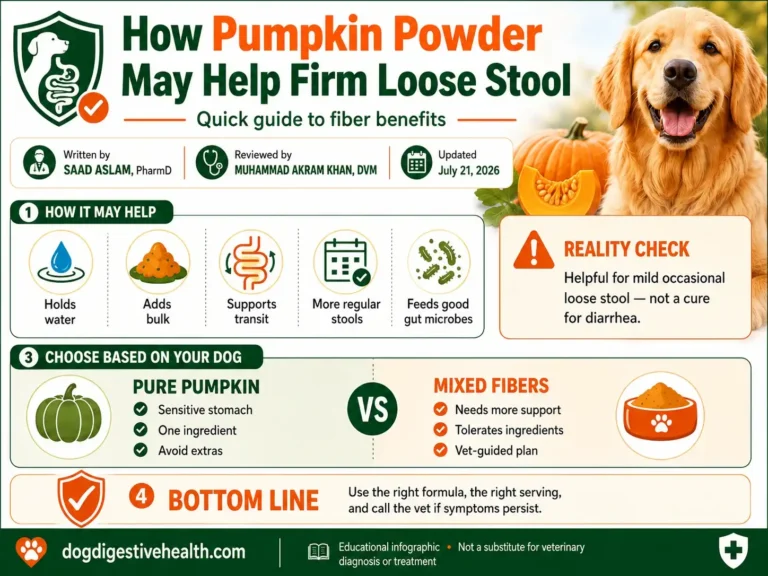
Can Pumpkin Powder Actually Firm Loose Stool in Dogs?

Pumpkin powder may help some dogs because dietary fiber can change how water and solid material move through the intestinal tract. Depending on its characteristics, fiber may:
- Bind or retain water within fecal material
- Reduce the amount of free liquid in stool
- Add bulk
- Influence gastrointestinal transit
- Support more regular colonic contractions
- Provide fermentable material for selected intestinal microorganisms
- Alter the production of microbial metabolites
However, “fiber helps diarrhea” is not a universal rule. The cause of the loose stool, the dog’s underlying health, the type and dose of fiber, and the rest of the diet all matter.
A 2025 randomized clinical trial studied cellulose supplementation in dogs with uncomplicated acute diarrhea. Dogs in both groups improved rapidly, and the study did not show a broad clinical advantage for every dog receiving cellulose; improved fecal consistency was observed in a subset (1). This is an important reminder that fiber can be helpful without being a guaranteed treatment.
The evidence also does not prove that pumpkin powder is superior to psyllium, cellulose, beet pulp, a therapeutic high-fiber diet, or another veterinary nutrition strategy. Commercial pumpkin products have not been established as equivalent through independent head-to-head trials.
Why the Type of Fiber Matters More Than Marketing Claims
Fiber is not one uniform nutrient.
Soluble fibers may dissolve or swell in water and can form a gel-like material. Apple pectin and some components of pumpkin fall into this broad category.
Insoluble or less-fermentable fibers contribute bulk and may influence transit with less microbial fermentation.
Fermentable fibers, such as inulin from chicory root, can be used by intestinal microorganisms and may affect short-chain fatty acid production. Rapid fermentation may also produce gas.
A 2024 crossover study in adult dogs found that different fiber-source combinations produced different effects on digestive function, fecal microbiota, intestinal fermentation, and other measured outcomes (2). Another 2024 study showed that fiber and biotic combinations influenced fecal output, metabolites, microbial populations, and nutrient digestibility in healthy adult dogs (3).
These studies did not test the commercial pumpkin powders reviewed here. Their practical message is broader: the complete fiber profile matters, and a product with more ingredients is not necessarily more effective or better tolerated.
How Much Pumpkin Powder Should You Give a Dog for Loose Stool?
There is no universal teaspoon or tablespoon dose for all products.
Pumpkin powders differ in:
- Concentration
- Moisture content
- Particle size
- Crude and total dietary fiber
- Added apple pectin or psyllium
- Scoop size
- Suggested frequency
- Additional prebiotic ingredients
Use the weight-based directions on the exact package. Start at the lowest label-directed serving and introduce it gradually, especially in a small dog or one with a sensitive stomach.
A sensible approach is to:
- Give only one new digestive supplement.
- Measure the product accurately.
- Mix it thoroughly into the normal meal.
- Add water if the label recommends rehydration.
- Keep fresh drinking water available.
- Observe the next several bowel movements.
- Stop if stool becomes more watery or the dog appears uncomfortable.
Do not keep increasing the amount because the first serving did not produce an immediate change. Excess fiber can create the opposite of the desired effect.
How Quickly Might Stool Consistency Improve?
Some manufacturers state that changes may be noticed within a few days, but no reliable clinical timeline applies to every commercial pumpkin powder or every dog.
A mild dietary upset may improve after one or several meals regardless of supplementation. A dog’s response is affected by:
- The reason for the loose stool
- The amount and type of fiber
- Intestinal transit time
- Hydration
- The main diet
- Other treats and supplements
- Medications
- Parasites or infection
- Underlying gastrointestinal disease
Look for a gradual trend: better shape, less free liquid, easier pickup, less urgency, and comfortable defecation. Do not use a rapid-change promise as the main reason to choose a product.
Pumpkin Powder Versus Plain Canned Pumpkin
Neither format is always better.
Pumpkin powder may be more practical when you want:
- A longer shelf life
- Less refrigerator waste
- Easier travel and storage
- A measured dry food topper
- A formula with apple pectin, psyllium, or prebiotic fiber
- A product that can be rehydrated as needed
Plain canned pumpkin may be preferable when you want:
- More moisture in the meal
- A soft, familiar texture
- A minimally processed puree
- Easy mixing with dry food
- A product the dog already tolerates
Choose plain pumpkin puree, not pumpkin pie filling. Pie filling may contain sugar, spices, or other ingredients unsuitable for dogs.
Do not substitute powder and puree tablespoon-for-tablespoon. Dehydrated powder is concentrated and must be served according to its own label.
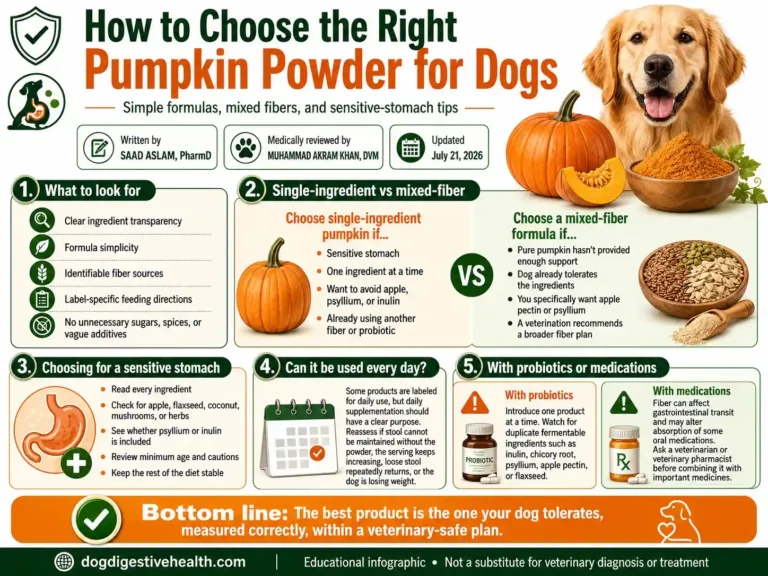
Pure Pumpkin or a Mixed Fiber Supplement?
A single-ingredient product may be the better starting point when:
- Your dog has a sensitive stomach
- You want to introduce one ingredient at a time
- Apple is not tolerated
- You want to avoid psyllium or inulin
- Your veterinarian is evaluating dietary reactions
- The dog is already receiving another probiotic or fiber source
A mixed formula may be reasonable when:
- Pure pumpkin has not provided enough support
- Your dog already tolerates its ingredients
- A veterinarian recommends several fiber types
- You specifically want apple pectin or psyllium
- The product fits a long-term digestive nutrition plan
The best pumpkin fiber supplement for loose stool is not automatically the one with the longest ingredient list. It is the product that is appropriately formulated, correctly measured, and well tolerated by the individual dog.
Choosing a Product for a Sensitive Stomach
For a dog with a history of gas, dietary reactions, or inconsistent stool, begin with the simplest formula that meets the goal.
Before buying, check:
- The first and only ingredients
- Whether apple, flaxseed, coconut, mushrooms, or herbs are included
- Whether the product contains psyllium or inulin
- The amount per serving
- The minimum recommended age
- Warnings for pregnancy or lactation
- Storage instructions
- Whether it overlaps with another supplement
Introduce the product while keeping the rest of the diet stable. Starting pumpkin powder, a probiotic, a new kibble, and a new chew on the same day makes it impossible to identify what helped or caused a reaction.
Dogs on a veterinary elimination diet should receive no new topper unless the supervising veterinarian approves it.
Is Pumpkin Powder Safe for Puppies?
Puppies need more caution because they can dehydrate quickly, and loose stool may be associated with parasites, infection, dietary indiscretion, or serious viral disease.
Do not rely on pumpkin powder when a puppy has:
- Repeated watery diarrhea
- Blood or black stool
- Vomiting
- Weakness or unusual sleepiness
- Poor appetite
- Abdominal pain
- Signs of dehydration
- Incomplete vaccination with significant illness
Check the product’s minimum age. Current manufacturer information varies: some formulas are labeled for dogs older than eight weeks, some for dogs older than 12 weeks, and others for older puppies. Label eligibility does not mean that home management is appropriate for a sick puppy.
Can Pumpkin Powder Be Given Every Day?
Some products are labeled for daily use, but daily supplementation should have a clear reason.
Occasional use may be practical during a gradual food transition, boarding, or travel when your veterinarian considers it appropriate. Long-term use may fit a structured nutrition plan for an individual dog.
Reassess ongoing daily use if:
- Normal stool cannot be maintained without the powder
- You keep increasing the serving
- Loose stool repeatedly returns
- The dog is losing weight
- Appetite has changed
- Mucus or blood appears
- Several fiber products are being combined
- The dog is already eating a therapeutic gastrointestinal diet
A supplement should not conceal a recurring medical problem.
What Happens When a Dog Gets Too Much Pumpkin Powder?
Too much pumpkin powder or too rapid an introduction can cause:
- Increased gas
- Bloating
- Abdominal discomfort
- More frequent defecation
- Softer or watery stool
- Straining
- Hard, dry stool
- Reduced appetite
A product containing pumpkin, pectin, psyllium, and inulin may produce a stronger total fiber effect than pure pumpkin alone.
If the stool worsens after introducing a powder, stop increasing the serving. Discontinue the new supplement, keep water available, record what was given, and contact the veterinarian if the dog is unwell or the problem persists.
Best Way to Serve Pumpkin Powder
Follow the manufacturer’s instructions. Depending on the product, you may:
- Sprinkle it over wet food
- Mix it thoroughly into kibble
- Combine it with cool water to form a paste
- Rehydrate it into a pumpkin-puree texture
Rehydration can improve meal moisture, distribution, and palatability. It may be especially helpful when the formula contains water-binding fibers.
Do not mix a fiber supplement directly into the dog’s entire water bowl unless the manufacturer specifically instructs you to do so. The dog may drink less if the taste or texture changes, and you cannot know how much supplement was consumed.
Using Pumpkin Powder With Probiotics
Pumpkin powder and probiotics are not the same.
- Fiber affects stool structure, transit, water retention, and microbial fermentation.
- Prebiotics are substrates used by selected microorganisms.
- Probiotics are live microorganisms intended to provide a benefit in an adequate amount.
- Synbiotics combine microorganisms and fermentable substrates.
A dog may sometimes use pumpkin powder and a probiotic together, but stacking products can unintentionally provide large amounts of fermentable material.
Read both labels for duplicated ingredients such as
- Inulin
- Chicory root
- Fructooligosaccharides
- Psyllium
- Apple pectin
- Flaxseed
- Probiotic organisms
Introduce one product at a time unless a veterinarian has recommended a specific combination.
Medication and Supplement Precautions
Discuss pumpkin powder with the prescribing veterinarian or veterinary pharmacist when the dog takes oral medication.
Fiber can influence gastrointestinal transit and may alter the absorption of certain medicines. Products containing psyllium, pectin, or adsorptive ingredients require particular attention. Do not assume that one standard separation interval is correct for every drug.
Individual advice is especially important for dogs receiving:
- Thyroid medication
- Seizure medication
- Antibiotics
- Immunosuppressants
- Cardiac medication
- Time-sensitive oral drugs
- Several supplements at once
The medication should not be stopped or rescheduled without professional guidance.
Ingredients and Claims to Avoid
Avoid pumpkin products containing:
- Xylitol or birch sugar
- Added sugar or syrup
- Nutmeg
- Pumpkin pie spice
- Artificial colors
- Dessert flavoring
- Poorly defined proprietary blends
- Ingredients that previously caused a reaction
- Multiple duplicate fibers already present in the diet
Look beyond front-label phrases such as “detox,” “miracle,” “clinically proven,” “pharmaceutical grade,” or “instant relief.” A responsible product should provide the full ingredient list, serving directions, cautions, lot or expiration information, and a way to contact the manufacturer.
How to Monitor Whether the Product Is Helping
Keep a simple three- to five-day record:
- Product and brand
- Amount given
- Time of administration
- Main food and treats
- Number of bowel movements
- Stool shape and ease of pickup
- Mucus, blood, or black coloration
- Straining or urgency
- Appetite
- Drinking
- Vomiting
- Energy level
The goal is not an unusually hard stool. A good response means the stool is formed, comfortable to pass, easier to pick up, and not accompanied by new symptoms.
Red Flags That Need Veterinary Attention
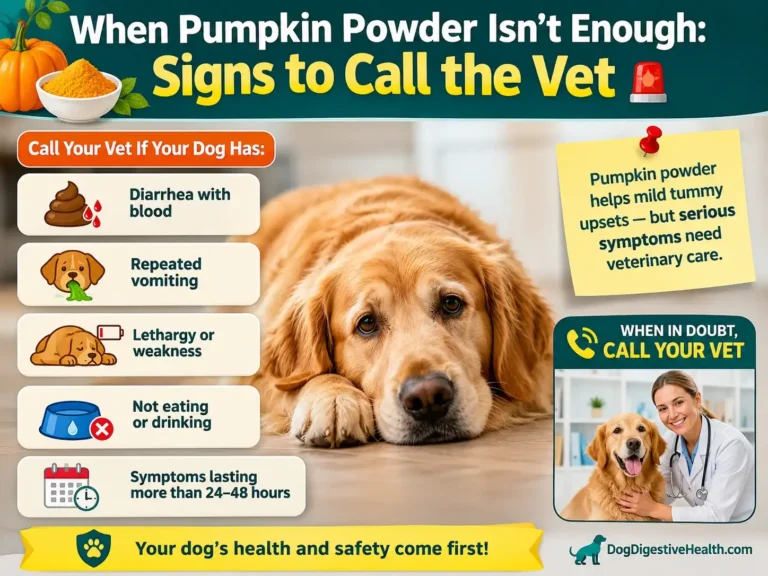
Skip home supplementation and seek veterinary advice promptly when your dog has:
- Blood in the stool
- Black or tar-like stool
- Repeated vomiting
- Marked lethargy or weakness
- Refusal to eat
- Signs of dehydration
- Abdominal pain or swelling
- Severe or rapidly worsening diarrhea
- Suspected toxin, garbage, bone, or foreign-object ingestion
- Significant diarrhea in a puppy
- Recurrent episodes
- Weight loss
- Loose stool lasting about 48 hours or longer
Puppies, elderly dogs, and medically complex dogs may need assessment sooner.
Practical Buying Checklist
Before purchasing a pumpkin powder for soft dog stool, ask:
- Is the full formula disclosed?
- Is pumpkin the principal ingredient?
- Does the dog need pure pumpkin or a mixed fiber blend?
- Are apple pectin, psyllium, inulin, herbs, or probiotics included?
- Does the label provide weight-based directions?
- Is the minimum age stated?
- Are storage and hydration instructions clear?
- Does it conflict with an elimination or therapeutic diet?
- Is there a manufacturer contact and lot information?
- Am I choosing it for mild support rather than delaying care?
Final Verdict
Native Pet Pumpkin is our best overall pumpkin powder for dogs with loose stool because its current formulation is relatively simple, clearly disclosed, easy to serve, and supported by weight-based directions.
Choose Diggin’ Your Dog Firm Up! when you specifically want pumpkin with apple pectin. Consider PetLab Co. Pumpkin fiber blend when mixed fibers, including psyllium, are appropriate. Select kin+kind Healthy Poops when certified-organic whole-food ingredients are a priority. For the simplest approach, Bugalugs and Buddy & Lola provide single-ingredient pumpkin powder options.
The most important decision is not the brand name. It is recognizing whether your dog’s loose stool is mild enough for nutritional support, choosing a formula the dog can tolerate, measuring it correctly, and knowing when veterinary care is the safer next step.
Medical Disclaimer
This article is for educational purposes only and is not a substitute for veterinary diagnosis or treatment. Consult a licensed veterinarian before introducing a new supplement, especially when loose stool is persistent, severe, recurrent, or accompanied by vomiting, blood, pain, lethargy, dehydration, or appetite loss.
Frequently Asked Questions(FAQs)
1. Is the overall top pick suitable for every dog?
No. Native Pet Pumpkin contains apple and pumpkin seed as well as pumpkin. A dog that reacts to either ingredient may be better suited to a single-ingredient product.
2. Can a pumpkin supplement help during a food transition?
It may support stool consistency during a gradual diet change, but it should not be used to justify an abrupt switch. Transition foods slowly unless a veterinarian directs otherwise.
3. Should normal dog food be stopped while using pumpkin powder?
Usually not. Pumpkin powder is generally used as a supplement to an appropriate diet, not as a complete meal. Ask a veterinarian for feeding advice when diarrhea is more than mild.
4. Is an organic formula automatically more effective?
No. Organic certification relates to production standards, not proven clinical superiority. Ingredient suitability, serving accuracy, and the individual dog’s response matter more.
5. Can human pumpkin powder be given to a dog?
Only consider a plain product whose sole ingredient is pumpkin and which contains no sweeteners, spices, or flavorings. A veterinarian should help determine an appropriate serving.
6. How should prepared pumpkin puree be stored?
Follow the manufacturer’s directions. Refrigerate a rehydrated portion when advised and discard it if it develops an unusual odor, appearance, or prolonged room-temperature exposure.
References
- Holz M, Fritz J, Suchodolski JS, Werner M, Unterer S. Effects of dietary cellulose on clinical and gut microbiota recovery in dogs with uncomplicated acute diarrhea: a randomized prospective clinical trial. Journal of the American Veterinary Medical Association. 2025;263(2):169–177. doi:10.2460/javma.24.07.0476.
- Montserrat-Malagarriga M, Castillejos L, Salas-Mani A, Torre C, Martín-Orúe SM. The impact of fiber source on digestive function, fecal microbiota, and immune response in adult dogs. Animals. 2024;14(2):196. doi:10.3390/ani14020196.
- Wilson SM, Kang Y, Marshall K, Swanson KS. Effects of dietary fiber and biotic supplementation on apparent total tract macronutrient digestibility and the fecal characteristics, metabolites, and microbiota of healthy adult dogs. Journal of Animal Science. 2024;102:skae138. doi:10.1093/jas/skae138.