
Canned Pumpkin for Dog Diarrhea: Dosage & Safety
Written by: Dr. Akram Khan, DVM
Veterinary review by: Dr. Khalid Mehmood, PhD (Assistant Professor in Clinical Veterinary Medicine)
Last medically reviewed: September 17, 2026
Canned Pumpkin for Dog Diarrhea at a Glance
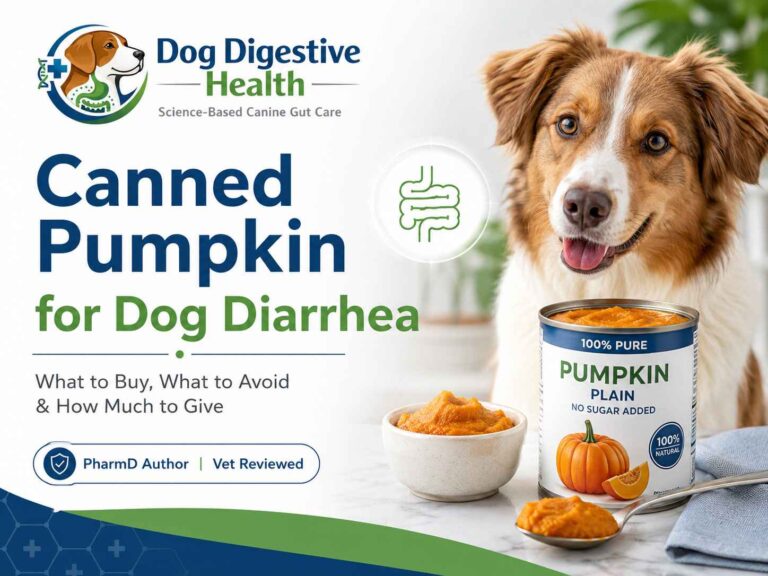
Canned pumpkin is one of the most popular home remedies for a dog with loose stool. A small amount of plain pumpkin may help some dogs by adding dietary fiber and improving stool consistency. However, choosing the wrong product—or giving too much—can worsen digestive upset.
The One-Ingredient Shopping Rule
Plain canned pumpkin may help some dogs with mild diarrhea by adding soluble and insoluble fiber that can absorb water and support firmer stool. Choose 100% pure pumpkin with no added sugar, salt, spices, oils, or artificial sweeteners. Give only a small, measured amount because excessive pumpkin can cause gas, bloating, or looser stool.
The safest canned pumpkin for dogs should have a one-word ingredient list:
Pumpkin
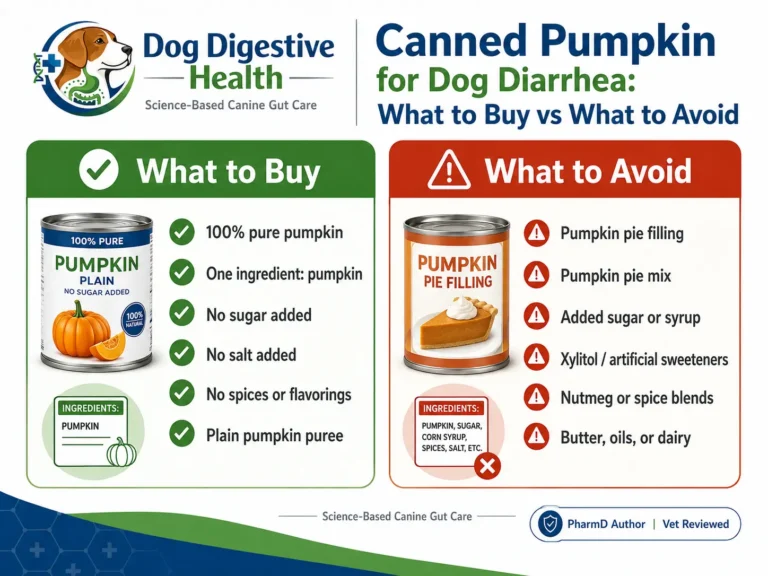
Avoid pumpkin pie filling, pumpkin pie mix, sweetened puree, seasoned pumpkin, and products containing xylitol, nutmeg, added sodium, butter, oils, or dairy ingredients. Grocery-store canned pumpkin is suitable when it is plain, unseasoned, and made entirely from pumpkin.
What Kind of Canned Pumpkin Should I Give My Dog for Diarrhea?
Choose plain canned pumpkin or pumpkin puree made from 100% pumpkin.
The ideal product should have:
- One ingredient: pumpkin
- No added sugar
- No artificial sweeteners
- No added salt
- No spices
- No flavorings
- No butter, cream, or oil
- No unnecessary preservatives
- An intact and unexpired package
Do not rely only on the words printed on the front of the can. Turn the package around and read the complete ingredient list.
Products labeled “pure pumpkin,” “pumpkin puree,” or “100% pumpkin” may be suitable, but the ingredient panel is what matters most.
Avoid anything labeled:
- Pumpkin pie filling
- Pumpkin pie mix
- Sweetened pumpkin
- Pie-ready pumpkin
- Pumpkin spice puree
- Seasoned pumpkin
- Pumpkin dessert filling
- Sugar-free pumpkin dessert
Sugar-free products are not automatically safe. Some sugar-free foods contain xylitol, also called birch sugar, which is highly toxic to dogs.
Does Canned Pumpkin Help Dogs With Diarrhea?
Canned pumpkin may help some dogs with mild diarrhea because it provides dietary fiber. Fiber can affect intestinal water content, stool bulk, gastrointestinal movement, and fermentation by bacteria in the colon.
Pumpkin contains a mixture of fiber types.
Soluble fiber
Soluble fiber interacts with water and may form a gel-like substance in the digestive tract. This can help regulate the amount of moisture present in stool.
Insoluble fiber
Insoluble fiber adds bulk to intestinal contents and may influence how quickly material moves through the gastrointestinal tract.
Fermentable fiber
Some fibers are fermented by intestinal bacteria. This process produces metabolites, including short-chain fatty acids, that help support cells lining the colon.
However, dietary fiber is not one uniform substance. Different fiber sources vary in solubility, fermentability, water-holding capacity, and their effects on intestinal transit and the gut microbiome.
Veterinary evidence supports selected fiber sources as part of dietary management for certain gastrointestinal disorders, including some cases of acute and chronic diarrhea. These findings cannot automatically be applied to every fiber-containing food or supplement (1).
A randomized prospective study of shelter dogs with acute large-bowel diarrhea found that a complete veterinary diet containing a high concentration of mixed soluble and insoluble fibers produced better fecal scores than a standard diet. This supports the potential value of properly formulated fiber-containing diets, but the study evaluated a complete therapeutic diet—not canned pumpkin alone (2).
A more recent randomized clinical trial evaluated cellulose supplementation in dogs with uncomplicated acute diarrhea. Most dogs recovered rapidly regardless of supplementation. Cellulose appeared to improve fecal consistency in a subset of dogs, but the study did not find a significant overall difference in clinical severity or intestinal microbiota composition between the supplemented and control groups (3).
Together, these findings suggest that fiber may support stool consistency in selected dogs, but they do not establish canned pumpkin as a universally effective treatment.
No published clinical trial has determined:
- An evidence-based canned-pumpkin dosage for dogs
- A guaranteed time in which pumpkin will stop diarrhea
- Whether canned pumpkin is effective for every type of diarrhea
- Whether pumpkin shortens the duration of acute canine diarrhea
- Whether more pumpkin produces better results
Pumpkin should therefore be viewed as a short-term dietary addition for selected dogs, not as a cure.
What Is the Best Canned Pumpkin for Dogs With Diarrhea?
The best canned pumpkin is not necessarily the most expensive, organic, or pet-specific product.
The most important factor is the ingredient list.
Look for:
100% pure pumpkin with no other ingredients
A plain grocery-store product may be completely appropriate. A pet-specific product may offer convenient packaging, but it is not automatically safer or more effective.
Canned-pumpkin buying checklist
Before placing a product in your shopping cart, confirm that:
- The ingredient list contains only pumpkin
- It is not pumpkin pie filling or pie mix
- No sugar or syrup has been added
- No salt has been added
- No artificial sweetener is present
- No cinnamon, nutmeg, cloves, or spice blend is present
- No butter, oil, cream, or milk ingredient is included
- The can is not swollen, leaking, rusted, or deeply dented
- The product is within its stated date
- The package size is practical for your dog
A large can may be inexpensive, but it can create waste when only a teaspoon or tablespoon is needed. Smaller cans or single-serving pouches may be more convenient for toy and small-breed dogs.
Is Grocery-Store Canned Pumpkin Safe for Dogs?
Yes. Grocery-store canned pumpkin can be suitable for dogs when it contains only plain pumpkin.
The product does not need to be marketed specifically for pets.
Compare the following before buying:
- Ingredient list
- Sodium content
- Added sugar
- Added seasonings
- Serving size
- Package size
- Cost per portion
A human-food product containing only pumpkin may be simpler than a pet-specific digestive topper containing several added fibers, flavorings, or supplements.
Is Organic Canned Pumpkin Better for Dogs?
Organic canned pumpkin is not proven to work better for dog diarrhea.
A conventional one-ingredient pumpkin puree may be just as suitable as an organic product. Organic certification describes how the crop was produced; it does not establish that the product has a stronger stool-firming effect.
Prioritize these features first:
- One ingredient
- No added sugar
- No added salt
- No spices
- No artificial sweeteners
- A practical serving size
Choose organic pumpkin when that characteristic matters to you, but do not overlook the ingredient label.
Should Canned Pumpkin for Dogs Be Low in Sodium?
A no-salt-added pumpkin product is preferable, especially for dogs with:
- Heart disease
- Kidney disease
- High blood pressure
- Fluid-retention disorders
- A veterinarian-prescribed low-sodium diet
“Low sodium” and “no salt added” are not identical claims. Read both the Nutrition Facts panel and ingredient list.
Salt is unnecessary when pumpkin is being used as a digestive food topper. A dog with a medical condition should not receive added pumpkin without approval from the veterinarian managing its diet.
Is Pumpkin Puree the Same as Canned Pumpkin for Dogs?
Usually, yes.
“Pumpkin puree” and “plain canned pumpkin” commonly refer to cooked pumpkin that has been pureed and packaged.
Both can be appropriate when the ingredient list contains only pumpkin.
They are not the same as pumpkin pie filling.
Product | Suitable for a dog with diarrhea? | What to check |
100% canned pumpkin | Usually | The ingredient list should contain only pumpkin. |
Plain pumpkin puree | Usually | Confirm no sugar, salt, or spices. |
Organic pumpkin puree | Usually | Organic does not replace label checking. |
Pet-specific pumpkin pouch | Possibly | Check for additional fibers or supplements. |
Pumpkin powder | Possibly | Follow product directions and rehydrate if required. |
Pumpkin pie filling | No | Usually contains sugar and seasonings |
Pumpkin pie mix | No | Designed for dessert preparation |
Pumpkin-spice spread | No | May contain sugar, fat, spices, or sweeteners |
What Ingredients Should I Avoid in Canned Pumpkin for Dogs?
The simplest rule is to avoid any canned pumpkin product containing ingredients other than pumpkin.
Pumpkin pie filling and pumpkin pie mix
Pumpkin pie filling is designed for dessert preparation. Depending on the formulation, it may contain:
- Sugar
- Brown sugar
- Syrup
- Salt
- Cinnamon
- Nutmeg
- Cloves
- Ginger
- Flavorings
- Preservatives
Even when a small taste does not cause poisoning, sweetened and seasoned products are inappropriate for a dog that already has digestive upset.
Added sugar
Pumpkin naturally contains carbohydrates and a small amount of naturally occurring sugar. That is different from added sugar.
Avoid ingredient-list terms such as
- Cane sugar
- Brown sugar
- Corn syrup
- Glucose syrup
- Fructose
- Molasses
- Maple syrup
- Sweetened puree
Added sugar provides no benefit for diarrhea. It may also be unsuitable for dogs with diabetes, obesity, or calorie-restricted diets.
Xylitol and artificial sweeteners
Xylitol is extremely dangerous to dogs. It may also appear on labels as
- Birch sugar
- Wood sugar
- Birch bark extract
Xylitol can cause a rapid release of insulin, leading to dangerously low blood glucose. Signs may include:
- Vomiting
- Weakness
- Difficulty walking
- Tremors
- Collapse
- Seizures
Larger exposures may also cause liver injury.
Xylitol is not expected in ordinary one-ingredient pumpkin, but it may be present in sugar-free dessert products, flavored spreads, or specialty foods.
Treat suspected xylitol ingestion as an emergency. Contact a veterinarian or animal poison control service immediately. Do not wait for symptoms.
Salt and sodium
Added salt is unnecessary. Avoid salted pumpkin when a plain no-salt-added option is available.
This is particularly important for dogs with heart, kidney, or blood-pressure conditions.
Nutmeg and pumpkin-spice blends
Nutmeg contains myristicin. Larger exposures can cause vomiting, disorientation, agitation, abnormal heart rate, difficulty walking, or neurologic signs.
A tiny accidental taste of a baked product may not contain enough nutmeg to cause serious poisoning, but pumpkin pie filling and spice blends should not be used as a digestive supplement.
Cinnamon, cloves, ginger, and other spices are also unnecessary. Concentrated seasonings and essential oils can cause additional risks.
Butter, cream, oils, and dairy ingredients
Prepared pumpkin products may contain:
- Butter
- Cream
- Milk
- Coconut oil
- Vegetable oil
- Cheese
- Flavoring fats
High-fat foods may worsen gastrointestinal upset and can be inappropriate for dogs that require dietary fat restriction.
Damaged or spoiled cans
Do not feed pumpkin from a can that is:
- Bulging
- Leaking
- Badly rusted
- Deeply dented along a seam
- Spurting liquid when opened
- Producing an unusual odor
- Showing mold or discoloration
Discard any product when its safety is uncertain.
How Much Canned Pumpkin Should I Give My Dog for Diarrhea?
There is no universally accepted, clinically proven dosage of canned pumpkin for dog diarrhea.
The appropriate amount depends on:
- Body weight
- Age
- Normal diet
- Medical history
- Type of diarrhea
- Fiber tolerance
- Other foods or supplements being given
Too much pumpkin can cause gas, abdominal discomfort, increased stool volume, or worsening diarrhea.
Start with a small amount rather than giving a large spoonful.
Conservative starting amounts by dog weight
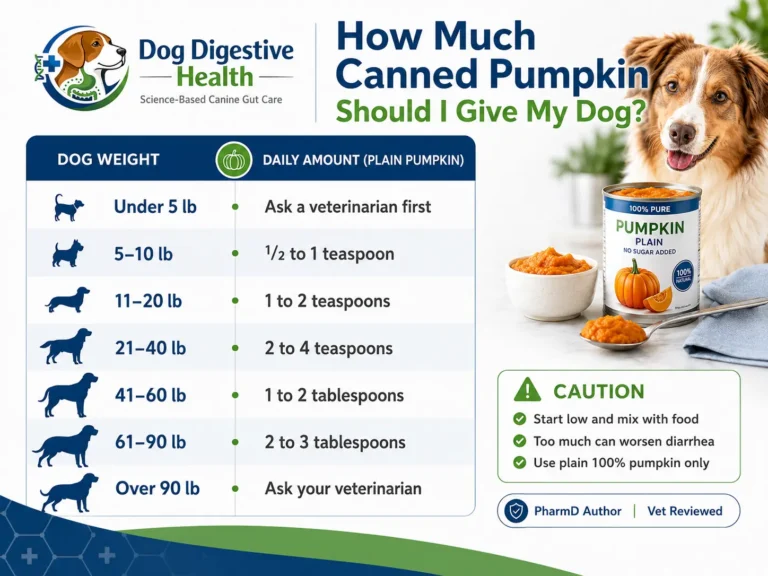
The following are cautious total daily starting amounts, not prescription doses. Divide the amount between one or two meals.
Dog’s weight | Conservative total daily starting amount |
Under 5 lb | Ask a veterinarian before use. |
5–10 lb | ½–1 teaspoon |
11–20 lb | 1–2 teaspoons |
21–40 lb | 2–4 teaspoons |
41–60 lb | 1–2 tablespoons |
61–90 lb | 2–3 tablespoons |
Over 90 lb | Ask a veterinarian for an individualized amount. |
One tablespoon equals three teaspoons.
Begin at the lower end. Mix the pumpkin thoroughly into food and watch the next several bowel movements.
Do not repeatedly increase the amount because the first serving did not produce an immediate change.
How much canned pumpkin for a 10-pound dog with diarrhea?
For an otherwise healthy adult dog weighing approximately 10 pounds, a cautious starting amount is ½ to 1 teaspoon during the day, mixed into food.
Contact a veterinarian before giving pumpkin to a toy-breed puppy, diabetic dog, medically fragile dog, or dog receiving a prescription diet.
How much canned pumpkin for a 20-pound dog with diarrhea?
A cautious starting amount for an adult 20-pound dog is approximately 1 to 2 teaspoons per day, divided between meals.
How much canned pumpkin for a 50-pound dog with diarrhea?
A cautious starting amount for an adult 50-pound dog is approximately 1 tablespoon per day.
Some dogs may tolerate more, but a larger body size does not mean that a large serving should be given immediately.
How much pumpkin per 10 pounds of dog weight?
Online sources often recommend approximately one teaspoon per 10 pounds of body weight.
This should be treated as a rough food-serving guideline—not a scientifically validated veterinary dose.
Fiber tolerance does not increase in a perfectly straight line with body weight. The dog’s complete diet, health status, and type of digestive problem also matter.
How Often Should I Give My Dog Pumpkin for Diarrhea?
When pumpkin is appropriate, the total daily amount can be divided between one or two meals.
For example, if the planned daily amount is two teaspoons:
- Mix one teaspoon into breakfast
- Mix one teaspoon into dinner
Do not give the full daily amount at every meal. That could unintentionally double or triple the planned intake.
Pumpkin should be used as a short-term dietary addition, not as an indefinite treatment.
Contact your veterinarian when:
- Diarrhea is not clearly improving within 24 hours
- Loose stool is becoming more frequent
- Pumpkin is needed for longer than one or two days
- Diarrhea repeatedly returns
- The dog requires pumpkin at every meal to maintain normal stool
- Symptoms worsen after pumpkin is introduced
Recurring diarrhea needs investigation rather than ongoing masking with fiber.
How Long Does Pumpkin Take to Work for Dog Diarrhea?
There is no scientifically established time in which canned pumpkin should stop dog diarrhea.
In a recent study of dogs with uncomplicated acute diarrhea, the median recovery time was approximately three days in both the cellulose-supplemented and control groups. Cellulose improved stool consistency in some dogs, but it did not significantly shorten the overall clinical course (3).
Some owners may notice firmer stool after one or two bowel movements. Other dogs may show no improvement.
Because mild, uncomplicated diarrhea can resolve with time and supportive dietary care, improvement after giving pumpkin does not prove that pumpkin caused the recovery.
Do not continue waiting for pumpkin to work when diarrhea is present.
- Becoming more frequent
- Becoming increasingly watery
- Accompanied by blood
- Accompanied by repeated vomiting
- Associated with weakness or abdominal pain
- Causing dehydration
- Occurring with loss of appetite
Can Too Much Pumpkin Make Dog Diarrhea Worse?
Yes.
Too much canned pumpkin can worsen diarrhea or cause additional digestive signs.
Possible effects include:
- Looser stool
- Increased stool volume
- More frequent bowel movements
- Gas
- Bloating
- Abdominal discomfort
- Reduced appetite
- Vomiting after a large serving
Fiber changes stool water, bulk, fermentation, and intestinal movement. A small amount may help some dogs, while an excessive amount can have the opposite effect.
Stop giving pumpkin and contact your veterinarian if diarrhea becomes more watery, urgent, or frequent after it is introduced.
How Should I Mix Canned Pumpkin With Dog Food?
What Are the Best Training Treats for Dogs With Sensitive Stomachs?
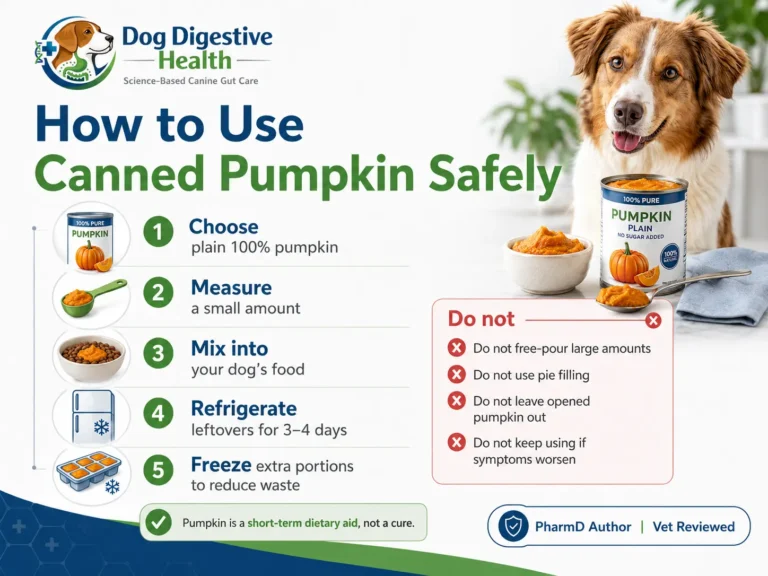
Measure the pumpkin with a proper teaspoon or tablespoon rather than estimating with a kitchen serving spoon.
To serve it:
- Measure the planned amount.
- Mix it thoroughly into the dog’s food.
- Provide unlimited access to clean drinking water.
- Avoid adding sugar, cream, butter, spices, or oil.
- Do not add broth unless it is free from onion, garlic, and excessive sodium.
- Record the amount given and monitor subsequent stools.
A simple stool diary can be useful. Record:
- Time pumpkin was given
- Amount given
- Number of bowel movements
- Stool consistency
- Presence of mucus
- Presence of blood
- Appetite
- Water intake
- Vomiting
- Activity level
This information can help your veterinarian assess whether symptoms are improving or worsening.
Should Canned Pumpkin Be Given With or Without Food?
Pumpkin is generally best mixed into a small meal rather than served as a large portion by itself.
Mixing it with food:
- Encourages slower consumption
- Makes the portion easier to control
- Prevents the dog from swallowing a large amount at once
- Incorporates it into the overall dietary plan
Do not replace a complete meal with pumpkin.
Pumpkin is not a complete and balanced dog food. It does not provide all the protein, essential fatty acids, vitamins, and minerals a dog requires.
Can Dogs Eat Canned Pumpkin Straight From the Can?
Plain pumpkin does not need to be heated before serving, but the amount should be measured first.
Do not allow a dog to:
- Eat unrestricted quantities from an open can
- Lick sharp metal edges
- Consume the full container
- Eat pumpkin that has been left unrefrigerated
- Lick directly from a container that will be stored again
Use a clean spoon and transfer the measured portion to the dog’s bowl.
Is Pumpkin Powder or Canned Pumpkin Better for Dog Diarrhea?
Neither format is automatically better for every dog.
Plain canned pumpkin
Advantages
- Ready to serve
- Widely available
- Contains moisture
- Easy to find as a one-ingredient product
- Usually inexpensive
Limitations
- Spoils relatively quickly after opening
- Large cans may create waste
- Owners may give oversized spoonfuls
Pumpkin powder
Advantages
- Longer shelf life
- Easier to store
- Convenient for travel
- May be easier to portion for small dogs
Limitations
- Often requires rehydration
- Serving instructions vary by brand
- Some products contain additional fibers or flavorings
- One tablespoon of powder is not equivalent to one tablespoon of puree
A product containing pumpkin plus psyllium, apple fiber, inulin, probiotics, or flaxseed should be treated as a multi-ingredient digestive supplement—not as plain pumpkin.
Follow the manufacturer’s directions and discuss combination products with your veterinarian.
Pet-specific pumpkin pouches
Pet-specific pouches can be convenient and may reduce food waste.
However, check the label carefully. Some contain:
- Tapioca
- Apple fiber
- Ginger
- Inulin
- Flaxseed
- Psyllium
- Probiotic organisms
- Natural flavors
These ingredients are not necessarily unsafe, but they change the product’s composition and may affect the amount that should be given.
Can Puppies Have Canned Pumpkin for Diarrhea?
Do not automatically treat puppy diarrhea with pumpkin.
Puppies can become dehydrated more quickly than healthy adult dogs. Diarrhea in a puppy may be associated with:
- Intestinal parasites
- Sudden dietary changes
- Food intolerance
- Bacterial or viral infection
- Toxin exposure
- Foreign-body ingestion
- Canine parvovirus
Contact a veterinarian promptly when a puppy has diarrhea, especially if the puppy:
- Is younger than six months
- Has not completed vaccinations
- Is a toy or very small breed
- Has repeated watery diarrhea
- Is vomiting
- Refuses food or water
- Appears weak or unusually tired
- Has blood in the stool
- Has been exposed to an ill or unvaccinated dog
A veterinarian may approve a small amount of plain pumpkin after assessing the puppy, but pumpkin should never delay medical care.
Can I Give Canned Pumpkin to a Dog With Diabetes?
Ask the veterinarian managing the dog’s diabetes before changing its diet.
Plain pumpkin does not contain added sugar when it is a one-ingredient product, but it still contributes carbohydrates and fiber. Changes in meal composition may affect digestion and glucose control.
Do not alter a diabetic dog’s meal plan or insulin routine without professional guidance.
Can Dogs With Kidney or Heart Disease Eat Canned Pumpkin?
A no-salt-added product is preferable, but veterinary approval is still necessary.
Dogs with kidney or heart disease may require carefully controlled levels of:
- Sodium
- Potassium
- Phosphorus
- Calories
- Protein
- Fluid intake
Adding pumpkin changes the nutrient composition of the meal. Confirm that it fits the dog’s therapeutic diet.
Can Pumpkin Be Added to a Prescription Gastrointestinal Diet?
Ask the prescribing veterinarian first.
A therapeutic gastrointestinal diet may already contain a precisely selected mixture of soluble, insoluble, and fermentable fibers.
Adding pumpkin may:
- Alter the intended fiber balance
- Increase total calories
- Change stool volume
- Reduce the amount of complete food consumed
- Interfere with assessment of the diet’s effectiveness
More fiber is not always better.
How Long Does Opened Canned Pumpkin Last in the Refrigerator?
After opening, transfer unused pumpkin to a clean, covered food-storage container and refrigerate it promptly.
As a cautious food-safety rule, use refrigerated pumpkin within three to four days.
Do not leave it at room temperature for longer than two hours.
Discard it sooner if you notice:
- Mold
- Bubbling or fermentation
- A sour or unusual smell
- A slimy texture
- Significant discoloration
- A swollen storage container
Do not taste questionable pumpkin to determine whether it is safe.
Can I Freeze Canned Pumpkin for My Dog?
Yes. Freezing measured portions can reduce waste.
Use this method:
- Spoon the pumpkin into a clean ice-cube tray or silicone mold.
- Measure how many teaspoons or tablespoons each section holds.
- Freeze the portions until solid.
- Transfer them to a labeled freezer-safe container.
- Write the date and portion size on the container.
- Thaw one portion in the refrigerator when needed.
Do not assume that one ice cube equals one tablespoon. Tray sizes vary considerably.
Thawed pumpkin may separate or appear slightly watery. Stir it before measuring and serving.
Do not repeatedly thaw and refreeze the same portion.
What Should I Do If My Dog Ate Pumpkin Pie Filling?
Check the package immediately.
Identify:
- The complete ingredient list
- How much was eaten
- Your dog’s weight
- Whether xylitol is present
- Whether nutmeg or concentrated spices are present
- Whether any packaging was swallowed
- Whether symptoms have begun
Seek urgent veterinary help when:
- Xylitol is listed or cannot be ruled out
- Your dog is weak, trembling, staggering, or collapsing
- Repeated vomiting occurs
- A large amount was consumed
- The product contained concentrated spices or essential oils
- Your dog has diabetes or another serious medical condition
- Packaging or part of the can was swallowed
Do not induce vomiting unless a veterinarian or animal poison-control professional specifically instructs you to do so.
A small lick of ordinary pie filling may cause only mild stomach upset, but the risk depends on the formulation, quantity, and dog’s size.
When Should I Stop Using Pumpkin and Call a Veterinarian?

Pumpkin should be considered only for selected dogs with mild symptoms and otherwise normal behavior.
Contact a veterinarian promptly if your dog has:
- Repeated or profuse watery diarrhea
- Diarrhea lasting longer than 24 hours
- Repeated vomiting
- Inability to keep water down
- Weakness, severe tiredness, or collapse
- Abdominal pain
- A swollen or tense abdomen
- Pale, gray, or unusually dark gums
- Signs of dehydration
- Black, tarry stool
- A large amount of fresh blood
- Repeated straining with little stool
- Possible foreign-body ingestion
- Possible toxin or medication exposure
- Significant loss of appetite
- Unexplained weight loss
- Recurrent diarrhea
- Diarrhea continuing for weeks
Seek veterinary advice sooner for puppies, elderly dogs, toy breeds, pregnant dogs, and dogs with chronic medical conditions.
Pumpkin cannot:
- Correct significant dehydration
- Remove an intestinal obstruction
- Treat parasites
- Treat pancreatitis
- Neutralize a toxin
- Replace diagnostic testing
- Treat serious bacterial or viral illness
The Bottom Line
For a dog with mild, uncomplicated diarrhea, the safest canned-pumpkin choice is
Plain, unseasoned, no-salt-added, 100% pumpkin with one ingredient.
Start with a small, measured amount mixed into food. Avoid pumpkin pie filling, added sugar, spices, high-sodium products, and artificial sweeteners.
Watch your dog—not just the stool.
A dog that remains bright, hydrated, comfortable, and interested in food may be suitable for a brief dietary trial under veterinary guidance. A dog that is weak, vomiting, painful, dehydrated, or passing blood needs professional evaluation.
The available veterinary research supports dietary management and selected fiber interventions, but it does not prove that canned pumpkin is a universal or precisely dosed treatment for canine diarrhea.
Pumpkin may support stool consistency in some dogs. It cannot diagnose or treat the underlying cause.
Medical Disclaimer
This article is for educational purposes only and is not a substitute for veterinary diagnosis or treatment. Contact a licensed veterinarian before giving pumpkin to puppies, medically fragile dogs, or dogs with persistent, severe, bloody, or recurrent diarrhea.
Frequently Asked Questions(FAQs)
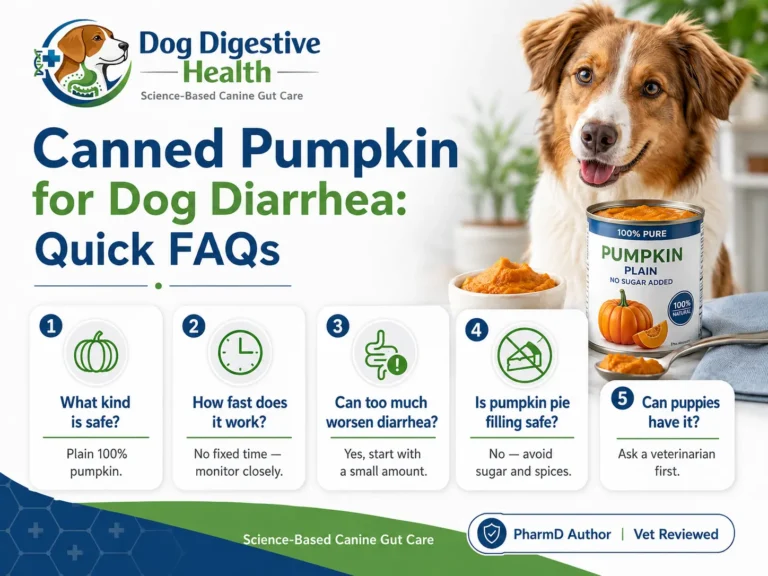
1. What kind of canned pumpkin is safe for dogs with diarrhea?
Choose plain 100% pumpkin with no added sugar, salt, spices, oils, or artificial sweeteners.
2. How much canned pumpkin should I give my dog?
Start with a small, weight-appropriate amount mixed into food. Too much pumpkin may cause gas or worsen diarrhea.
3. How quickly does pumpkin work for dog diarrhea?
Some dogs may have firmer stool within one or two bowel movements, but there is no scientifically proven time frame.
4. Can pumpkin make a dog’s diarrhea worse?
Yes. Excess pumpkin or a sudden increase in dietary fiber can cause loose stool, bloating, or abdominal discomfort.
5. Is pumpkin pie filling safe for dogs?
No. Pumpkin pie filling may contain added sugar, salt, nutmeg, spices, or sweeteners that are unsuitable or dangerous for dogs.
6. When should I call a veterinarian?
Seek veterinary advice for bloody or persistent diarrhea, repeated vomiting, weakness, abdominal pain, dehydration, or loss of appetite.
References
- Moreno AA, Parker VJ, Winston JA, Rudinsky AJ. Dietary fiber aids in the management of canine and feline gastrointestinal disease. Journal of the American Veterinary Medical Association.2022;260(S3):S33–S45. doi:10.2460/javma.22.08.0351
- Lappin MR, Zug A, Hovenga C, Gagne J, Cross E. Efficacy of feeding a diet containing a high concentration of mixed fiber sources for management of acute large-bowel diarrhea in dogs in shelters. Journal of Veterinary Internal Medicine.2022;36(2):488–492. doi:10.1111/jvim.16360
- Holz M, Fritz J, Suchodolski JS, Werner M, Unterer S. Effects of dietary cellulose on clinical and gut microbiota recovery in dogs with uncomplicated acute diarrhea: a randomized prospective clinical trial. Journal of the American Veterinary Medical Association.2025;263(2):169–177. doi:10.2460/javma.24.07.0476