
Best Prebiotics for Dogs in 2026: Vet-Reviewed Picks
Written by: Dr. Akram Khan, DVM
Medically Reviewed by: Dr. Muhammad Saeed, PhD
Last updated: September 09, 2026
The best prebiotics for dogs help nourish selected microorganisms already living in the digestive tract. Unlike ordinary fiber, a scientifically recognized prebiotic must be selectively used by host microorganisms and provide a measurable health benefit (1). The right ingredient may support digestive comfort, balanced gut bacteria, healthy stool consistency, and normal intestinal barrier function.
What are the best prebiotics for dogs?
Useful options include fructooligosaccharides, inulin, mannan-oligosaccharides, acacia fiber, psyllium, resistant starch, and carefully designed fiber blends. The right choice depends on your dog’s current diet, digestive symptoms, medical history, age, size, and tolerance.
Best prebiotic options at a glance
- For feeding beneficial gut bacteria: FOS or inulin
- For improving stool consistency: Psyllium husk
- For gentler, gradual fermentation: Acacia fiber
- For broader digestive support: A balanced soluble and insoluble fiber blend
- For combined microbial support: A veterinarian-approved synbiotic
- For a natural food-based option: Plain pumpkin in a suitable portion
Prebiotics can be valuable, but they are not a substitute for diagnosis. Repeated vomiting, bloody or black stool, severe bloating, ongoing diarrhea, appetite loss, abdominal pain, or unexplained weight loss requires veterinary attention.
Clinical takeaway:
The best dog prebiotic supplement is not necessarily the one with the longest label. A transparent formula, selected for a clear purpose and introduced slowly, is often the safer and more useful choice.
Probiotics vs. Prebiotics: Understanding the Symbiotic Loop
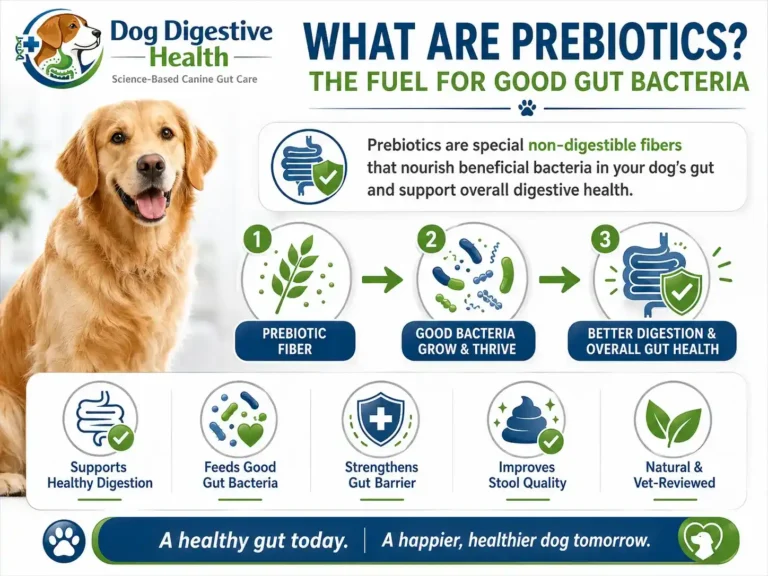
Prebiotics and probiotics both influence the intestinal environment, but they do different jobs.
Prebiotics are substrates that selected microorganisms use for nourishment. Most prebiotic fibers resist complete digestion in the stomach and small intestine before reaching the colon.
Probiotics are live microorganisms administered in an adequate amount to provide a health benefit. A quality probiotic product should identify its microorganisms clearly and maintain adequate viable organisms through its stated expiration date.
When a product combines probiotics and prebiotics, it is called a synbiotic. Some formulas simply place both components in the same supplement. Other products pair a specific bacterial strain with a substrate intended to support its activity.
Think of the canine gut microbiome as a garden:
- Probiotics add selected microorganisms.
- Prebiotics provide nourishment for suitable organisms.
- Your dog’s food, health, medications, and existing microbiome create the growing conditions.
Adding seeds to poor soil does not guarantee a thriving garden. In the same way, a high probiotic CFU count does not automatically make a supplement effective. The bacterial strain, dose, storage conditions, formulation, and reason for use all matter.
A 2026 study examined synbiotic supplementation in healthy adult Beagles exposed to an abrupt dietary change. The tested product did not significantly improve fecal characteristics or the canine dysbiosis index compared with placebo, although it affected the abundance of one potentially harmful bacterial species under one dietary condition (3).
These findings do not mean synbiotics never help. Instead, they show why the response can vary from one dog to another. Different diets, prebiotic substrates, bacterial strains, doses, and health conditions may lead to very different outcomes.
Are prebiotics better than probiotics for dogs?
Neither category is universally better.
A dog may benefit from a prebiotic when the goal is to nourish selected members of the existing microbiome. A probiotic may be considered when a veterinarian wants to introduce a particular microorganism. A synbiotic may offer both approaches in one product.
The choice should reflect your dog’s symptoms and the quality of the formulation, not a general claim that one category always works better.
The Science: How Prebiotics Undergo Fermentation in the Canine Colon
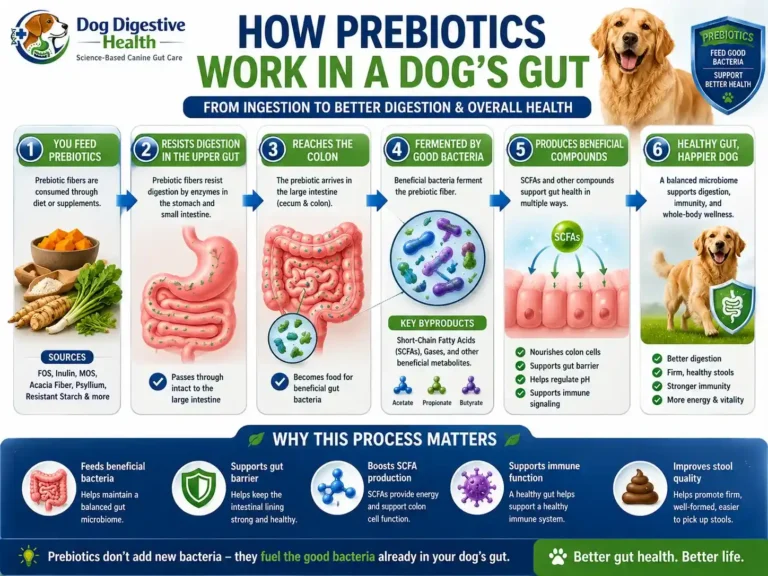
Many prebiotic fibers resist digestion by the dog’s enzymes in the upper gastrointestinal tract. They pass into the large intestine, where microorganisms can break them down through fermentation.
This process generally follows several steps:
- Your dog consumes a fermentable fiber or carbohydrate.
- The ingredient escapes complete digestion in the stomach and small intestine.
- It reaches the colon, where suitable microorganisms metabolize it.
- Fermentation produces gases and microbial metabolites.
- These metabolites may influence stool quality, colon cells, microbial competition, and local immune signaling.
Among the best-known fermentation products are short-chain fatty acids, often shortened to SCFAs. The major SCFAs include acetate, propionate, and butyrate.
Each one behaves differently. Butyrate is an important energy source for cells lining the colon. Acetate and propionate also contribute to local and systemic metabolic processes.
However, microbiome research requires careful interpretation. A high fecal SCFA concentration does not necessarily mean the intestine produced the ideal amount. Lower concentrations may sometimes reflect greater absorption or utilization.
Similarly, a change in bacterial abundance does not automatically prove that a dog is healthier. Researchers must examine microbial composition alongside stool quality, clinical symptoms, diet, metabolites, and other health outcomes.
A 2025 study involving adult dogs found that soluble corn fiber influenced fecal quality, microbial composition, and SCFA concentrations. The most favorable stool response occurred at a 1% dietary inclusion level in that controlled experiment (2).
The study also found different changes among individual fatty acids. This highlights an essential point: not every fermentable fiber produces the same response. The type of fiber and its amount may be just as important as whether a label calls it “prebiotic.”
How long does it take prebiotics to work in dogs?
Some dogs show changes in stool consistency within several days. Microbial adaptation may take longer.
The response depends on:
- The ingredient
- The amount given
- The existing diet
- The dog’s microbiome
- The underlying digestive problem
- How quickly the supplement was introduced
Increasing the serving too quickly will not necessarily produce faster benefits. It may simply cause more gas or loose stool.
Types of Essential Prebiotics: FOS, MOS, and Inulin Explained
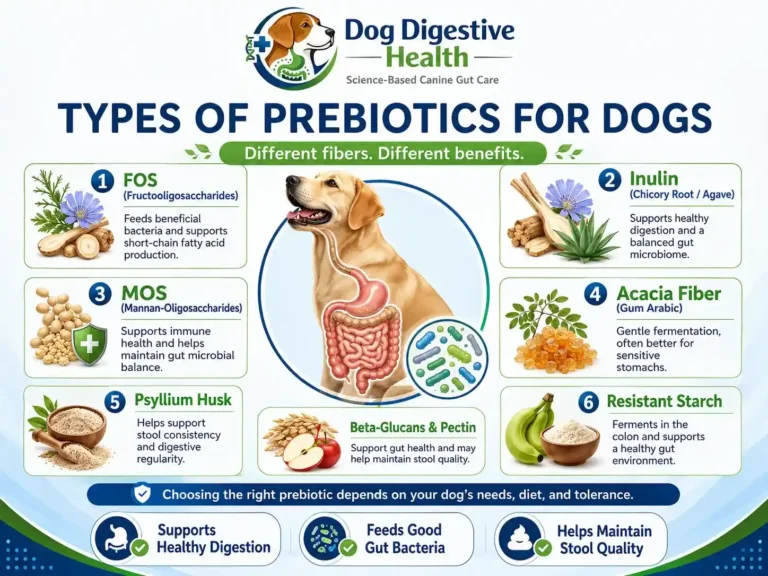
Different fibers have different chemical structures and physical properties. Chain length, solubility, viscosity, water-holding ability, and fermentation rate can all affect how a prebiotic behaves inside a dog’s digestive tract.
Fructooligosaccharides
Fructooligosaccharides, commonly called FOS, are short chains of fructose molecules. They occur naturally in some plants and are also produced for use in dog food and digestive supplements.
FOS is readily fermented by selected intestinal microorganisms. It appears frequently in synbiotic powders, capsules, chews, and complete diets.
Possible benefits include:
- Nourishing selected beneficial bacteria
- Supporting microbial fermentation
- Contributing to SCFA production
- Promoting a balanced intestinal environment
- Complementing certain probiotic formulas
Because FOS ferments relatively quickly, a large amount may cause flatulence, abdominal noises, or loose stool. Dogs with sensitive digestion may need a lower starting serving.
Mannan-Oligosaccharides
Mannan-oligosaccharides, or MOS, usually come from yeast cell walls. They are commonly added to veterinary diets, puppy foods, and supplements designed for digestive or immune support.
MOS may interact with the intestinal environment differently from FOS. Its proposed actions include influencing microbial ecology and helping limit the attachment of certain undesirable organisms within the digestive tract.
Potential uses include:
- Supporting balanced intestinal microorganisms
- Complementing FOS in mixed formulas
- Supporting normal intestinal defenses
- Supplying functional yeast-derived compounds
The source and manufacturing process matter. Evidence involving one MOS ingredient cannot automatically validate every supplement listing yeast, yeast culture, or MOS.
Inulin
Inulin is a fructan commonly obtained from chicory root, agave, or Jerusalem artichoke. Its chain length influences where and how quickly it ferments in the colon.
Inulin may appear on a product label as:
- Inulin
- Chicory root fiber
- Chicory root extract
- Agave inulin
- Jerusalem artichoke inulin
Potential benefits include:
- Feeding selected gut microorganisms
- Supporting SCFA production
- Promoting a balanced intestinal environment
- Complementing probiotic organisms in synbiotic formulas
Concentrated inulin can cause substantial gas in some dogs. A formula containing inulin alongside FOS and other fermentable fibers may require an especially gradual introduction.
Acacia Fiber or Gum Arabic
Acacia fiber, also known as gum arabic, is a soluble fermentable fiber derived from Acacia species. It often ferments more gradually than short-chain fructans.
This slower pattern may suit dogs that do not tolerate rapidly fermented ingredients. Individual responses still vary, so acacia should also be introduced in small amounts.
Psyllium Husk
Psyllium is a soluble, gel-forming fiber with strong water-holding properties. It may help normalize stool texture by absorbing excess water or retaining moisture in dry stool.
Its effects are not limited to microbial fermentation. Psyllium also influences stool bulk, viscosity, and intestinal transit.
Adequate hydration is important when using psyllium. Concentrated fiber without sufficient water may worsen constipation or digestive discomfort.
Resistant Starch
Resistant starch avoids complete digestion in the small intestine and reaches the colon. Sources may include green bananas, specially formulated starches, and some cooked foods that have been cooled.
It can produce meaningful changes in the gut microbiome, but those changes are not automatically beneficial in every dog. The response depends on the starch type, diet, dose, and existing microbial community.
Beta-Glucans and Pectin
Beta-glucans occur in oats, barley, yeast, and some fungi. Pectin is found naturally in fruits such as apples.
These fibers may influence fermentation, viscosity, and stool structure. However, a food containing fiber should not automatically be described as a proven canine prebiotic unless selective microbial use and a health benefit have been demonstrated.
Top Natural Whole-Food Sources of Prebiotics for Dogs

Natural foods can provide useful fibers, but they are less concentrated and less standardized than commercial dog prebiotic supplements.
Their composition may change with variety, ripeness, cooking method, and serving size. Whole-food additions should complement a complete and balanced diet rather than replace essential nutrition.
Chicory Root, Green Bananas, and Dandelion Greens
Chicory root is a concentrated natural source of inulin. It appears in many commercial dog foods and digestive supplements.
Because it can ferment quickly, excessive chicory root may cause gas, bloating, or loose stool. Avoid estimating large home doses of concentrated chicory powder.
Green bananas contain more resistant starch than ripe bananas. As the fruit ripens, resistant starch decreases while available sugars increase.
A small, plain piece may suit some healthy dogs. Green banana should not be used as a home treatment for persistent diarrhea, intestinal dysbiosis, or chronic digestive disease.
Dandelion greens provide fiber and plant compounds, but direct canine research defining an effective prebiotic dose remains limited.
Only use clean greens that have not been exposed to pesticides, herbicides, traffic pollution, or animal waste. Dogs with gallbladder disease, urinary conditions, chronic illness, or prescription medications should receive veterinary guidance before consuming herbal ingredients.
Is pumpkin a good prebiotic for dogs?
Plain pumpkin provides soluble and insoluble fiber and may help improve stool consistency. It is one of the most practical food toppers for dogs with mild stool irregularity.
Use plain cooked pumpkin or unsweetened canned pumpkin. Pumpkin pie filling may contain sugar, fat, spices, or ingredients that are unsuitable for dogs.
Pumpkin can support stool structure, but it is less standardized than supplements containing measured amounts of FOS, inulin, acacia, or psyllium.
Apples
Apple flesh contains pectin and other fibers. Small pieces may serve as an occasional snack for dogs that tolerate fruit.
Remove the stem, seeds, and firm core. The core can create a choking or obstruction risk.
Cooked Oats
Plain cooked oats provide soluble fiber, including beta-glucans. A small amount may be suitable as a food topper for some dogs.
Avoid flavored oatmeal containing sugar, chocolate, raisins, artificial sweeteners, or large amounts of milk.
Sweet Potato
Plain cooked sweet potato provides fiber and starch. Serve it without butter, salt, sugar, oil, or seasoning.
Large portions can add unnecessary calories and may loosen stool. Dogs with diabetes, obesity, or prescription diets need individualized advice.
Carrots and Green Beans
Carrots and green beans add fiber, moisture, and low-calorie bulk. They can be useful treats, although they are not among the most established targeted prebiotics for dogs.
Unsafe Foods That Should Never Be Used as Prebiotics
Several foods found on human prebiotic lists are dangerous for dogs.
Do not use:
- Onions
- Garlic
- Chives
- Leeks
- Grapes
- Raisins
- Chocolate
- Xylitol-sweetened foods
- Moldy fermented foods
Onions, garlic, chives, and leeks belong to the Allium family and can damage canine red blood cells. Their fiber content does not make them safe.
Medically Reviewed Guide: The Best Commercial Prebiotic Supplements for Dogs in 2026
No commercial supplement works best for every dog. The products below represent different formulation types and practical uses.
Before publishing or purchasing, check the latest label. Manufacturers can change ingredients, serving directions, age restrictions, and product availability.
How We Evaluated the Products
A credible review should consider:
- Named prebiotic ingredients
- Amounts disclosed per serving
- Probiotic organisms identified clearly
- CFUs guaranteed through expiration
- Instructions based on body weight
- Ease of administration
- Storage requirements
- Allergen and flavoring information
- Quality-control practices
- Suitability for the intended purpose
- Cost per daily serving
- Evidence relevant to the ingredients or formula
A product does not become better simply because it contains more ingredients. Simple formulations are often easier to introduce and evaluate.
Best Broad-Spectrum Synbiotic Powder: Fera Pets USDA Organic Probiotics With Prebiotics
This flavorless powder combines probiotic organisms with FOS, agave-derived inulin, and organic acacia.
Why it may suit some dogs
- Contains three clearly named prebiotic ingredients
- Mixes easily with regular food
- Provides combined prebiotic and probiotic support
- Avoids a heavily flavored chew format
What to consider
The combination may be too fermentable for some sensitive dogs when introduced at the full serving. Start gradually when the label and veterinarian allow it.
Best Capsule-Based Synbiotic: Nutramax Proviable-DC
Proviable-DC combines FOS and gum arabic with several probiotic organisms. The capsule can be given whole or opened and sprinkled over food.
Why it may suit some dogs
- Uses clearly identified prebiotic ingredients
- Provides a convenient capsule
- Can be mixed into food
- Does not require a soft chew
What to consider
Owners of very small dogs or dogs taking several medications should confirm the serving and timing with a veterinarian.
Best Mixed-Fiber Formula: Proviable Fiber Powder
This product combines several fiber types, including psyllium, apple fiber, beta-glucans, gum arabic, and cellulose.
Why it may suit some dogs
- Provides soluble and insoluble fibers
- Supports more than one aspect of stool formation
- Does not rely on added live probiotic organisms
- May suit a veterinarian-directed fiber plan
What to consider
Some ingredients primarily affect stool bulk or water retention rather than meeting the strict definition of a prebiotic.
Best Veterinarian-Directed Option for Loose Stool: Purina FortiFlora PRO Synbiotic Action
This veterinary supplement combines psyllium husk with Enterococcus faecium SF68 in individually measured sachets.
Why it may suit some dogs
- Provides a disclosed amount of psyllium
- Uses a clearly identified probiotic organism
- Comes in premeasured packets
- Fits easily into a veterinarian-supervised digestive plan
What to consider
A dog with persistent diarrhea still needs a diagnosis. No sachet can replace hydration, parasite testing, dietary management, or treatment of an underlying disease.
Best Food-Based Powder: Native Pet Probiotic
This powder combines pumpkin and inulin with probiotic organisms.
Why it may suit some dogs
- Works as an easy food topper
- Contains familiar food-based ingredients
- May suit dogs that reject capsules
- Combines fiber and probiotic support
What to consider
Flavored products may not suit every food sensitivity. Pumpkin also provides broader fiber support rather than acting exactly like a measured FOS-only formula.
Best All-in-One Fiber Topper: Bernie’s Perfect Poop
This formula combines miscanthus grass, pumpkin, flaxseed, inulin, probiotic organisms, and digestive enzymes.
Why it may suit some dogs
- Provides fermentable and stool-bulking fibers
- Includes several digestive-support categories
- Works as a crunchy food topper
- May simplify administration for some owners
What to consider
An all-in-one product makes it harder to identify which component caused a benefit or side effect. A simpler formula may be more appropriate for a dog with multiple sensitivities.
How to Choose a Prebiotic for a Dog With a Sensitive Stomach
The best prebiotic for dogs with sensitive stomachs is usually a simple product introduced at a low amount.
Look for:
- One or two clearly named fiber sources
- Transparent serving instructions
- Few flavorings or inactive ingredients
- No unnecessary herbal blend
- No ingredients your dog has previously reacted to
- A format that allows gradual introduction
Acacia may ferment more gradually than some short-chain fructans. Psyllium may help when stool moisture is the primary issue. However, tolerance varies, and even a gentle ingredient can cause problems when the amount rises too quickly.
Avoid changing the food and starting several supplements at the same time. One controlled change provides much clearer information.
Clinical Benefits: How Prebiotics Enhance Short-Chain Fatty Acid Production
Prebiotic benefits begin with microbial metabolism. When selected bacteria ferment suitable substrates, they produce SCFAs and other compounds that influence the colon.
Supporting Healthy Stool Consistency
Different fibers may improve stool quality through different mechanisms:
- Absorbing excess water
- Retaining moisture in dry stool
- Adding bulk
- Forming a gel
- Influencing intestinal transit
- Changing microbial fermentation
That is why the best prebiotic for a dog with loose stool may not be the best choice for constipation.
Psyllium provides strong water-binding properties. FOS and inulin tend to produce more active fermentation. A mixed-fiber formula may combine several actions.
Nourishing Colon Cells
Butyrate provides energy to cells lining the colon. It also participates in processes related to intestinal barrier function and local immune signaling.
However, a product should not be judged solely by a claim that it “boosts butyrate.” Production, absorption, and utilization depend on the dog’s diet, microbiome, dose, and underlying health.
Supporting the Intestinal Barrier
The intestinal barrier allows nutrient absorption while helping limit the passage of microbes, toxins, and antigens.
SCFAs and microbial signaling may support mucus production and normal barrier integrity. Prebiotics should still be described as nutritional support, not as a treatment for a damaged or “leaky” intestine.
Influencing Microbial Competition
Fermentation changes acidity and nutrient availability in the colon. These changes may favor certain organisms and make the environment less suitable for others.
Prebiotics do not simply kill harmful bacteria. They alter the ecological conditions within the intestine.
Supporting Normal Immune Function
The gastrointestinal tract contains extensive immune tissue. Microorganisms and their metabolites communicate with intestinal and immune cells.
Prebiotics may support normal immune signaling, but they should not be presented as treatments for food allergies, autoimmune disease, cancer, or chronic inflammatory conditions.
Can Too Much Prebiotic Fiber Cause Severe Gas or Bloating?
Yes. Large servings or rapid introduction can lead to:
- Flatulence
- Abdominal gurgling
- Bloating
- Cramping
- Loose stool
- Increased stool frequency
- Urgency
- Reduced appetite
These effects occur when intestinal microorganisms receive more fermentable material than the digestive system can comfortably handle.
Mild gas may improve after reducing the serving and increasing it more slowly. Stop the supplement and speak with a veterinarian if discomfort persists or your dog develops vomiting, appetite loss, or worsening diarrhea.
Do not assume that every swollen abdomen is harmless gas. Seek emergency veterinary care for:
- Repeated attempts to vomit without producing anything
- Heavy drooling
- Severe restlessness
- A rapidly enlarging abdomen
- Pale gums
- Weakness
- Collapse
- Significant abdominal pain
These signs may indicate gastric dilatation-volvulus or another medical emergency.
Are Prebiotics Safe for Dogs Recovering From Acute Pancreatitis?
Do not introduce a new prebiotic supplement during acute pancreatitis unless the treating veterinarian approves it.
Dogs with pancreatitis may experience:
- Vomiting
- Nausea
- Abdominal pain
- Dehydration
- Appetite loss
- Diarrhea
- Weakness
Treatment focuses on pain and nausea control, hydration, appropriate nutrition, and monitoring for complications.
A highly fermentable supplement may worsen bloating or diarrhea. Starting it during active illness can also make changing symptoms harder to interpret.
After recovery, a veterinarian may recommend fiber or synbiotic support for a clear reason. The product must fit the prescribed diet.
Check the entire ingredient list. Some soft chews and powders contain animal fats, oils, rich flavors, or other ingredients that may not suit a low-fat feeding plan. a
Should Prebiotics Be Given Daily or Only During Acute Diarrhea?
Many healthy dogs can take an appropriate prebiotic daily when it is well tolerated. Other dogs need only a short, carefully monitored trial.
Daily use may be reasonable when:
- A veterinarian recommends ongoing fiber support
- The dog consistently benefits
- The complete diet does not already provide the same fibers
- The supplement supports a diagnosed condition
- No adverse effects occur
Short-term use may be considered during:
- A gradual food transition
- Travel-related digestive disruption
- Stress-associated stool changes
- Recovery after certain medications
- A veterinarian-directed plan for mild loose stool
Prebiotics are not fast-acting antidiarrheal medicines. A rapidly fermentable fiber may make active diarrhea worse in some dogs.
Acute diarrhea can result from parasites, infection, food changes, dietary indiscretion, medications, toxins, pancreatic disease, or systemic illness. The cause matters more than the supplement.
Contact a veterinarian when diarrhea:
- Contains blood
- Appears black or tarry
- Occurs with repeated vomiting
- Causes dehydration or marked lethargy
- Affects a young puppy
- Persists or becomes worse
- Occurs with pain or fever
- Follows possible toxin or foreign-object exposure
How to Safely Introduce Prebiotics Without Causing Stomach Upset

A slow introduction gives the intestinal microbiome time to adapt.
Check Your Dog’s Current Food
The regular diet may already contain:
- Chicory root
- Inulin
- FOS
- MOS
- Beet pulp
- Psyllium
- Pumpkin
- Gum arabic
- Yeast-derived ingredients
- Mixed fibers
Adding another concentrated product can unintentionally increase the total fiber load.
Establish a Baseline
Before starting, monitor your dog for three to five days and record:
- Stool consistency
- Stool frequency
- Gas
- Vomiting
- Appetite
- Abdominal discomfort
- Treats and toppers
- Current medications
This baseline makes changes easier to recognize.
Add Only One New Product
Do not begin a new dog food, prebiotic, probiotic, digestive enzyme, and herbal powder on the same day.
Changing one thing at a time helps you identify benefits and side effects.
Increase the Serving Gradually
When the label allows gradual dosing, a cautious schedule may look like this:
- Days 1–2: One-quarter of the labeled serving
- Days 3–4: One-half of the labeled serving
- Days 5–6: Three-quarters of the labeled serving
- Day 7 onward: The full serving if tolerated
This schedule is a general example rather than a prescription. Follow your veterinarian’s instructions and the current product label.
Maintain Good Hydration
Water is especially important with psyllium and other gel-forming fibers.
Contact a veterinarian if your dog refuses water, repeatedly vomits, or appears dehydrated.
Watch for Signs of Intolerance
Reduce or stop the product if your dog develops:
- New or worsening gas
- Loose stool
- Straining
- Vomiting
- Appetite loss
- Abdominal discomfort
- Unusual lethargy
Consider Medication Timing
Fiber can affect the absorption of some oral medications. Products containing adsorbent ingredients may also need to be separated from prescription drugs.
Ask your veterinarian or pharmacist whether the supplement and medication should be given at different times.
Evaluate the Results
A supplement should provide a noticeable benefit. Do not continue it indefinitely simply because the package uses reassuring health claims.
After a reasonable trial, consider:
- Did stool quality improve?
- Did gas improve or worsen?
- Is your dog more comfortable?
- Have any new symptoms appeared?
- Does the benefit justify the cost?
- Is ongoing use still necessary?
Choosing the Right Prebiotic for Your Dog
The best dog prebiotic is a transparent, well-tolerated product selected for a clear purpose.
FOS and inulin may provide focused fermentation. Acacia may offer a more gradual approach. Psyllium can be useful when stool moisture and consistency are the main concerns. Mixed fibers may combine water binding, fermentation, and stool bulking.
No ingredient works equally well for every dog. The response depends on:
- The existing diet
- Current fiber intake
- Gut microbiome
- Age and size
- Hydration
- Medications
- Underlying health
- Product amount
- Speed of introduction
Current canine research shows that selected fermentable fibers can influence stool quality, microbial composition, and SCFA patterns (2). At the same time, recent synbiotic evidence shows that a gut-health supplement may not improve every clinical or microbiome measure in every situation (3).
Choose a product with a clear label, introduce it gradually, and judge it by your dog’s actual response. Persistent digestive symptoms deserve veterinary investigation rather than a growing collection of supplements.
Medical Disclaimer:
This article is for educational purposes only and does not replace veterinary diagnosis or treatment. Consult your veterinarian before giving your dog a prebiotic supplement, especially if your dog has ongoing digestive symptoms, pancreatitis, chronic illness, or takes medication.
Frequently Asked Questions(FAQs)
1. What is the best prebiotic for dogs?
Common options include FOS, inulin, acacia fiber, psyllium, and veterinarian-approved mixed-fiber formulas.
2. Can dogs take prebiotics every day?
Many dogs can take them daily when the product is appropriate, introduced gradually, and well tolerated.
3. Can prebiotics cause gas in dogs?
Yes. Excessive amounts or rapid introduction may cause gas, bloating, stomach noises, or loose stool.
4. Are prebiotics and probiotics the same?
No. Prebiotics nourish selected microorganisms, while probiotics contain live microorganisms intended to provide a health benefit.
5. Is pumpkin a good prebiotic for dogs?
Pumpkin provides helpful fiber and may support stool consistency, but it is less standardized than FOS or inulin.
6. Can puppies take prebiotics?
Some products are suitable for puppies, but puppy diarrhea requires veterinary attention because dehydration and infection can develop quickly.
References
- Gibson GR, Hutkins R, Sanders ME, Prescott SL, Reimer RA, Salminen SJ, et al. Expert consensus document: The International Scientific Association for Probiotics and Prebiotics consensus statement on the definition and scope of prebiotics. Nature Reviews Gastroenterology & Hepatology. 2017;14(8):491–502. doi: 10.1038/nrgastro.2017.75
- Liang D, Zhao S, Yin G. Dietary supplementation with soluble corn fiber improved fecal score, microbiota, and short-chain fatty acids in dogs. Frontiers in Veterinary Science. 2025;12:1599213. doi: 10.3389/fvets.2025.1599213
- Sanches PM, Souza RBMS, Silva HL, Fernandes EL, Santos LNA, Lima LS, et al. Effects of synbiotic supplementation on fecal characteristics and microbiota in dogs submitted to an abrupt dietary change. Microbiology Research. 2026;17(7):121. doi: 10.3390/microbiolres17070121