Can I Give My Dog Pepto-Bismol for Diarrhea? Vet-Reviewed
Written by: Dr. Akram Khan, DVM
Medically Reviewed by: Dr. Muhammad Saeed, PhD
Last updated: September 12, 2026
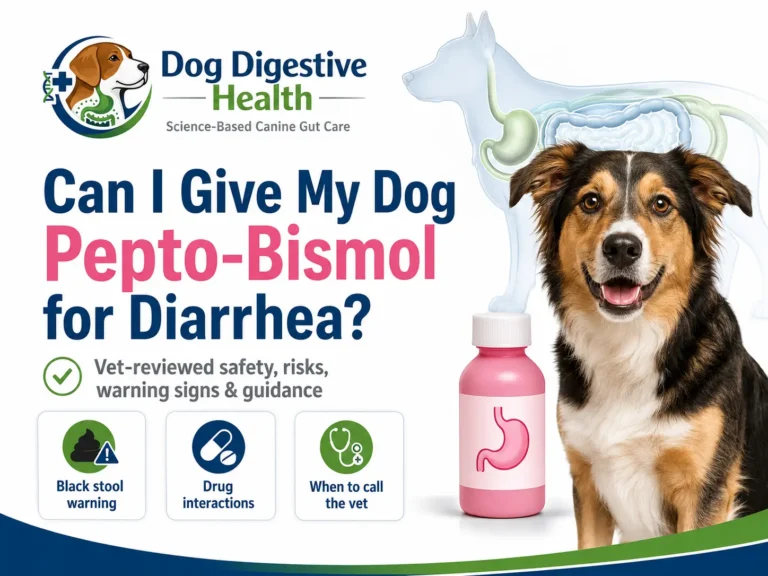
Seeing your dog rush outside with sudden, watery diarrhea can make the pink bottle in your medicine cabinet look like an easy solution. However, Pepto-Bismol is not a harmless home remedy for every dog. It contains bismuth subsalicylate, an aspirin-related medication that can interact with other drugs, irritate the stomach, increase bleeding risk, and turn the stool black. Give it only when a veterinarian has approved the exact product, amount, and duration for your dog.
Quick Answer
Pepto-Bismol is not considered a universally safe treatment for dog diarrhea. Although a veterinarian may occasionally use bismuth subsalicylate in a carefully selected dog, it can cause stomach irritation, ulcers, gastrointestinal bleeding, medication interactions or salicylate toxicity. Do not give it without veterinary approval.
What should you do when your dog has diarrhea?
- Keep fresh water available and monitor your dog for dehydration.
- Check the stool for bright-red blood or a black, sticky appearance.
- Watch for vomiting, weakness, pain, poor appetite, or unusual behavior.
- Do not give Pepto-Bismol, Imodium, or another human medication without professional guidance.
- Contact your veterinarian if the diarrhea is frequent, severe, recurrent, or not improving within 24–48 hours.
- Seek emergency care for collapse, pale gums, persistent vomiting, breathing changes, or suspected poisoning.
Most dogs with uncomplicated acute diarrhea improve with supportive care such as hydration and appropriate nutrition. Treatment and diagnostic testing should be based on the dog’s overall condition, including mental alertness, hydration, circulation, and the presence of systemic illness—not simply on how loose the stool appears (1, 2).
A healthy adult dog that passes one or two soft stools but remains energetic and interested in food is very different from a puppy that has repeated watery diarrhea, vomiting, and weakness. The second dog may deteriorate quickly and should not be treated with an over-the-counter human medication at home.
Diarrhea is a symptom rather than a diagnosis. Possible causes include:
- Eating spoiled food, garbage, or table scraps
- A sudden change in diet
- Stress, boarding, or travel
- Food intolerance
- Intestinal parasites
- Viral or bacterial infection
- Pancreatitis
- Toxin exposure
- A swallowed toy, bone, cloth, or other foreign object
- Chronic gastrointestinal disease
Temporarily firming the stool does not necessarily correct the underlying problem.
Is Pepto-Bismol Safe for Dogs? (The Critical Veterinary Consensus)
What Should You Look for on a Dog Fiber Supplement Label?
Pepto-Bismol may be used by veterinarians in selected cases, but it is not routinely recommended as a first-line home treatment for canine diarrhea.
The phrase “safe for dogs” can be misleading because safety depends on far more than body weight. A veterinarian must consider your dog’s age, hydration, medical history, current medications, symptoms, and the exact Pepto-Bismol formulation being used.
Bismuth subsalicylate contains two clinically important components:
- Bismuth, which may coat irritated gastrointestinal surfaces and bind some substances in the intestinal tract
- Salicylate, an aspirin-related compound with anti-inflammatory and antisecretory effects
The salicylate component is responsible for many of the concerns surrounding Pepto-Bismol for dogs.
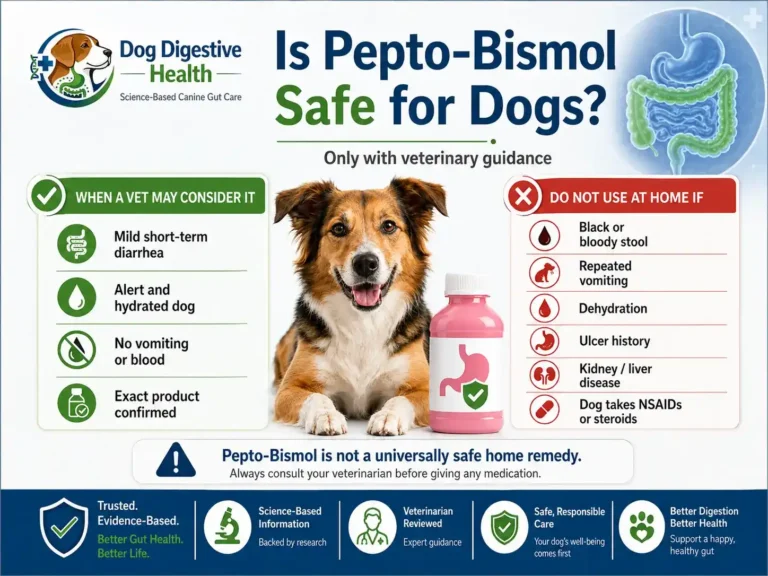
A veterinarian may occasionally consider it for a stable adult dog with mild, short-term diarrhea when:
- The dog remains alert and adequately hydrated
- There is no blood in the stool
- The stool is not black or tarry
- Vomiting is absent or minimal
- An intestinal blockage is unlikely
- The dog has no history of gastric ulcers
- Kidney and liver function are not a concern
- The dog is not taking an interacting medication
- The veterinarian has confirmed the exact formulation and concentration
Even in this relatively mild situation, the veterinarian may recommend a highly digestible diet, hydration support, a veterinary probiotic, or another intestinal product instead.
Why can one veterinarian allow it while another advises against it?
Two dogs of the same weight can have very different risk profiles. A veterinarian might approve a limited amount for one otherwise healthy adult dog but avoid it in another dog because that dog:
- Takes carprofen or another NSAID
- Is dehydrated
- Has kidney disease
- Has a bleeding disorder
- Is vomiting repeatedly
- May have swallowed a foreign object
- Has recently undergone surgery
- Is pregnant, nursing, or very young
This is why an online Pepto-Bismol dose should never be treated as a personal veterinary prescription.
Is Pepto-Bismol approved specifically for dogs?
Standard Pepto-Bismol products are marketed for human use. Veterinarians can sometimes prescribe or recommend human medications for animals when medically appropriate, but professional use is different from unrestricted home dosing.
Treat Pepto-Bismol as a medication with meaningful pharmacological effects—not as a simple stomach-soothing liquid.
The Core Mechanism: How Bismuth Subsalicylate Affects the Canine GI Tract
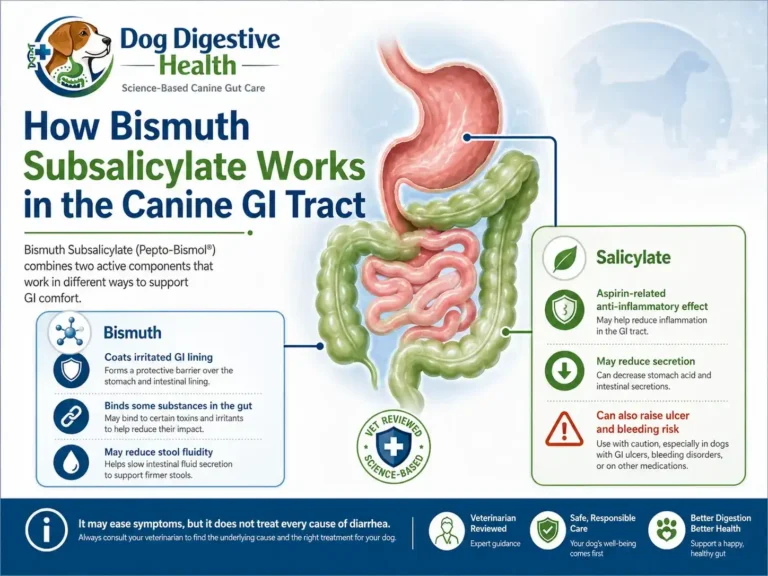
Bismuth subsalicylate acts within the stomach and intestines through several proposed mechanisms.
The bismuth component
Bismuth may:
- Coat irritated areas of the gastrointestinal lining
- Bind certain bacterial toxins and other substances in the intestinal lumen
- Reduce fluid secretion into the bowel
- Provide limited antimicrobial activity
- Temporarily improve stool consistency
Bismuth compounds have demonstrated antisecretory, anti-inflammatory, and antimicrobial properties, although much of the detailed pharmacological research has been conducted in humans rather than dogs (3).
The word “adsorb” is sometimes used when discussing bismuth or intestinal clays. Adsorption means that substances adhere to the surface of another material. It does not mean that Pepto-Bismol neutralizes every poison, removes a foreign body, or cures an intestinal infection.
The salicylate component
The subsalicylate portion is converted into salicylate, which is chemically and pharmacologically related to aspirin. It may reduce inflammation and intestinal secretion, but it can also interfere with protective mechanisms in the stomach and affect platelet function.
Prostaglandins help maintain blood flow, mucus production, and protective barriers in the stomach lining. When these pathways are suppressed, the stomach and upper intestine can become more vulnerable to irritation, erosion, and ulcer formation.
This creates a clinically important trade-off: the aspirin-like activity that may reduce inflammation can also increase gastrointestinal and bleeding risks in a susceptible dog.
Will Pepto-Bismol stop dog diarrhea immediately?
There is no dependable time in which Pepto-Bismol must work for every dog. Response depends on:
- The cause of the diarrhea
- The dog’s health and hydration
- The product formulation
- The amount administered
- Whether vomiting is also present
- Whether a serious underlying condition exists
Even if the stool becomes temporarily firmer, Pepto-Bismol will not eliminate:
- Giardia, or intestinal worms
- Parvovirus
- Pancreatitis
- A swallowed foreign object
- An intestinal obstruction
- Food intolerance
- Chronic inflammatory enteropathy
- Addison’s disease
- Significant dehydration
- Toxin exposure
Continued diarrhea is not a reason to keep increasing the dose. It is a reason to contact a veterinarian.
The Hidden Danger: Why Salicylates Can Cause Gastric Bleeding and Ulcers
Salicylates can affect both the gastrointestinal lining and normal blood clotting.
When exposure is excessive—or when the dog already has another risk factor—the medication may contribute to:
- Nausea
- Vomiting
- Reduced appetite
- Abdominal discomfort
- Constipation
- Gastric irritation
- Stomach or intestinal ulcers
- Gastrointestinal bleeding
- Weakness
- Rapid breathing
- Changes in body temperature
- Tremors or seizures in severe toxicity
The risk is not limited to an obviously massive overdose. Problems can also develop when an owner gives repeated doses too close together, uses a concentrated product by mistake, or combines Pepto-Bismol with another medication that affects the stomach or clotting system.
Why repeated home dosing can become dangerous
Medication errors are more likely when:
- More than one family member gives a dose
- The liquid is measured with a kitchen spoon
- A maximum-strength formulation is mistaken for regular strength
- Tablets and liquid are assumed to be interchangeable
- Treatment continues for several days without reassessment
- The dog is small or underweight
- The dog is already dehydrated
- Another aspirin-related drug or NSAID is being used
If the diarrhea is not improving, do not assume your dog simply needs more Pepto-Bismol.
Why diarrhea and dehydration increase concern
A dog with repeated watery diarrhea loses fluid and electrolytes. Dehydration may reduce blood flow to vital organs and make a sick dog less able to tolerate medication.
Possible signs include:
- Dry or tacky gums
- Low energy
- Reduced interest in food
- Sunken-looking eyes
- Reduced urination
- Weakness
- Skin that returns slowly after being gently lifted
Home checks are imperfect, particularly in older dogs, overweight dogs, and dogs with loose skin. Puppies, toy breeds, senior dogs, and animals with chronic disease can deteriorate more rapidly than expected.
Vet-Approved Pepto-Bismol Dosage Chart by Dog Weight
There is no universal Pepto-Bismol dosage chart that can safely tell every owner how many teaspoons to give based only on a dog’s weight.
A proper veterinary decision must account for:
- The exact concentration in the bottle
- Whether it is regular strength or maximum strength
- Liquid, tablet, caplet, or chewable formulation
- The dog’s current weight
- Age and overall health
- Hydration status
- Kidney and liver function
- History of stomach ulcers
- Possible gastrointestinal bleeding
- Current medications and supplements
- The likely cause of the diarrhea
A 10-pound dog with mild dietary diarrhea is not medically equivalent to a 10-pound dog taking an NSAID, vomiting repeatedly, or passing black stool.
Safety chart for dog owners
Dog’s weight | Home-dosing recommendation | Why caution is needed |
Under 5 lb | Do not calculate a dose without a veterinarian. | A small measuring error can create a large exposure relative to body weight. |
5–10 lb | Veterinarian-calculated amount only | Toys and small dogs have little margin for dosing or formulation mistakes. |
11–25 lb | Veterinarian-calculated amount only | Weight does not reveal dehydration, ulcer risk, or drug interactions. |
26–50 lb | Veterinarian-calculated amount only | Product concentration and medical history remain essential. |
51–75 lb | Veterinarian-calculated amount only | Larger size does not prevent ulcers, bleeding, or salicylate toxicity. |
Over 75 lb | Veterinarian-calculated amount only | Body weight alone still cannot establish safety. |
This safety-first chart intentionally does not provide a teaspoon amount. Publishing one number for all products could encourage a dangerous mistake when concentrations or formulations differ.
Before calling your veterinarian, gather the following information:
- Your dog’s current weight
- Age and breed
- When the diarrhea began
- Number of loose bowel movements
- Stool color and consistency
- Presence of blood or mucus
- Whether your dog is vomiting
- Appetite and water intake
- Current medications and supplements
- History of ulcers, kidney disease, or liver disease
- A clear photograph of the product label
- The product strength and formulation
Do not assume that Pepto-Bismol liquid, maximum-strength liquid, chewable tablets, caplets, generic bismuth products, and Kaopectate contain equivalent amounts.
How to Correctly Administer Liquid Pepto-Bismol Using a Needleless Syringe
Only administer liquid Pepto-Bismol after your veterinarian has confirmed:
- The specific product
- The exact volume
- The interval between doses
- The maximum number of doses
- When treatment must stop
- Which changes require immediate veterinary care
Before administering the liquid
- Read the full active-ingredient panel.
- Confirm the concentration with your veterinarian.
- Make sure no additional active drug is present.
- Check the expiration date.
- Shake the suspension as instructed.
- Use a clearly marked oral syringe.
- Never measure liquid medication with a kitchen spoon.
- Write down the amount and time of each dose.
Using the syringe safely
- Keep your dog sitting or standing upright.
- Draw up only the amount approved by the veterinarian.
- Remove large air bubbles from the syringe.
- Place the tip inside the side of the mouth, behind the canine tooth.
- Aim toward the cheek rather than directly toward the throat.
- Give the liquid slowly in small portions.
- Pause between portions so your dog can swallow.
- Stop if your dog coughs, chokes, or has difficulty breathing.
Do not sharply tilt your dog’s head backward. Forcing medication toward the throat can cause aspiration, which means liquid enters the airway or lungs.
What if my dog vomits after taking Pepto-Bismol?
Do not immediately repeat the dose. Some medication may already have been absorbed, even if liquid is visible in the vomit.
Tell your veterinarian:
- How soon the vomiting occurred
- Whether the medication was visible
- Whether your dog has vomited more than once
- Whether blood was present
- Whether your dog appears weak, painful, or unusually sleepy
Can Pepto-Bismol be mixed into dog food?
Do not mix it into a full meal unless your veterinarian approves. A dog that eats only half of the food will receive an uncertain amount. The unpleasant taste may also cause food aversion when the dog is already nauseated.
Critical Warning Signs: Why Pepto Turns Dog Poop Black (The Melena Illusion)
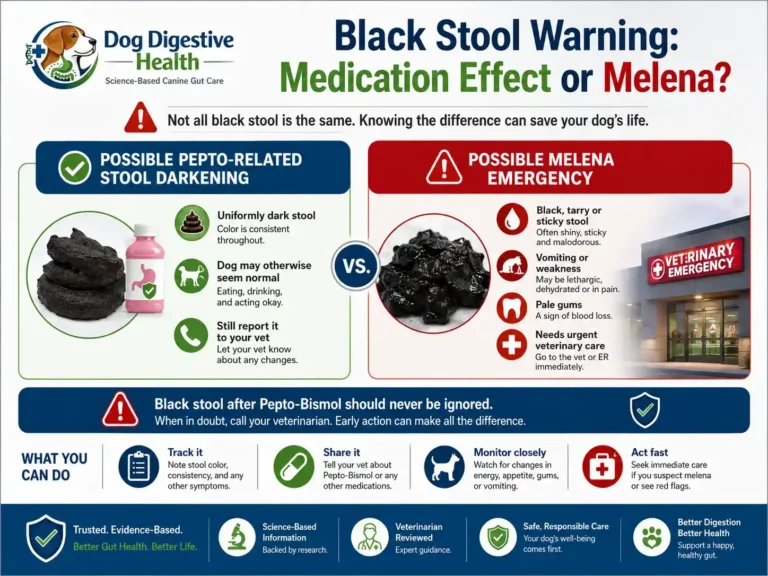
Bismuth can turn a dog’s stool gray-black, green-black, or very dark. This happens when bismuth reacts with sulfur-containing substances in the gastrointestinal tract.
The color change may be caused by the medication, but it can conceal a more serious problem because digested blood also makes stool appear black.
What does black tarry stool mean in a dog?
Black, sticky, or tar-like stool is called melena. It generally indicates that blood has been digested as it passed through the stomach or upper small intestine.
Possible causes include:
- Gastric or intestinal ulcers
- A foreign-body injury
- Severe inflammation
- A clotting disorder
- Medication-related bleeding
- A gastrointestinal tumor
- Swallowed blood
If your dog’s poop turns black after Pepto-Bismol, do not rely on color alone to decide that it is harmless.
Feature | Possible bismuth discoloration | Possible melena |
Color | Gray-black, green-black, or uniformly dark | Deep black |
Texture | May retain a relatively normal texture | Often sticky, shiny, or tar-like |
Odor | May be relatively unchanged | Frequently unusually strong or foul |
Other signs | Dog may otherwise appear comfortable. | Weakness, vomiting, pain, pale gums, or appetite loss may occur. |
Action | Inform the veterinarian who recommended the medication. | Seek urgent veterinary advice. |
It is not always possible to distinguish medication-related discoloration from bleeding at home.
Contact a veterinarian urgently when black stool is accompanied by:
- Pale, gray, or white gums
- Weakness or collapse
- Vomiting
- Blood in vomit
- Abdominal pain
- Refusal to eat
- Rapid breathing
- Repeated sticky or tar-like stools
Do not give another dose simply because the diarrhea remains loose or dark.
High-Risk Groups: Dogs That Must NEVER Take Bismuth Subsalicylate
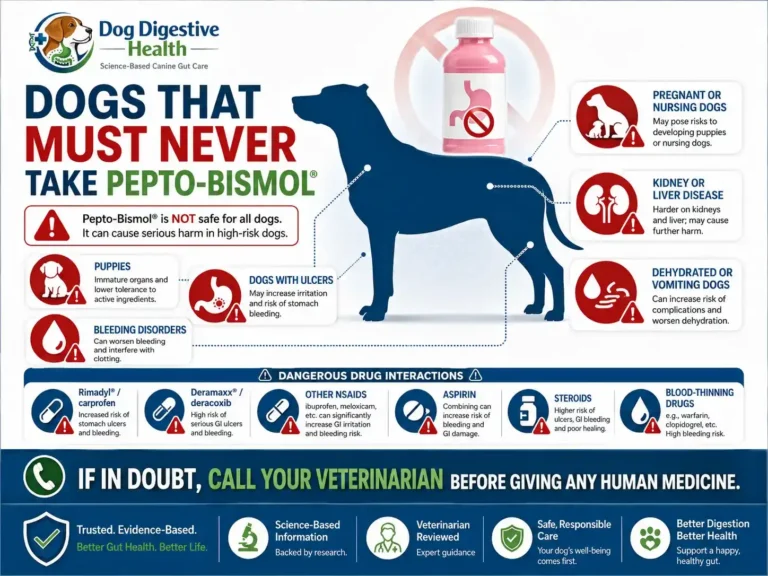
Unless a veterinarian who understands the full medical situation specifically decides otherwise, Pepto-Bismol should be avoided in dogs with:
- Bloody diarrhea
- Black or tarry stool
- Known or suspected gastric ulcers
- Bleeding or clotting disorders
- Aspirin or salicylate sensitivity
- Significant dehydration
- Kidney disease
- Liver disease
- Persistent vomiting
- Recent gastrointestinal surgery
- Possible intestinal obstruction
- Suspected toxin exposure
- Pregnancy or nursing
- Very young age
- Concurrent NSAID treatment
- Anticoagulant or antiplatelet treatment
Dangerous Drug Interactions: Pepto and NSAIDs (Rimadyl, Deramaxx)
Do not combine Pepto-Bismol with a nonsteroidal anti-inflammatory drug unless the prescribing veterinarian specifically authorizes it.
Veterinary NSAIDs include:
- Carprofen, commonly sold as Rimadyl
- Deracoxib, commonly sold as Deramaxx
- Meloxicam
- Firocoxib
- Aspirin
Both salicylates and NSAIDs may affect protective mechanisms in the gastrointestinal tract. Combining them can increase the risk of irritation, ulceration, or bleeding.
This means that giving Pepto-Bismol after Rimadyl is not a safe way to manage diarrhea without contacting the veterinarian who prescribed the carprofen.
Other medications that require careful review include:
- Corticosteroids such as prednisone
- Anticoagulants
- Antiplatelet medications
- Other aspirin or salicylate products
- Certain antibiotics
- Some supplements that may affect clotting
Separating potentially interacting medications by a few hours does not automatically make the combination safe.
Bleeding Disorders, Pregnancy, and Breed Sensitivities
Dogs with von Willebrand disease, platelet abnormalities, or other clotting disorders may be at greater risk from an aspirin-related medication.
Some breeds have a higher prevalence of inherited bleeding disorders, but breed alone does not prove that an individual dog is affected. A mixed-breed dog can also have a clotting problem.
The relevant factors are the individual dog’s:
- Clotting status
- Medical history
- Current medications
- Previous response to aspirin or NSAIDs
- Signs of gastrointestinal bleeding
Pregnant or nursing dogs should not receive bismuth subsalicylate unless a veterinarian determines that its use is necessary.
Pepto-Bismol is also not an appropriate casual treatment for puppy diarrhea. Puppies can become dehydrated quickly, and diarrhea may be caused by parasites, dietary problems, or serious infections such as parvovirus.
What happens if my dog accidentally licks or swallows a chewable Pepto tablet?
If your dog ate a Pepto-Bismol chewable, the risk depends on:
- The strength of the tablet
- The number swallowed
- Your dog’s weight
- The time since ingestion
- Existing health conditions
- Current medications
- Whether the product contains additional ingredients
Take these steps:
- Remove the remaining tablets.
- Keep the original packaging.
- Estimate the maximum number that may be missing.
- Note the approximate time of ingestion.
- Call your veterinarian, an emergency clinic, or an animal poison-control service.
- Do not induce vomiting unless a veterinary professional directs you to do so.
Monitor for vomiting, appetite loss, abdominal pain, weakness, black tarry stool, rapid breathing, tremors, or altered behavior.
Do not wait for obvious poisoning signs before seeking advice. An early calculation based on milligrams ingested and body weight is more useful than waiting for symptoms to appear.
Can Pepto-Bismol cause aspirin toxicity in small dogs?
Yes. The salicylate released from bismuth subsalicylate is related to aspirin. Excessive or repeated exposure can cause salicylate toxicity.
Small dogs have less margin for error. A small difference in liquid volume can substantially change the amount received per pound of body weight.
Possible signs include:
- Vomiting
- Blood in vomit
- Black tarry stool
- Loss of appetite
- Abdominal pain
- Weakness
- Rapid breathing or panting
- Elevated body temperature
- Confusion
- Tremors
- Seizures
- Collapse
Never continue giving repeated doses to a small dog because the first dose did not stop the diarrhea.
Does Pepto-Bismol show up on a dog's abdominal X-ray? (SERP Secret)
Bismuth is radiopaque, meaning it may appear relatively white or dense on diagnostic imaging.
Bismuth-containing liquid or chewable material in the gastrointestinal tract may:
- Appear as dense material in the stomach or intestines
- Resemble swallowed foreign material
- Partially obscure nearby structures
- Complicate interpretation when the veterinary team does not know it was administered
Tell your veterinarian if your dog has recently received:
- Pepto-Bismol liquid
- Pepto-Bismol chewable tablets
- A generic bismuth product
- Kaopectate containing bismuth subsalicylate
- A veterinary bismuth suspension
Provide the approximate amount and the time it was given. Being open about home medication use can help the veterinary team interpret an abdominal X-ray more accurately.
Safer Alternatives: Veterinary Formulations (Corrective Suspension) and Clays
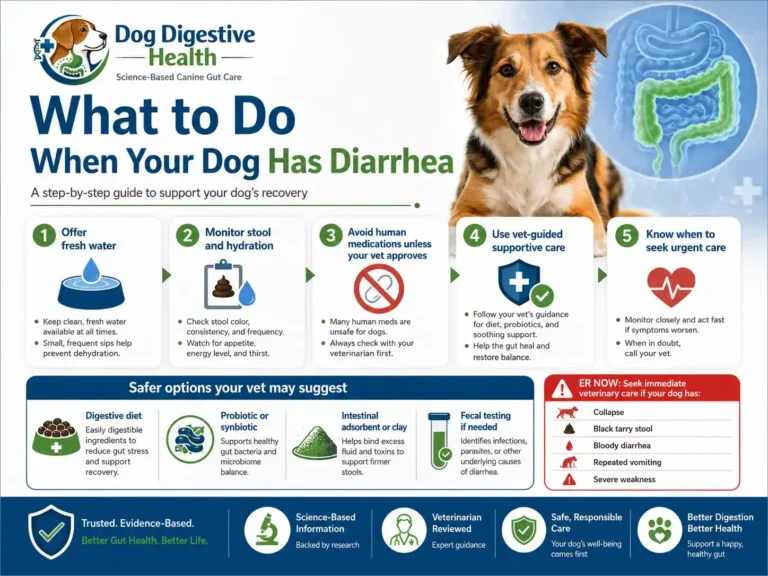
The safest alternative is not automatically another antidiarrheal. Treatment should match the dog’s condition and the probable cause of the diarrhea.
Is Corrective Suspension safer than Pepto-Bismol?
Some veterinary corrective suspensions contain bismuth subsalicylate. Although the product may have animal-use instructions, the active ingredient can still carry salicylate-related risks.
Always read the current label because formulations can change. A veterinary bismuth product still requires caution in a dog with:
- Gastrointestinal bleeding
- An ulcer
- Dehydration
- Kidney or liver disease
- An interacting medication
- Black or bloody stool
A product made for animals is not automatically suitable for every animal.
Veterinary intestinal adsorbents and clays
A veterinarian may recommend a product containing:
- Diosmectite
- Montmorillonite
- Kaolin
- Pectin
- Psyllium
- Prebiotics
- Selected probiotic or synbiotic preparations
These products may help bind water or other substances in the intestinal tract and improve stool consistency without exposing the dog to salicylate.
Product quality and evidence vary. Do not substitute:
- Garden clay
- Craft clay
- Cosmetic bentonite
- An unverified detox powder
- A product containing potentially harmful herbs or essential oils
Use a veterinary-selected product with a complete ingredient label.
What can you give a dog for diarrhea instead?
For a bright, stable adult dog with mild, uncomplicated diarrhea, a veterinarian may suggest:
- Frequent access to fresh water
- A highly digestible veterinary gastrointestinal diet
- Smaller, more frequent meals
- A veterinary probiotic or synbiotic
- An appropriate intestinal adsorbent
- Fecal testing if parasites are possible
- Antiemetic treatment if nausea or vomiting is present
- Reassessment if symptoms persist
Current veterinary guidance emphasizes hydration, nutrition, and treatment of the underlying cause. Routine antibiotic use is not recommended for most dogs with mild or moderate acute diarrhea, while benefits from probiotics and other nutraceuticals vary between products (1, 2).
Are pumpkin, chicken and rice safe alternatives?
Plain canned pumpkin and a temporary bland diet may be useful for some dogs, but they are not suitable in every situation.
Keep in mind:
- Too much pumpkin can worsen stool changes in some dogs.
- Chicken is unsuitable for a dog with chicken sensitivity.
- Homemade chicken and rice is not nutritionally complete for long-term use.
- Broth may contain onion, garlic, excessive salt, or too much fat.
- Dietary care does not eliminate parasites or remove an intestinal obstruction.
A commercial veterinary gastrointestinal diet is often more balanced and predictable than a homemade meal.
Do not automatically fast puppies, toy breeds, diabetic dogs, senior dogs, or medically fragile animals. Their nutritional needs should be discussed with a veterinarian.
When to Skip Home Care and Drive Straight to the Veterinary ER
Go to an emergency veterinary hospital when diarrhea occurs with:
- Collapse or inability to stand
- Pale, gray, or white gums
- Difficulty breathing
- Severe weakness
- A swollen or painful abdomen
- Persistent vomiting
- Blood in vomit
- Black, sticky, or tarry stool
- A large amount of blood in the diarrhea
- Repeated unproductive retching
- Suspected intestinal obstruction
- Suspected poison exposure
- A medication overdose
- Severe dehydration
- Tremors or seizures
- Marked confusion or reduced responsiveness
- Rapid deterioration
Contact your regular veterinarian the same day when:
- Watery diarrhea occurs repeatedly
- Your dog cannot keep water down
- A puppy, senior, or medically vulnerable dog develops diarrhea
- An otherwise healthy adult dog is not improving within 24–48 hours
- Diarrhea keeps returning
- Weight loss is occurring
- Blood or mucus repeatedly appears in the stool
- Appetite is reduced
- Your dog is taking an NSAID, steroid, or blood thinner
- Pepto-Bismol has already been given, and the stool becomes black
Depending on your dog’s symptoms, the veterinary team may assess hydration and circulation, examine the abdomen, test a stool sample, perform bloodwork, or recommend abdominal X-rays or ultrasound.
Most uncomplicated cases improve with appropriately selected supportive care. However, systemic illness, dehydration, toxin exposure, and possible intestinal obstruction require prompt evaluation (1).
The goal is not simply to stop the bowel movements. It is to determine how sick the dog is, maintain hydration, and identify whether the diarrhea is a sign of something that needs specific treatment.
Medical Disclaimer
This article is for educational purposes only and is not a substitute for veterinary diagnosis or treatment. Do not give Pepto-Bismol or any human medication to your dog without consulting a licensed veterinarian.
Frequently Asked Questions(FAQs)
1.Can I give my dog Pepto-Bismol for diarrhea?
Only give Pepto-Bismol if your veterinarian approves the exact product, dose, and duration. Its aspirin-related salicylate component can cause stomach irritation, bleeding, and medication interactions.
2. How much Pepto-Bismol can I give my dog?
There is no universally safe dose based on weight alone. The correct amount depends on the product concentration, your dog’s health, hydration and current medications.
3. Why does Pepto-Bismol turn dog poop black?
Bismuth can darken stool. However, black, sticky or tar-like poop may also indicate digested blood, particularly when accompanied by weakness, vomiting, pale gums or appetite loss.
4. Can Pepto-Bismol cause aspirin toxicity in dogs?
Yes. Excessive or repeated exposure to its salicylate component may cause vomiting, ulcers, gastrointestinal bleeding, rapid breathing, weakness, tremors or seizures.
5. Which dogs should not take Pepto-Bismol?
It should generally be avoided in puppies, pregnant or nursing dogs, dehydrated dogs and dogs with ulcers, bleeding disorders, kidney disease or liver disease. It should not be combined with an NSAID without veterinary approval.
6. When is dog diarrhea an emergency?
Seek urgent veterinary care for black tarry stool, substantial blood in the diarrhea, repeated vomiting, pale gums, collapse, severe weakness, abdominal pain, dehydration, breathing changes or suspected poisoning.
References
- Amirsultan S, Odunayo A. From diagnosis to resolution: A practical guide to acute diarrhea in veterinary patients. Veterinary Clinics of North America: Small Animal Practice.2026;56(3):665–679. doi: 1016/j.cvsm.2025.12.003
- Jessen LR, Werner M, Singleton D, et al. European Network for Optimization of Veterinary Antimicrobial Therapy (ENOVAT) guidelines for antimicrobial use in canine acute diarrhoea. The Veterinary Journal.2024;307:106208. doi: 1016/j.tvjl.2024.106208
- Senderovich H, Vierhout M. Is there a role for bismuth in diarrhea management? Rambam Maimonides Medical Journal.2021;12(1):e0002. doi: 5041/RMMJ.10422