
White Specks in Dog Poop: Worms, Food, or Bone Debris?
Written by: Dr. Akram Khan, DVM
Medically Reviewed by: Dr. Khalid Mehmood, PhD (Assistant Professor in Clinical Veterinary Medicine)
Last updated on September 05, 2026
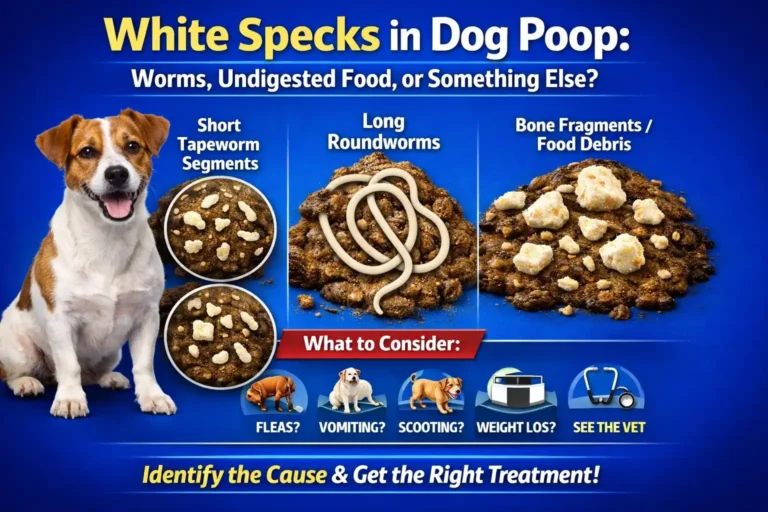
White specks in dog poop can be confusing because they may be harmless food residue, bone fragments, or a sign of intestinal worms. If you’re searching “what are the white specks in my dog’s poop,” the biggest clue is how the material looks: rice-like white specks in dog poop are often linked with tapeworm segments, especially when they move or appear repeatedly, while long white worms in dog poop may point more toward roundworms. Some cases of white stuff in dog poop are undigested food or chalky bone debris, but repeated white spots in dog stool, scooting, fleas, diarrhea, vomiting, or weight loss should be checked by a veterinarian.
What Are White Specks in Dog Poop?
White specks in dog poop may be tapeworm segments, undigested food, bone fragments, or other debris. Rice-like white specks that move or keep returning are more suspicious for tapeworms, especially if your dog has fleas or scoots. Long white worms may suggest roundworms, while irregular chalky pieces may be food or bone debris. Repeated white specks, diarrhea, vomiting, weight loss, or puppy age should be checked by a veterinarian.
White Specks in Dog Poop: What Are They and Should You Worry?

- The most important medical cause of white specks in dog stool is tapeworm segments.
- Tapeworm segments often look like:
- grains of rice
- cucumber seeds
- tiny sesame-like moving pieces
- Dogs usually get this infection by swallowing an infected flea during grooming.
- This is why white specks in dog poop, plus fleas, are a strong clue for tapeworm infection.
- Fresh segments may move.
- Dried segments may stop moving and become easier to confuse with food particles or debris.
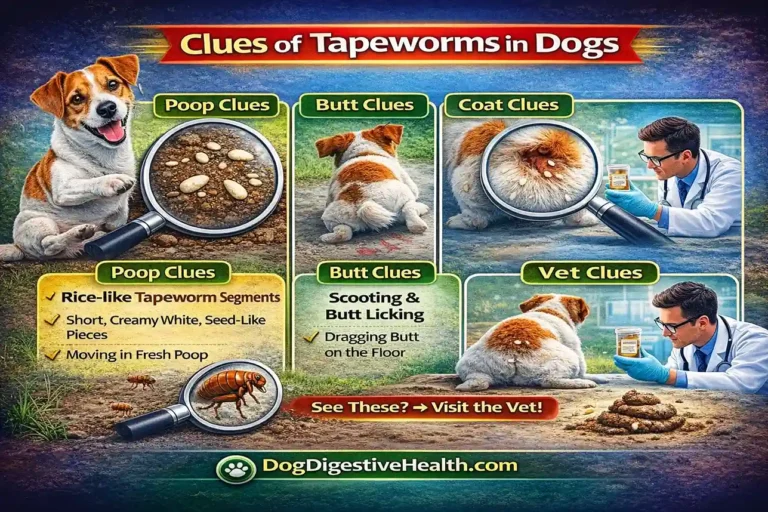
Are White Rice-Like Specks in Dog Poop Tapeworms?
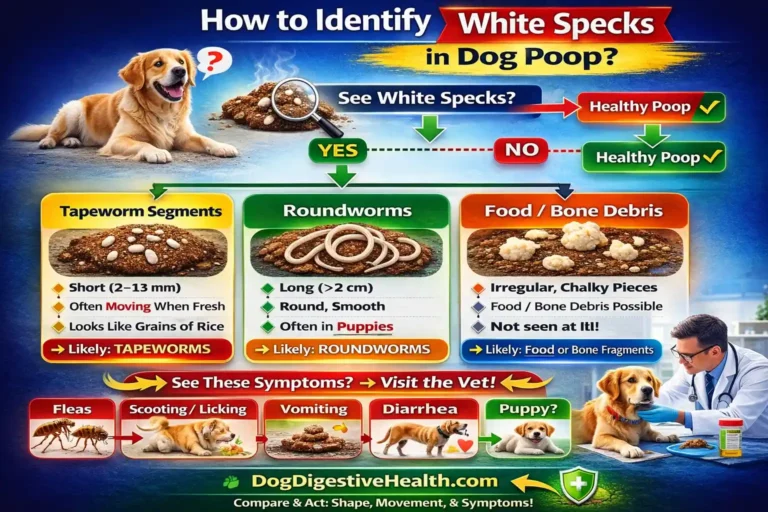
- If the material looks like:
- grains of rice
- cucumber-seed-like pieces
- short white moving segments
Tapeworms move higher on the list of likely causes.- Dipylidium caninum has an indirect life cycle involving:
- fleas
- lice
- Dogs shed egg-containing segments in feces.
- Some dogs may also show:
- scooting
- rear-end licking
- mild perianal irritation
- A common problem is that routine fecal flotation can miss tapeworm infections.
- That means a dog can have white rice-like specks in dog poop and still have an unrevealing routine stool check.
This is why visible stool appearance, flea history, and proper veterinary follow-up matter together.
What Is the Difference Between Short White Worms and Long White Worms in Dog Poop?
- Not all worms look the same.
- Short white worms in dog poop or rice-like pieces are more suggestive of:
- tapeworm segments
- Long spaghetti-like worms in dog poop are more suggestive of:
- roundworms
- ascarids
- Puppies deserve extra attention because intestinal parasites are more common and more important in young dogs.
- Puppies with parasite problems may also show:
- poor growth
- pot-bellied appearance
- vomiting
- soft stool
- poor coat quality
- This makes white specks in puppy poop an important symptom to check quickly.
Can White Specks in Dog Poop Be Undigested Food?
- Yes, undigested food is a real possibility.
- This is more likely when:
- The specks appear after a specific meal
- The material does not move
- It does not look segmented
- It does not keep returning
- Owners may confuse parasites with:
- food particles
- seeds
- gristle
- chewing residue
- Still, repeated white specks should not be dismissed too quickly.
- If the specks keep returning, especially with:
- diarrhea
- vomiting
- scooting
- flea exposure
- appetite change
- weight loss
Parasites become more important to rule out.
Can White Specks in Dog Poop Be Bone Fragments or Debris?
- Yes, white flecks in dog poop can come from:
- bone fragments
- indigestible chewing material
- foreign debris
- This is more likely if the material is:
- irregular
- crumbly
- chalky
- hard
- Dogs that chew bones, eat prey, or scavenge have a wider differential diagnosis.
- In those cases, both of these remain possible:
- parasites
- non-parasitic debris
- A practical way to think about it:
- Irregular chalky fragments = more suspicious for bone or debris
- Rice-like repeated segments = more suspicious for tapeworms
Long, smooth worms = more suspicious for roundworms
Are Moving White Specks in Dog Poop More Likely to Be Worms?
- This is one of the most useful visual comparisons.
- If the material is:
- fresh
- moving
- seed-like
Tapeworm segments become much more likely. - If the material is:
- non-moving
- irregular
- seen only once
Food residue or debris becomes more plausible. - But non-moving white specks do not rule tapeworms out.
- Once proglottids dry, they may stop moving and lose their obvious worm-like look.
- The best next step is to:
- inspect a fresh stool sample
- Take a clear photo
- Note whether your dog has fleas, diarrhea, scooting, raw-diet exposure, hunting behavior, or vomiting
When Should You Take Your Dog to the Vet for White Specks in Poop?

- A vet visit becomes more important when white specks in dog poop:
- keep returning
- appear with fleas
- appear with diarrhea
- appear with vomiting
- appear with scooting
- appear with weight loss
- appear with lethargy
- appear with appetite loss
- appear with abdominal discomfort
- Puppies need faster attention because parasite burdens can affect them more seriously.
- There is also a public-health reason not to ignore some worm infections.
- Roundworm exposure can matter in homes with:
- small children
- frequent soil exposure
- immunocompromised individuals
- Good hygiene matters:
- Wash hands after handling stool
- Remove stool promptly
- Keep the environment clean
Can a Dog Have Tapeworms Even If the Stool Test Is Negative?
- A common mistake is assuming one basic stool test always gives a final answer.
- That is not always true.
- Some infections are easier to miss than others.
- Tapeworm infections may be missed because:
- Segments are not always present in every sample
- Parasite material is not always recovered well on routine flotation
- Ascarid infections may also need more targeted testing depending on:
- egg shedding
- age of infection
- type of test used
- This means a dog with:
- white specks in dog stool
- flea exposure
- a rice-like appearance
may still need follow-up even if an initial routine test is unrevealing.- The best clinical approach is
- appearance
- risk factors
- testing strategy
used together
How Are White Worms or White Specks in Dog Poop Treated?
- Treatment should match the actual cause.
- If the white material is due to tapeworms:
- Parasite treatment alone may not be enough
- Flea control also matters
- Reinfection can happen if fleas are not addressed
- If the cause is roundworms:
- Testing and deworming follow a different path
- If the cause is food residue or debris:
- The focus shifts to diet history
- chewing habits
- possible GI irritation
- foreign-body concerns
- The key question is not
- “Are white specks bad?”
- The key question is:
- “What exactly are the white specks, and what pattern do they fit?”
How Can You Prevent White Worms or Recurring White Specks in Dog Poop?

- Prevention matters more than a one-time reaction.
- Helpful prevention steps include:
- year-round broad-spectrum parasite control
- regular parasite testing when appropriate
- prompt stool cleanup
- hand washing after handling feces
- controlling fleas
- limiting hunting and scavenging
- reducing access to rodents, prey, carcasses, and risky raw meat exposure
- Dogs with higher risk may need closer parasite-control planning, especially if they have:
- outdoor roaming
- shared housing
- flea exposure
- raw meat access
- prey exposure
- hunting behavior
What Should You Do If You See White Specks in Your Dog’s Poop?
- The most accurate answer is this:
- Rice-like white segments are most suspicious for tapeworms
- Long spaghetti-like worms are more suspicious for roundworms
- Irregular chalky or crumbly pieces may be bone fragments, food residue, or debris
- Recurrent white specks deserve more attention when they happen with:
- fleas
- scooting
- vomiting
- diarrhea
- puppy age
- weight loss
- A negative basic stool test does not always rule out tapeworm infection.
- The best next step is to:
- Collect a fresh stool sample
- Take a clear photo
- Note whether the material is moving
- Contact your veterinarian if the pattern repeats or your dog has other symptoms
Medical disclaimer
- This article is for educational purposes only.
- It is not a substitute for veterinary diagnosis or treatment.
- If your dog has recurring white specks in stool, vomiting, diarrhea, weight loss, lethargy, or signs of pain, contact your veterinarian promptly.
Frequently Asked Questions (FAQs)
1. Can white specks in dog poop be normal?
- Sometimes they may be harmless food residue or debris.
- Repeated white specks should not be assumed to be normal.
2. Do white specks in dog poop always mean worms?
- No
- They can be worms, undigested food, bone fragments, or other debris.
3. What do tapeworm segments look like in dog poop?
- They often look like:
- rice grains
- cucumber seeds
- tiny white moving pieces
4. Are moving white specks in dog poop more concerning?
- Yes
- Moving rice-like specks are more suspicious for tapeworm segments.
5. Can puppies get white worms in their poop?
- Yes
Puppies can get intestinal parasites and should be checked quickly
6. Should I take my dog to the vet for white specks in stool?
- Yes, especially if:
- the specks keep returning
- your dog has fleas
- your dog has diarrhea
- your dog is vomiting
- your dog is losing weight
- your dog is scooting
7. What should I bring to the vet?
- Bring:
- a fresh stool sample
- a clear photo of the stool
- notes about flea exposure
- diet details
- raw meat exposure
- hunting behavior
- recent symptoms
References:
- Elsemore, D., Bezold, T., Geng, J., Hanna, R., Tyrrell, P., & Beall, M. (2023). Immunoassay for detection of Dipylidium caninumcoproantigen in dogs and cats. Journal of Veterinary Diagnostic Investigation, 35(6), 671–678. DOI: 1177/10406387231189193. This source supports that routine fecal methods can miss Dipylidium caninum and that coproantigen testing improves detection.
- Little, S., Braff, J., Duncan, K., Elsemore, D., Hanna, R., Hanscom, J., et al. (2023). Diagnosis of canine intestinal parasites: Improved detection of Dipylidium caninuminfection through coproantigen testing. Veterinary Parasitology, 324, 110073. DOI: 1016/j.vetpar.2023.110073. Your current reference lists this as volume 323 and article 109983, but the verified ScienceDirect record shows volume 324, article 110073.
- Rousseau, J., Castro, A., Novo, T., & Maia, C. (2022). ** Dipylidium caninumin the twenty-first century: Epidemiological studies and reported cases in companion animals and humans.** Parasites & Vectors, 15, 131. DOI: 1186/s13071-022-05243-5. This is useful for tapeworm epidemiology, flea/lice transmission, companion animals, and zoonotic context.
- Jesudoss Chelladurai, J., Kifleyohannes, T., Scott, J., & Brewer, M. T. (2018). Praziquantel resistance in the zoonotic cestode Dipylidium caninum.The American Journal of Tropical Medicine and Hygiene, 99(5), 1201–1205. DOI: 4269/ajtmh.18-0533. Use this only if you discuss treatment failure, reinfection, or resistant tapeworm cases.
- Loftus, J. P., Acevedo, A., Bowman, D. D., Liotta, J. L., Wu, T., & Zhu, M. (2022). Elimination of probable praziquantel-resistant Dipylidium caninumwith nitroscanate in a mixed-breed dog: A case report. Parasites & Vectors, 15, 438. DOI: 1186/s13071-022-05559-2. This is also useful only if your article mentions difficult or recurring tapeworm infection after treatment.
- Conboy, G. (2009). Cestodes of dogs and cats in North America.Veterinary Clinics of North America: Small Animal Practice, 39(6), 1075–1090. DOI: 1016/j.cvsm.2009.06.005. This is a strong background reference for tapeworms/cestodes in dogs and cats.
- Barrera, J. P., Montoya, A., Marino, V., et al. (2026). Intestinal parasite prevalences in dogs and cats: A decade of retrospective data from a reference veterinary laboratory in Madrid, Spain.Parasites & Vectors, 19, 45. DOI: 1186/s13071-025-07168-1. This is useful as a newer parasite-prevalence reference, especially for regular testing and parasite-control context.