
Yellow Dog Poop: Is It a Food Change, Bile Issue, or Something More Serious?
Written by: Dr. Akram Khan, DVM
Medically Reviewed by: Dr. Khalid Mehmood, PhD (Assistant Professor in Clinical Veterinary Medicine)
Last updated on September 05, 2026
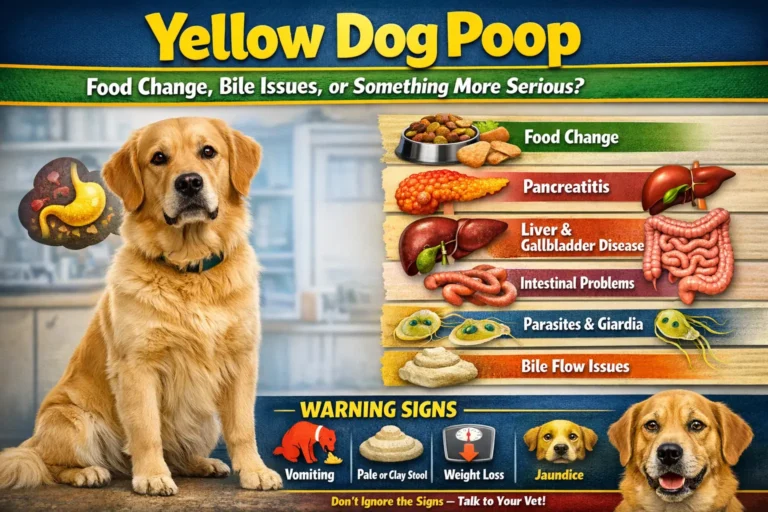
Yellow dog poop is a clue, not a diagnosis.
- The main question is whether the stool turned yellow after a food change, whether it looks yellow because of bile pigment and fast intestinal transit, or whether it is part of a more serious liver disease, gallbladder disease, pancreatitis, parasite infection, colitis, or chronic enteropathy
- A one-time episode of mustard yellow dog poop after switching food is not the same as persistent yellow dog poop, pale yellow dog poop, yellow dog poop with vomiting, or clay-colored dog stool.
- Color matters, but the full pattern matters more: frequency, texture, appetite, energy level, vomiting, mucus, abdominal pain, weight loss, dehydration, and jaundice all help explain what the stool color may mean.
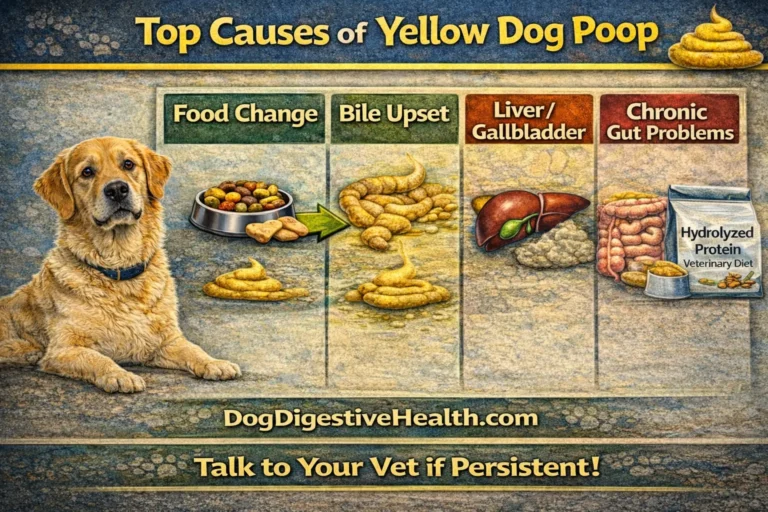
What yellow dog poop can mean?
Yellow dog poop after food change
- A sudden switch in kibble, canned food, topper, treats, table scraps, fatty chews, or scavenged food can irritate the digestive tract and cause yellow diarrhea in dogs or mustard yellow dog poop.
- This is more likely when the stool change starts within 24 to 72 hours of the new food or rich snack.
- If your dog is otherwise bright, drinking normally, and eating fairly well, and the problem resolves quickly, a short-term dietary upset is often the most likely explanation.
Yellow dog poop from bile and fast gut transit
- Bile helps digest fats, and problems with digestion or rapid movement through the intestines can make stool look yellow, yellow-brown, or mustard-colored.
- A loose stool that moves through the gut too quickly may not develop a normal brown appearance.
- This is one reason some dogs have yellow dog poop with diarrhea, suffering mild stomach upset, stress-related diarrhea, or short-lived gastroenteritis.
Yellow dog poop from large-bowel irritation or mucus
- If the stool is slimy, jelly-like, coated, or stringy, the more important clue may be mucus, not just color.
- Yellow mucus dog poop can happen with colitis, lower bowel irritation, food intolerance, parasites, or stress-related bowel inflammation.
- Repeated small stools, urgency, straining, and mucus usually point more toward large-bowel inflammation than a simple diet issue.
Yellow dog poop from chronic gut disease
- If yellow stool keeps coming back, it may fit a pattern of food-responsive enteropathy, chronic enteropathy, intestinal inflammation, or poor digestion.
- This becomes more likely when the stool change is linked with weight loss, poor body condition, reduced appetite, flatulence, intermittent vomiting, or long-term soft stools.
- Recurrent stool color change should not be dismissed as a “sensitive stomach” forever.
Yellow dog poop from liver, bile duct, or gallbladder disease
- Yellow stool becomes more worrying when it turns very pale, gray, chalky, or clay-like.
- That pattern raises more concern for bile flow problems, extrahepatic bile duct obstruction, gallbladder disease, or liver disease.
- If your dog also has jaundice, vomiting, lethargy, abdominal pain, reduced appetite, or dark urine, the stool color needs faster veterinary attention.
Yellow dog poop with pancreatitis or pancreatic stress
- Yellow dog poop with vomiting, yellow stool with abdominal pain, or yellow diarrhea with weakness and poor appetite is more concerning than stool color alone.
- Pancreatitis can overlap with digestive upset, dehydration, nausea, and poor fat digestion.
- If the dog seems painful, hunched, restless, weak, or refuses food, do not treat it like a simple food reaction.
Yellow dog poop from parasites or infections
- Giardia, contaminated water exposure, dog park exposure, kennel exposure, and some infections can cause yellow loose stool in dogs, especially when diarrhea is intermittent or persistent.
- Parasites become more important when the dog is a puppy, has repeated diarrhea, has poor weight gain, or is exposed to contaminated environments.
- Stool testing becomes much more important in these cases.
Is yellow dog poop just a food change?
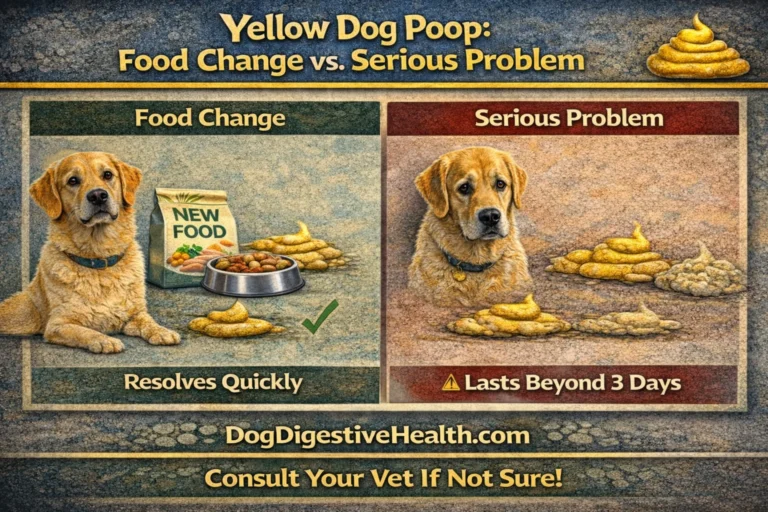
Sometimes yes, but not always.
- A recent diet change is one of the most practical explanations for dog poop yellow after switching food.
- This is especially true when:
- The stool changed soon after a new kibble, topper, canned food, or treat.
- The dog has no major red flags.
- The stool improves within a short time.
- It is less likely to be “just food” when:
- The stool keeps turning yellow again and again.
- Your dog has chronic soft stool.
- There is weight loss, low appetite, vomiting, or low energy.
- The stool becomes pale or clay-like.
- The dog already has a history of liver, gallbladder, pancreatic, or chronic GI disease.
Can bile make dog poop yellow?

- Yes, bile can contribute to yellow stool, but bile alone does not explain every case.
- Bile is part of normal digestion and can influence stool color.
- In mild digestive upset, faster stool transit may leave the stool looking more yellow or mustard-colored than usual.
- But there is a major difference between:
- soft yellow stool during diarrhea, and
- pale, gray, washed-out, or clay-colored stool
That distinction matters because pale or acholic stool is much more concerning for bile flow obstruction or significant hepatobiliary disease.
Yellow dog poop with no other symptoms
- This is usually less urgent, but it still deserves observation.
- If your dog has one episode of yellow stool and is otherwise:
- eating normally,
- drinking normally,
- playful,
- comfortable,
- not vomiting,
- and not straining,
- The cause may be temporary digestive irritation or a minor food-related upset.
- Still, monitor for:
- recurrence,
- mucus,
- vomiting,
- loss of appetite,
- abdominal pain,
- pale stool,
- or changes in energy.
Yellow dog poop with diarrhea
- Yellow dog poop with diarrhea is one of the most common ways this problem appears.
- Common possibilities include:
- sudden food change,
- rich treats,
- scavenging,
- stress,
- parasites,
- colitis,
- acute gastroenteritis,
- or early pancreatitis.
- What matters most is whether the diarrhea is:
- mild and short-lived,
- frequent and urgent,
- mucus-heavy,
- paired with vomiting,
- or part of a recurring pattern.
Yellow dog poop with mucus
- Yellow dog poop with mucus often points more toward bowel irritation than bile disease.
- Mucus can suggest:
- colitis,
- large-bowel inflammation,
- food sensitivity,
- stress-related bowel upset,
- or parasites.
- If the stool is repeatedly small in volume, slimy, frequent, and urgent, think beyond simple food color change.
Yellow dog poop with vomiting
- This is more concerning than yellow stool alone.
- The combination of yellow dog poop and vomiting can occur with:
- pancreatitis,
- gastroenteritis,
- dietary indiscretion,
- bile flow disorders,
- or more significant digestive disease.
- Fast veterinary evaluation becomes more important if vomiting is paired with:
- abdominal pain,
- lethargy,
- refusal to eat,
- dehydration,
- pale stool,
- or jaundice.
Yellow dog poop and liver or gallbladder disease
- The more serious hepatobiliary pattern is usually not just “yellow.”
- Warning stool descriptions include:
- pale dog poop
- gray dog stool
- clay-colored dog poop
- chalky or washed-out stool
- Concerning related symptoms include:
- yellow gums or eyes,
- vomiting,
- loss of appetite,
- lethargy,
- abdominal discomfort,
- and progressive illness.
Yellow dog poop and chronic enteropathy
- Recurrent yellow dog poop can be part of a chronic GI pattern.
- This is more likely when digestive signs last for weeks or keep returning.
- Dogs with chronic enteropathy may show:
- repeated loose stool,
- intermittent vomiting,
- reduced appetite,
- weight loss,
- poor coat or body condition,
- flatulence,
- or partial response to food changes.
Yellow dog poop and Giardia
- Giardia belongs on the list when yellow stool keeps coming back or exposure risk is high.
- Think about Giardia when:
- Your dog is a puppy
- Diarrhea is intermittent
- Stool is soft, pale, or foul-smelling
- there is kennel or dog-park exposure,
- or your dog drinks from puddles, shared bowls, or contaminated water sources.
- Repeated stool testing may be needed in some dogs because parasite detection is not always straightforward on one sample.
How to tell food change, bile issues, and serious illness apart
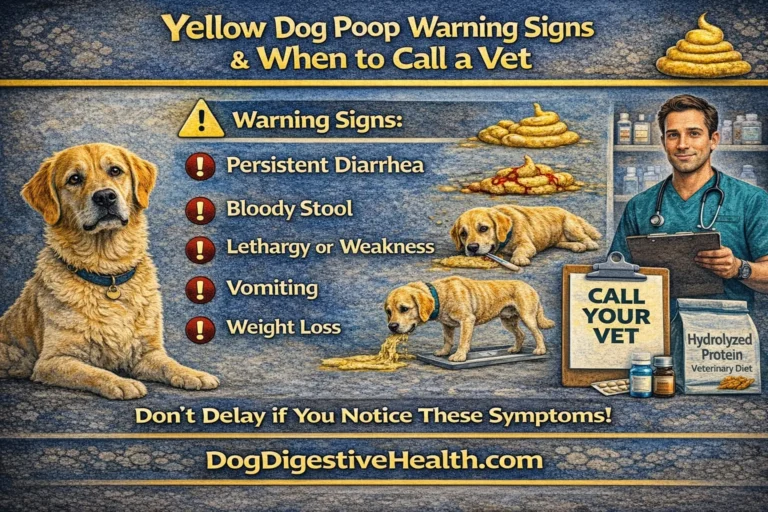
Food change pattern
- Started after a new food, treats, scraps, or fatty chew.
- Dog is mostly normal otherwise.
- Stool improves quickly.
- No persistent vomiting, jaundice, or severe pain.
Bile or fast-transit pattern
- Stool is loose, yellow, or mustard-colored during a short digestive upset.
- Often linked with diarrhea.
- Usually not truly pale or clay-like.
- May improve as the GI episode settles.
More serious medical pattern
- Stool is persistent, recurrent, very pale, gray, or clay-like.
- There is vomiting, abdominal pain, lethargy, low appetite, dehydration, weight loss, or jaundice.
- The dog is a puppy, senior, toy breed, or already medically compromised.
- The pattern keeps returning instead of resolving.
What to do if your dog’s poop is yellow?
Start with the recent history
- Check the last 24 to 72 hours for:
- food changes,
- new treats,
- table scraps,
- fatty chews,
- garbage exposure,
- raw food exposure,
- boarding,
- travel,
- stress,
- or medication changes.
- Look at the full stool pattern
Ask:
- Is it one episode or repeated episodes?
- Is the stool loose, formed, slimy, or pale?
- Is there mucus?
- Is your dog straining?
- Is there vomiting?
- Is appetite normal?
- Is your dog bright and hydrated?
Do not focus on color alone
- Yellow stool by itself is less meaningful than yellow stool plus:
- vomiting,
- pain,
- low energy,
- weight loss,
- or jaundice.
Keep a simple symptom log
- Note:
- time of onset,
- food changes,
- stool color,
- stool consistency,
- vomiting,
- appetite,
- and hydration.
This makes a vet visit much more useful if the problem continues.
When to worry about yellow dog poop
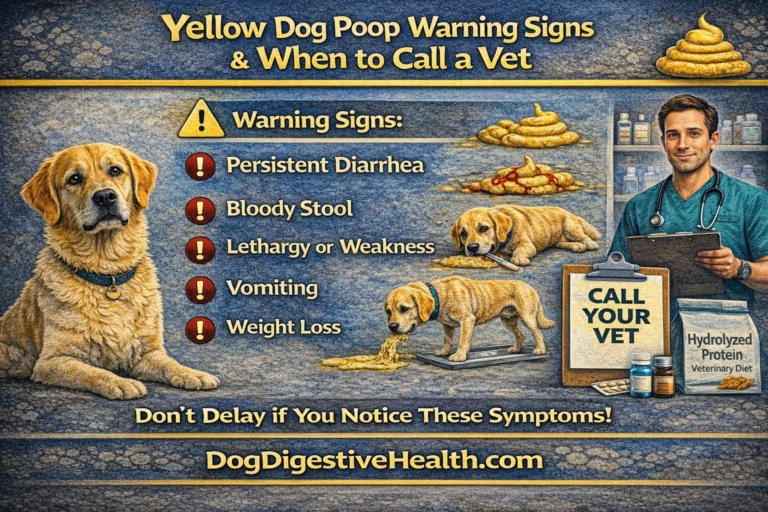
Contact a veterinarian promptly if your dog has:
- persistent yellow dog poop,
- recurrent yellow diarrhea,
- pale, gray, or clay-colored stool,
- yellow stool with vomiting,
- yellow stool with abdominal pain,
- yellow stool with lethargy,
- yellow stool with reduced appetite,
- yellow stool with weight loss,
- yellow stool with jaundice,
- or repeated mucus-heavy stool.
Higher-risk dogs include:
- puppies,
- senior dogs,
- toy breeds,
- dogs with known liver disease,
- dogs with gallbladder disease,
- dogs with pancreatitis history,
- and dogs with chronic gastrointestinal disease.
Bottom line
- Yellow dog poop can be minor, but it can also be clinically important.
- A one-off episode after treats or a food switch may reflect temporary digestive upset.
- Mustard yellow dog poop with diarrhea may happen with rapid gut transit and mild GI irritation.
- Pale yellow dog poop, clay-colored stool, or recurring yellow stool deserves more concern.
- The real red flags are not just color. They are persistence, recurrence, vomiting, abdominal pain, lethargy, jaundice, poor appetite, dehydration, and weight loss.
- The safest takeaway is simple: color matters, but pattern matters more.
Medical Disclaimer
This article is for educational purposes only and does not replace veterinary diagnosis or treatment.
FrequentlyAsked Questions(FAQs)
1) Is yellow dog poop normal after changing food?
- It can happen after a sudden food switch, especially if the stomach and intestines get irritated.
- If it is brief and your dog seems normal otherwise, it is often less serious.
- If it keeps happening, the dog needs a better diet review and possibly a veterinary check.
2) Can bile make dog poop yellow?
- Yes, bile and fast intestinal transit can make stool look yellow or mustard colored.
- But very pale, gray, or clay-like stool is more concerning than simple yellow diarrhea.
3) What does mustard yellow dog poop mean?
- It often points to digestive upset, fast stool transit, food change, treats, or mild diarrhea.
- It becomes more concerning if it is repeated or comes with vomiting, pain, or low appetite.
4) Why is my dog’s poop yellow and slimy?
- Yellow slimy stool often suggests mucus and bowel irritation.
- Colitis, stress, food sensitivity, or parasites can all be possible causes.
5) When should I worry about yellow dog poop?
- Worry more when it is persistent, recurrent, pale, clay-like, or paired with vomiting, lethargy, abdominal pain, jaundice, or weight loss.
6) Can pancreatitis cause yellow dog poop?
- It can be part of a broader digestive upset pattern, especially if the dog also has vomiting, pain, weakness, or poor appetite.
- Stool color alone cannot diagnose pancreatitis.
7) Can parasites cause yellow dog poop in dogs?
- Yes, parasites such as Giardia can be part of the differential, especially in puppies or dogs with repeated diarrhea and exposure risk.
References
- O’Neill, D. G., Prisk, L. J., Brodbelt, D. C., Church, D. B., & Allerton, F. (2025). Epidemiology and clinical management of acute diarrhoea in dogs under primary veterinary care in the UK. PLOS ONE, 20(6), e0324203. https://doi.org/10.1371/journal.pone.0324203
- Lim, S. Y., Cridge, H., Twedt, D. C., Ohta, H., Nuruki, T., & Steiner, J. M. (2024). Management of acute-onset pancreatitis in dogs: A narrative review. Journal of the American Veterinary Medical Association, 262(9), 1231–1240. https://doi.org/10.2460/javma.24.02.0107
- Ing, N. H., & Steiner, J. M. (2024). The use of diets in the diagnosis and treatment of common gastrointestinal diseases in dogs and cats. Advances in Experimental Medicine and Biology, 1446, 39–53. https://doi.org/10.1007/978-3-031-54192-6_3
- Gookin, J. L., Mathews, K. G., & Seiler, G. (2025). Diagnosis and management of gallbladder mucocele formation in dogs. Journal of the American Veterinary Medical Association, 263(6), 777–785. https://doi.org/10.2460/javma.24.12.0789
- Center, S. A. (2024). Extrahepatic bile duct obstruction in small animals. MSD Veterinary Manual. Reviewed/Revised August 2023; Modified September 2024.
- Collier, A. (2025). Chronic enteropathies in small animals. MSD Veterinary Manual.
- Companion Animal Parasite Council. (2025). Giardia guidelines. CAPC. (PubMed)