
Proviable-Forte vs Proviable-DC: Which Is Best?
Written by: Dr. Akram Khan, DVM
Medically Reviewed by: Dr. Muhammad Saeed, PhD
Last updated: September 15, 2026

Proviable-Forte and Proviable-DC are closely related canine probiotics from Nutramax, but they are not identical. Both provide the same seven probiotic organisms and two prebiotic ingredients, while Proviable-Forte delivers 10 billion colony-forming units per serving compared with 5 billion in Proviable-DC. Therefore, that difference may matter in some veterinary care plans, although a higher CFU count does not automatically make one probiotic more effective for every dog.
Additionally, a quick product-name clarification is important. Nutramax verifies the canine product as Proviable-Forte, not “ProviaMax.” Because ProviaMax is not part of Nutramax’s current dog probiotic line, this medically accurate comparison focuses on Proviable-Forte and Proviable-DC.
Direct answer
Proviable-DC is often the more practical option for routine daily digestive support because it is widely available and usually less expensive. In comparison, Proviable-Forte may be more suitable when a veterinarian specifically recommends the higher 10-billion-CFU concentration. Both products contain the same seven probiotic organisms, so Forte is not necessarily better simply because it provides twice as many CFUs.
Key differences at a glance
- Proviable-DC: 5 billion CFUs per serving and broad retail availability.
- Proviable-Forte: 10 billion CFUs per serving and veterinary-channel availability.
- Both formulas: Seven probiotic organisms, fructooligosaccharide, gum arabic, capsule, and chewable-tablet options.
- Best everyday value: Usually Proviable-DC.
- Best higher-CFU option: Proviable-Forte when recommended by a veterinarian.
- Most important limitation: No direct clinical trial has established that Forte produces better outcomes than DC in dogs.
Overview: Comparing Proviable-Forte and Nutramax Proviable-DC
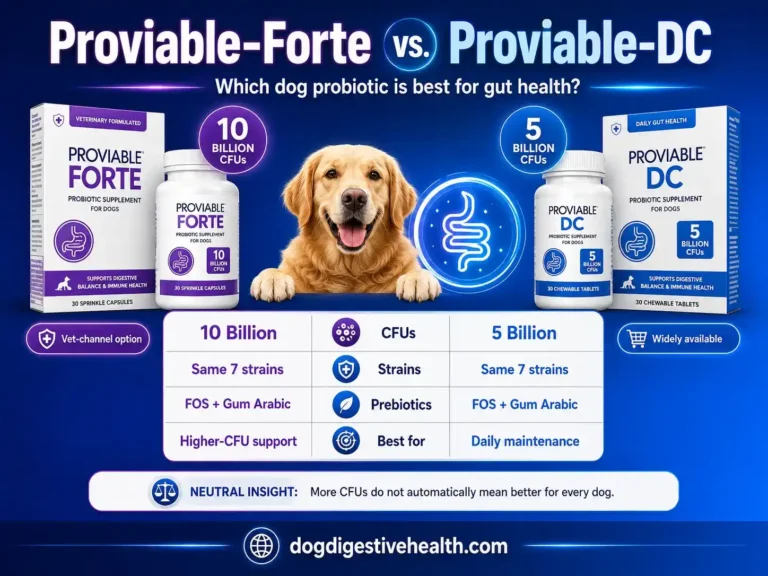
Proviable-Forte and Proviable-DC are multi-strain synbiotic supplements designed to support a healthy intestinal microbiota in dogs. They may be used when intestinal balance is disturbed by dietary changes, food sensitivities, dietary indiscretion, travel, kenneling, stress, or other gastrointestinal challenges.
A probiotic contains live microorganisms intended to provide a health benefit when given in an appropriate amount. A prebiotic is a substrate used by selected intestinal microorganisms. A supplement containing probiotics and prebiotics is commonly described as a synbiotic.
Both proviable products fit this definition because they combine seven probiotic organisms with fructooligosaccharide and gum arabic. Their formulations are therefore much more similar than some product comparisons suggest.
Feature | Proviable-DC | Proviable-Forte |
Total CFUs per serving | 5 billion | 10 billion |
Number of probiotic organisms | Seven | Seven |
Organism profile | Same seven-organism blend | Same seven-organism blend |
Prebiotic ingredients | Fructooligosaccharide and gum arabic | Fructooligosaccharide and gum arabic |
Available forms | Sprinkle capsules, chewable tablets, and diarrhea-support kits | Sprinkle capsules, chewable tablets, and diarrhea-support kits |
Standard capsule direction | One capsule daily or as directed by a veterinarian | One capsule daily long-term or as directed by a veterinarian |
Availability | Commonly sold through pet retailers and pharmacies | Available through veterinarians |
Storage | At or below 77°F and away from direct sunlight | At or below 77°F and away from direct sunlight |
Main practical advantage | Accessibility and lower long-term cost | Twice the labeled CFU concentration |
Key Differences and Clinical Limitations
The difference between Proviable-Forte and Proviable-DC is therefore primarily one of concentration and distribution—not the number or identity of the listed probiotic organisms.
Proviable-DC may be a sensible starting option for a stable dog needing routine intestinal support. Proviable-Forte may be selected when the veterinarian wants the same organism blend at a higher total daily concentration.
Neither formula should be described as a cure for diarrhea, chronic enteropathy, inflammatory bowel disease, infection, or food allergy. A probiotic may support gastrointestinal care, but it cannot replace diagnostic testing, dietary management, hydration, or prescription treatment when these are needed.
When Proviable-DC May Be the Better Fit
Proviable-DC may be appropriate when:
- The goal is routine daily digestive support.
- A veterinarian considers 5 billion CFUs sufficient.
- The dog has previously tolerated the formula.
- Wider retail availability is convenient.
- Long-term affordability is important.
- The owner wants a choice between capsules and chewable tablets.
- The supplement is being used alongside a stable diet and broader care plan.
When Proviable-Forte May Be Worth Considering
Proviable-Forte may be preferred when:
- A veterinarian specifically recommends 10 billion CFUs.
- The dog is already under veterinary care for recurring digestive problems.
- The standard proviable organism profile has been well tolerated.
- A higher-concentration product is desired without changing the organism blend.
- The veterinary clinic is managing the dog’s supplements and medications.
- The Forte diarrhea-support kit has been recommended for short-term loose stool.
The decision should be based on the dog’s condition and treatment goals, not on the assumption that the largest number on the label must provide the best result.
Bacterial Strain Profile: Same Organisms at Different Concentrations

Proviable-Forte and Proviable-DC list the same seven probiotic organisms:
- Enterococcus faecium NCIMB 30183
- Bifidobacterium bifidum NCIMB 30179
- Streptococcus thermophilus NCIMB 30189
- Lactobacillus helveticus NCIMB 30184
- Lactobacillus delbrueckii NCIMB 30186
- Lactobacillus casei NCIMB 30188
- Lactobacillus plantarum NCIMB 30187
The deposited strain identifiers are useful because probiotic effects may be strain-specific. Two supplements can contain organisms from the same genus or species yet differ in viability, stability, dose, manufacturing process, and biological activity.
For example, simply stating that a supplement contains “Lactobacillus” provides limited clinical information. A stronger formula assessment considers:
- The complete organism name
- The strain or deposit number
- The guaranteed viable CFU count
- The amount delivered in one serving
- The presence of prebiotics
- Product storage and expiration
- Evidence connected with the exact strain or formulation
Proviable-Forte does not provide broader bacterial coverage than Proviable-DC. It delivers a higher total concentration of the same listed organisms.
This matters when comparing a broad-spectrum dog probiotic with a targeted single-strain formula. A multi-strain supplement exposes the intestinal environment to several organisms, but more organisms do not automatically guarantee a stronger clinical response. A well-studied single strain may be more appropriate for a particular purpose than an inadequately studied multi-strain blend.
The Role of Lactobacillus and Bifidobacterium Species
Several organisms in Proviable belong to bacterial groups commonly discussed in canine gut-health research. The formulas include four listed Lactobacillus species and one Bifidobacterium species, together with Enterococcus faecium and Streptococcus thermophilus.
These organisms may interact with the intestinal environment through mechanisms such as
- Competing with other microorganisms for nutrients or attachment sites
- Producing fermentation metabolites
- Supporting intestinal-barrier function
- Influencing microbial-community composition
- Interacting with local immune responses
- Contributing to an environment favorable to beneficial microbes
These mechanisms are biologically plausible, but they should not be converted into claims that Proviable treats a specific disease unless the exact formulation has demonstrated that outcome in suitable clinical studies.
Does Proviable Contain Lactobacillus acidophilus or Bifidobacterium animalis?
The current US labels for Proviable-Forte and Proviable-DC do not list Lactobacillus acidophilus or Bifidobacterium animalis. Those organisms may appear in other canine probiotics or older online product descriptions, but they should not be presented as ingredients in the current Proviable formulas.
The relevant organisms are Lactobacillus helveticus, Lactobacillus delbrueckii, Lactobacillus casei, Lactobacillus plantarum, and Bifidobacterium bifidum.
Checking the current package label is important because retailer listings may remain online after formulations or product descriptions have changed.
CFU Count Breakdown: Higher-Dose Support vs. Daily Maintenance
CFU means colony-forming unit. It estimates the number of viable microorganisms able to grow under defined laboratory conditions.
Proviable-DC guarantees at least 5 billion CFUs per capsule. Proviable-Forte guarantees at least 10 billion CFUs per capsule. Both are generally administered once daily unless the veterinarian gives different directions.
It is reasonable to describe Proviable-Forte as the higher-CFU formula. It is not accurate to call it twice as effective.
The clinical value of a probiotic depends on more than its total CFU count. Relevant factors include:
- The identity of the organisms
- Their viability at the time of administration
- The dog’s underlying gastrointestinal condition
- The existing gut microbiome
- Diet and fiber intake
- Antibiotic or other medication use
- Storage conditions
- Duration of supplementation
- The outcome being measured
A veterinarian might choose the 10-billion-CFU formula for a dog with recurring digestive sensitivity or as part of a more intensive gastrointestinal plan. Another dog may do well on 5 billion CFUs and gain no meaningful benefit from changing products.
Is Proviable-Forte Better Than Proviable-DC for Diarrhea?
There is no direct clinical study proving that Proviable-Forte resolves diarrhea faster than Proviable-DC.
A 2024 systematic review and meta-analysis evaluated probiotics, prebiotics, synbiotics, and antimicrobial treatments for canine acute diarrhea. The included nutraceutical studies were limited and varied considerably in their products, populations, and methods. The review found that the overall evidence did not support a reliable assumption that probiotic treatment produces a clinically important improvement in every dog with acute diarrhea (1).
The related 2024 ENOVAT guideline concluded that the available evidence was insufficient to recommend either for or against probiotics as a universal treatment for canine acute diarrhea. It also advised against routine antimicrobial treatment for many dogs with mild or moderate acute diarrhea when severe systemic illness is absent (2).
This does not mean that probiotics have no value. It means that their benefits are likely to depend on the exact strain, formulation, dose, dog, and clinical situation.
For loose stool, the Proviable kit may appear to act differently from capsules alone because it includes kaolin-and-pectin paste. The paste can help firm stool, while the capsules provide the probiotic and prebiotic blend. A faster change in stool consistency should not automatically be credited to the higher CFU count.
Is Proviable-DC Suitable for Long-Term Daily Use?
The capsule formulations are positioned for longer-term intestinal support under veterinary guidance. A dog using Proviable-DC daily should still be reassessed if loose stool, excessive gas, poor appetite, or other digestive symptoms continue.
Long-term supplementation is most useful when it forms part of a clear plan. That may include:
- A consistent, complete diet
- Gradual food transitions
- Appropriate fiber intake
- Parasite prevention
- Treatment of underlying disease
- Review of medications
- Monitoring of body weight and stool quality
A daily probiotic should not become a reason to ignore recurring symptoms.
Prebiotic Inclusion: Soluble-Fiber Support for Beneficial Bacteria
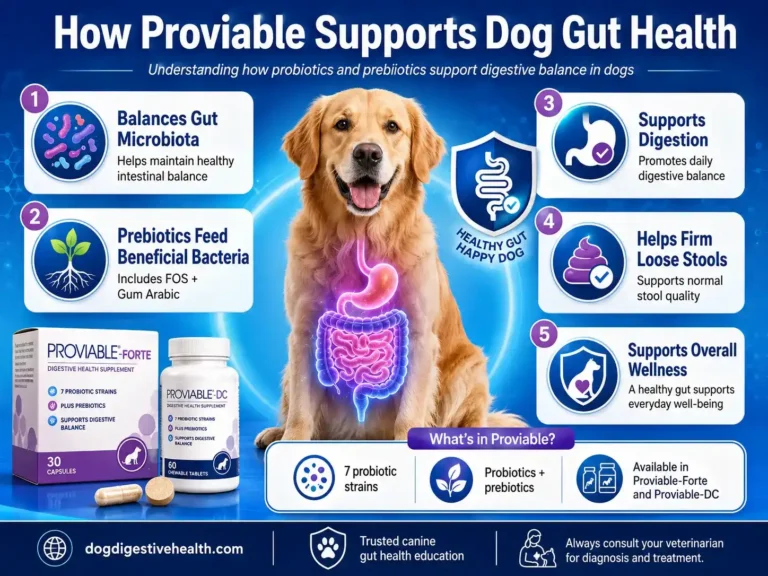
Both capsule formulas include fructooligosaccharide, or FOS, and gum arabic.
These prebiotic ingredients provide fermentable substrates that selected intestinal microorganisms may use. Their inclusion is intended to support the probiotic organisms and the dog’s existing intestinal microbiota.
Fermentation of suitable fibers can contribute to the production of short-chain fatty acids. These microbial metabolites participate in:
- Colonocyte energy metabolism
- Intestinal-barrier maintenance
- Regulation of the colonic environment
- Communication between microbes and host tissues
- Microbial-community stability
The effect of a prebiotic is not identical in every dog. Response can vary with the type and amount of fiber, the dog’s normal diet, intestinal transit time, microbial composition, and health status.
Prebiotics also do not guarantee that supplemented bacteria will permanently colonize the intestine. Many probiotic organisms remain temporary members of the gastrointestinal community and may decline after supplementation ends.
Proviable Kit vs. Capsules: What Is the Difference?
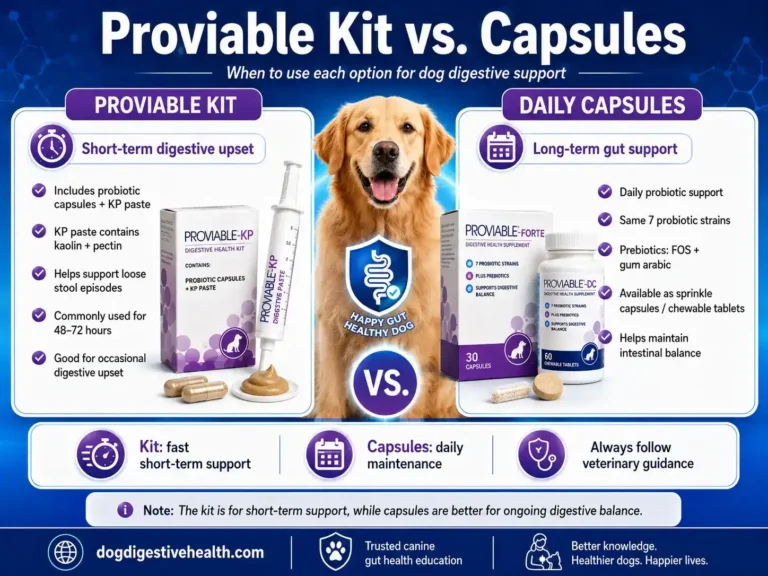
Proviable-DC and Proviable-Forte are both available in kits containing probiotic capsules and Proviable-KP Paste.
The paste contains kaolin and pectin and is intended to help firm loose stool. It is generally administered for 48 to 72 hours, while the capsules may be continued according to the veterinarian’s recommendation.
The components serve different purposes:
- Probiotic capsules: Provide the seven-organism blend and prebiotic ingredients.
- KP Paste: Provides short-term stool support with kaolin and pectin.
- Kaolin: Acts as an adsorbent.
- Pectin: A soluble fiber that can contribute to stool formation.
The kit may be useful during a short episode of digestive upset when the dog otherwise appears stable. It should not be used to delay veterinary care when the dog is vomiting, dehydrated, painful, weak, or passing substantial blood.
Excessive or prolonged use of the paste may contribute to constipation. Kaolin and pectin can also delay the absorption of some oral medications, so administration times may need to be separated.
Taste and Ease of Delivery: Chewable Tablets vs. Sprinkle Capsules
Both product lines offer sprinkle capsules and chewable tablets for dogs. Choosing between proviable capsules and chewables usually depends on how reliably the dog accepts the product.
Advantages of Sprinkle Capsules
The capsule can be:
- Given whole, like a pill
- Opened and sprinkled onto food
- Mixed with a small amount of tolerated food
- Used when a dog refuses flavored tablets
A sprinkle capsule may be especially convenient for dogs that already take pills or readily finish their meals.
However, mixing the powder into a full bowl can be unreliable when the dog has a poor appetite. If the meal is left unfinished, the dog may not receive the complete serving. Using a small portion of food first can make dosing more dependable.
The powder should not be mixed into very hot food because excessive heat can reduce the viability of live microorganisms.
Advantages of Chewable Tablets
Chewable tablets may be:
- Offered directly like a treat
- Broken into smaller pieces
- Added to a small amount of food
- Easier to handle than an opened capsule
The main limitation is palatability. A chewable product is convenient only when the dog consistently eats it. Some dogs may reject the flavor or spit out part of the tablet.
Inactive ingredients also differ between product forms. A dog with known food sensitivities should have the full ingredient list reviewed before changing from capsules to chewables.
Which Form Is Better for a Sensitive Stomach?
Neither form is universally gentler. The best choice depends on:
- The dog’s ingredient tolerances
- Appetite
- Ability to swallow capsules
- Acceptance of flavored tablets
- Need for precise administration
- Concurrent dietary restrictions
A dog that reacts poorly after changing formulations should be assessed rather than repeatedly switching products.
Is Proviable-Forte Safe for Puppies With Sensitive Stomachs?
Proviable products are marketed for young and adult dogs, but a puppy with diarrhea should not automatically be managed with a probiotic at home.
Puppies have smaller fluid reserves and may deteriorate more rapidly than healthy adult dogs. Loose stool can be associated with a simple food transition, but it can also occur with:
- Intestinal parasites
- Parvovirus or other infections
- Dietary indiscretion
- Abrupt food changes
- Stress
- Toxin exposure
- Foreign-body ingestion
- Congenital or metabolic disease
Contact a veterinarian promptly when a puppy has:
- Repeated or profuse diarrhea
- Vomiting
- Blood in the stool
- Black or tarry stool
- Reduced appetite
- Weakness
- Abdominal pain
- Pale or tacky gums
- Incomplete vaccination
- Weight loss or poor growth
- Possible toxin or foreign-object exposure
For a stable puppy with mild digestive sensitivity, a veterinarian may recommend Proviable-DC or Proviable-Forte as part of the care plan. The choice should depend on the puppy’s age, size, hydration, diet, diagnosis, and medical history.
There is no evidence that every puppy with a sensitive stomach needs the 10-billion-CFU formula. A higher dose should serve a defined clinical purpose.
How Quickly Can I Switch My Dog From Proviable-DC to Proviable-Forte?
The manufacturer does not publish a formal step-by-step transition schedule between Proviable-DC and Proviable-Forte.
Because both products list the same seven organisms and similar prebiotic ingredients, a veterinarian may advise changing at the next scheduled daily serving rather than gradually combining them.
A practical transition may involve:
- Giving the final Proviable-DC serving at the usual time.
- Starting Proviable-Forte at the next scheduled daily dose.
- Avoiding two complete servings on the same day unless directed otherwise.
- Keeping the dog’s food and treats stable during the change.
- Monitoring stool consistency, gas, appetite, vomiting, and behavior.
- Contacting the veterinarian if symptoms worsen.
Owners should not automatically give two Proviable-DC capsules to create a 10-billion-CFU serving. Although the CFU total would be similar, doubling the labeled serving also increases the amount of every other ingredient.
There is no need to describe the change as a detox, cleanse, or microbiome reset. These are marketing terms rather than established veterinary processes.
Do Proviable-Forte and Proviable-DC Require Refrigeration?
Neither product routinely requires refrigeration.
Both should be stored:
- At room temperature
- At or below 77°F or 25°C
- Away from direct sunlight
- In closed, original packaging
- Away from excess heat and moisture
- Where children and animals cannot access the package
Refrigeration may be used when there is concern about exposure to temperatures above 77°F, but the products should not be frozen.
Avoid keeping probiotics:
- In a parked car
- On a sunny windowsill
- Near an oven or heating appliance
- In a humid bathroom
- In a garage or outdoor storage area with large temperature changes
Check the expiration date before administration. Refrigerating an expired or heat-damaged product will not restore lost microbial viability.
Clinical Scenarios: Which Brand Excels During Antibiotic Therapy?
Antibiotics can alter the canine gut microbiome because they may affect beneficial intestinal bacteria as well as the organisms being targeted.
This does not mean that every dog receiving an antibiotic needs the highest-CFU probiotic. It also does not prove that Proviable-Forte prevents antibiotic-associated diarrhea better than Proviable-DC.
A 2025 controlled study evaluated Saccharomyces cerevisiae, a yeast probiotic, in healthy dogs receiving metronidazole. Metronidazole produced marked changes in the fecal microbiota, while the supplemented group showed some differences that suggested a possible moderating effect. However, the study involved only 20 dogs and used a yeast product rather than either proviable formula. Its results cannot be directly applied to Proviable-Forte or Proviable-DC (3).
The most accurate interpretation is that:
- Antibiotics can disrupt the intestinal microbiome.
- Certain probiotic approaches may influence microbial recovery.
- Benefits from one probiotic cannot be assumed for every other product.
- A change in microbiome composition does not always produce an observable clinical benefit.
- Direct evidence comparing Proviable-Forte and Proviable-DC during antibiotic treatment is lacking.
Can Proviable Be Given With Metronidazole or Another Antibiotic?
Proviable capsules and chewable tablets should not be administered at exactly the same time as an antibiotic because the medication may reduce the viability of the bacterial probiotics.
Nutramax recommends separating them by approximately one to two hours.
The KP Paste should also be separated from oral medications by one to two hours because kaolin and pectin may delay medication absorption.
A sample schedule for a dog receiving an antibiotic twice daily might be:
- Antibiotic with breakfast
- Proviable one to two hours later
- Antibiotic with the evening meal
The treating veterinarian should confirm the timing because some medications have specific food and dosing requirements.
Never stop, reduce, or change a prescribed antibiotic based solely on an online probiotic comparison.
Which Product Is Better After Antibiotics?
Proviable-DC may be reasonable when the veterinarian wants standard daily supplementation at a lower cost. Proviable-Forte may be chosen when the veterinarian prefers the higher concentration.
Neither product has been proven to restore the canine microbiome completely or within a guaranteed period. Recovery depends on the antibiotic, treatment duration, diet, health status, and baseline microbial community.
Price vs. Value: Long-Term Cost for One or More Dogs
The price of Proviable-Forte and Proviable-DC varies by package size, retailer, veterinary clinic, subscription discount, shipping, and location. Because prices change, the most reliable comparison uses cost per serving rather than a fixed online price.
How to Calculate Daily Cost
Use:
Package price ÷ number of servings = daily cost per dog
For example, an 80-count package costing $48 would cost:
$48 ÷ 80 = $0.60 per daily serving
Estimating Monthly and Annual Cost
For one dog:
- Monthly cost: daily cost × 30
- Annual cost: daily cost × 365
At $0.60 per serving:
- Estimated monthly cost: $18
- Estimated annual cost: $219
For three dogs receiving the same supplement daily:
- Estimated monthly cost: $54
- Estimated annual cost: $657
Even a small difference in serving price becomes important in a multi-pet household.
A product costing $0.25 more per daily serving adds approximately:
- $7.50 per month for one dog
- $91.25 per year for one dog
- $182.50 per year for two dogs
- $273.75 per year for three dogs
Is Proviable-Forte Worth the Higher Price?
It may be worth paying more when:
- The veterinarian specifically wants 10 billion CFUs.
- The dog responds better after changing under supervision.
- The higher concentration simplifies the treatment plan.
- The veterinary clinic is monitoring a chronic gastrointestinal condition.
It may offer limited extra value when:
- Proviable-DC already provides the desired result.
- The higher dose has no defined purpose.
- Cost makes consistent use difficult.
- The underlying cause of symptoms has not been investigated.
Cost per Billion CFUs
Owners may also calculate cost per billion CFUs:
- Divide Proviable-DC’s serving cost by five.
- Divide Proviable-Forte’s serving cost by ten.
This can help compare concentration, but it should not be treated as a measurement of effectiveness. Cheap CFUs are not necessarily better CFUs, and a more expensive serving does not guarantee a better clinical response.
Safety, Side Effects and Signs That Need Veterinary Care
Proviable is generally intended to be well tolerated when given according to the label, but not every dog with gastrointestinal signs is suitable for home probiotic use.
Possible changes after starting a probiotic include:
- Temporary gas
- Changes in stool consistency
- Reduced interest in a flavored tablet
- Vomiting or poor appetite unrelated to the supplement
- Constipation after excessive kaolin-and-pectin paste
- Sensitivity to an inactive ingredient
Veterinary guidance is especially important for dogs that are:
- Critically ill
- Severely dehydrated
- Vomiting repeatedly
- Immunocompromised
- Pregnant or nursing
- Receiving several medications
- Managing chronic gastrointestinal disease
- Very young or elderly
Seek veterinary care when diarrhea is accompanied by:
- Marked lethargy
- Abdominal pain
- Repeated vomiting
- Black stool
- Substantial blood
- Pale gums
- Fever
- Weakness or collapse
- Reduced urination
- Refusal of food or water
- Possible toxin exposure
- Suspected foreign-body ingestion
A dog with recurrent loose stool may need fecal testing, bloodwork, pancreatic assessment, dietary trials, cobalamin evaluation, or diagnostic imaging. Adding more CFUs cannot replace an appropriate diagnostic plan.
Final Recommendation: Which Supplement Should You Choose?

The most useful way to compare Proviable-Forte and Proviable-DC is to focus on what is actually different.
Both products contain:
- The same seven listed probiotic organisms
- Fructooligosaccharide
- Gum arabic
- Capsule and chewable-tablet options
- Room-temperature storage instructions
- Kit options containing probiotic capsules and KP Paste
The primary differences are
- Proviable-DC contains 5 billion CFUs per serving.
- Proviable-Forte contains 10 billion CFUs per serving.
- Proviable-DC is widely available through retail channels.
- Proviable-Forte is available through veterinarians.
- Proviable-DC is usually the more economical long-term option.
Choose Proviable-DC When:
- You want an accessible probiotic for routine digestive support.
- Your dog is stable and otherwise healthy.
- Five billion CFUs fit the veterinary plan.
- Long-term affordability matters.
- The dog already responds well to it.
- There is no clear reason to move to a higher concentration.
Choose Proviable-Forte When:
- Your veterinarian recommends 10 billion CFUs.
- Your dog is being managed for recurring gastrointestinal problems.
- The current Proviable blend is already well tolerated.
- A higher-concentration version fits the clinical plan.
- Purchasing through the veterinary clinic is convenient.
Do Not Rely on Either Product Alone When:
- Diarrhea is persistent, recurrent, or heavily bloody.
- The dog is dehydrated, weak, or painful.
- Repeated vomiting is present.
- A puppy may have an infection.
- Foreign-body or toxin exposure is possible.
- The dog needs fluids, diagnostic testing, or prescription treatment.
The final verdict:
Proviable-DC is often the better-value choice for routine daily gut support. Proviable-Forte may be appropriate when a veterinarian intentionally selects the higher 10-billion-CFU concentration. Because no direct study shows that Forte is clinically superior to DC, the best choice depends on the individual dog rather than CFU count alone.
Medical Disclaimer
This article is for educational purposes only and is not a substitute for professional veterinary advice, diagnosis, or treatment. Consult your veterinarian before starting, stopping, or changing a probiotic or digestive supplement, especially for puppies, pregnant or nursing dogs, immunocompromised animals, or dogs with persistent diarrhea, vomiting, blood in the stool, dehydration, or other concerning symptoms.
Frequently Asked Questions(FAQs)
1. Are Proviable-Forte and Proviable-DC synbiotics?
Yes. Both combine seven probiotic organisms with prebiotic ingredients, including fructooligosaccharide and gum arabic.
2. Is 10 billion CFUs twice as effective as 5 billion?
Not necessarily. Proviable-Forte contains twice the labeled CFUs, but no direct study shows that it provides twice the clinical benefit.
3. Can Proviable cure chronic diarrhea?
No. Chronic or recurrent diarrhea requires veterinary investigation. Proviable may be used as supportive care but does not replace diagnosis or treatment.
4. How long should Proviable-KP Paste be used?
The paste is generally given for 48 to 72 hours unless a veterinarian recommends a different duration.
5. Can cats take Proviable capsules?
The current Proviable-DC and Proviable-Forte sprinkle capsules are labeled for dogs and cats. The chewable tablets are intended for dogs.
6. When should a dog with diarrhea see a veterinarian?
Contact a veterinarian for persistent diarrhea, repeated vomiting, blood or black stool, dehydration, weakness, abdominal pain, poor appetite or symptoms in a young puppy.
References
- Scahill K, Jessen LR, Prior C, Singleton D, Foroutan F, Ferran AA, et al. Efficacy of antimicrobial and nutraceutical treatment for canine acute diarrhoea: A systematic review and meta-analysis for European Network for Optimization of Antimicrobial Therapy guidelines. The Veterinary Journal. 2024;303:106054. doi: 10.1016/j.tvjl.2023.106054
- Jessen LR, Werner M, Singleton D, Prior C, Foroutan F, Ferran AA, et al. European Network for Optimization of Veterinary Antimicrobial Therapy guidelines for antimicrobial use in canine acute diarrhoea. The Veterinary Journal. 2024;307:106208. doi: 10.1016/j.tvjl.2024.106208
Arghavani S, Chorfi Y, Segura M, Lesaux AA, Costa MC. Impact of Saccharomyces cerevisiae on the intestinal microbiota of dogs with antibiotic-induced dysbiosis. Frontiers in Veterinary Science. 2025;12:1462287. doi: 10.3389/fvets.2025.1462287