
Dog Straining to Poop? Causes, Treatment, and When to See a Vet
Written by: Dr. Akram Khan, DVM
Medically Reviewed by: Dr. Khalid Mehmood, PhD
Last updated on September 06, 2026
If your dog is straining to poop but nothing comes out, or your dog keeps trying to poop but can’t, it usually means something is irritating, painful, or blocking the lower digestive tract. Many owners describe this as a dog not pooping and straining, but it is not always simple constipation. Dogs may also strain because of colitis, anal gland pain, rectal irritation, diarrhea, or a partial obstruction. Pay close attention if your dog is straining to poop with mucus, fresh blood, repeated squatting, crying, vomiting, or weakness. This repeated urge to pass stool is called tenesmus, and it needs veterinary attention when it is persistent, painful, or paired with red-flag symptoms.
What Does It Mean When a Dog Is Straining to Poop?
Straining to poop in dogs, also called tenesmus, means your dog is making frequent, painful, or ineffective attempts to pass stool. In many cases, only a small amount of feces comes out, or nothing comes out at all.
If your dog is straining to poop but nothing comes out, or your dog keeps trying to poop but can’t, this is not something to ignore. Tenesmus is not a disease by itself. It is a clinical sign that points to an underlying problem involving the colon, rectum, anus, or nearby pelvic structures.
Common signs include repeated squatting, urgency to defecate, passing mucus, fresh blood, pain while trying to poop, or producing very small amounts of stool. In dogs, tenesmus is especially associated with large bowel disease, where urgency, frequent attempts, mucus, and fresh red blood are more common than large-volume stool loss. (MSD Veterinary Manual)
Is My Dog Constipated or Having Tenesmus?
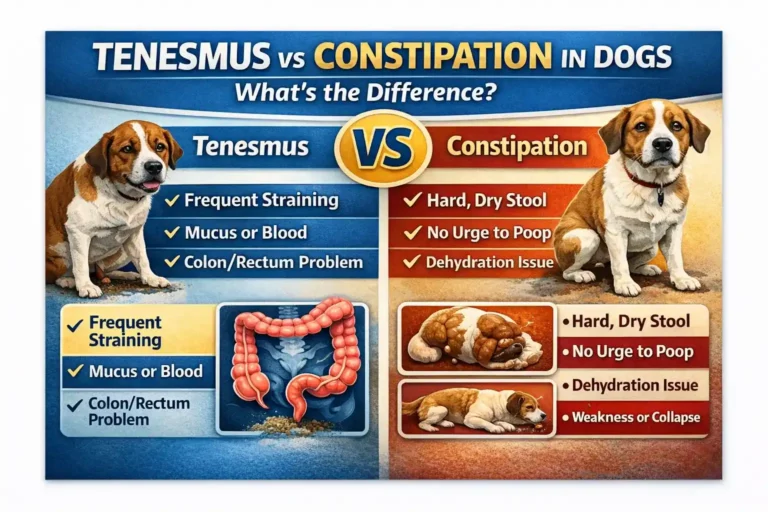
Many owners confuse dog straining to poop with constipation, but they are not always the same.
Feature | Tenesmus | Constipation |
Urge to poop | Frequent and urgent | Often reduced |
Stool passed. | Small amount or none | Hard, dry stool |
Pain | Common | Can occur |
Mucus or fresh blood | More common | Less common |
Main location | Colon or rectum | Colon, hydration, motility |
A constipated dog may pass hard, dry stool with difficulty. A dog with tenesmus may act as if it urgently needs to poop over and over, often with mucus, discomfort, or fresh blood. That is why searches like “dog not pooping” and “straining,” “dog difficulty defecating,” and “urge to defecate in dogs” can point to different conditions that need different treatment.
If your dog is straining to poop but nothing comes out, it may be constipation, tenesmus, colitis, anal gland pain, rectal irritation, or a blockage. Watch for mucus, fresh blood, vomiting, weakness, or repeated painful attempts. If straining continues or your dog seems unwell, contact a veterinarian promptly.
Why Is My Dog Trying to Poop But Nothing Comes Out?
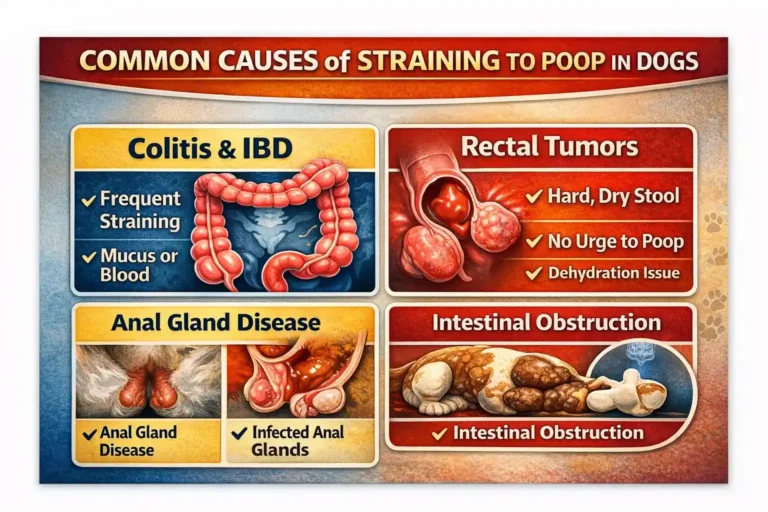
The causes of straining to poop in dogs range from mild digestive irritation to urgent surgical disease. Important causes include:
Can Colitis Make a Dog Strain to Poop?
Colitis is one of the most common reasons for tenesmus in dogs. It can cause urgency, repeated straining, mucus in stool, and fresh red blood.
Can Constipation Cause a Dog to Strain Without Pooping?
Constipation causes difficult or painful passage of stool. In more severe cases, stool becomes impacted in the colon, which may require enemas or other veterinary treatment.
Can a Blockage Make a Dog Keep Trying to Poop?
A dog may strain if something is blocking normal stool passage. This can become serious quickly, especially if vomiting, abdominal pain, or lethargy is also present.
Can Anal Gland Problems Make a Dog Strain to Poop?
Painful anal sacs, impaction, infection, or abscesses can make a dog strain repeatedly.
Can Rectal Problems Cause Straining in Dogs?
Inflammation of the rectum, rectal narrowing, rectal tears, rectal masses, or perineal hernia can all lead to tenesmus.
Can Worms or Infection Make a Dog Strain to Poop?
Some intestinal parasites and infectious causes of colitis can trigger urgency, blood, mucus, and straining.
Can Diet or Dehydration Make It Hard for a Dog to Poop?
Low water intake, diet issues, poor fiber balance, inactivity, or reduced intestinal movement can contribute to difficult defecation.
What Symptoms Come With Dog Straining to Poop?
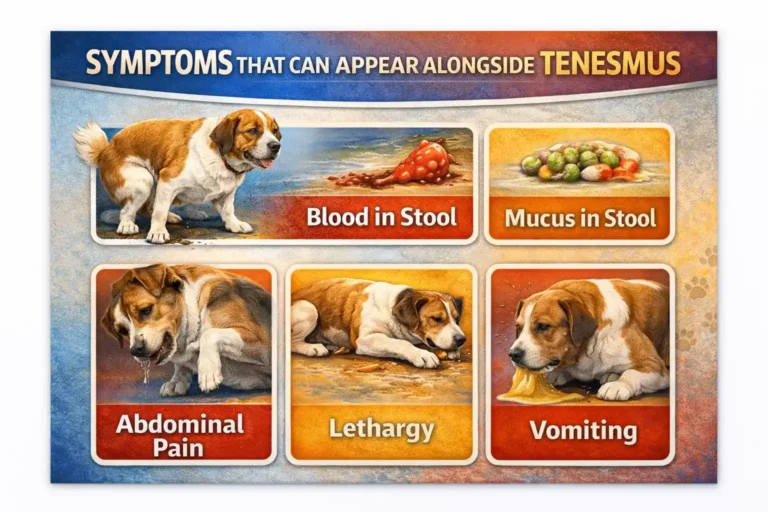
A dog with tenesmus may also show:
- Repeated unsuccessful attempts to poop
- Passing only a tiny amount of stool
- Mucus in stool
- Fresh red blood in stool
- Crying or pain while defecating
- Scooting or licking the rear end
- Abdominal discomfort
- Reduced appetite
- Lethargy
- Vomiting in more serious cases
A very important point is that dog straining to poop with diarrhea can still happen. Large-bowel diarrhea often causes urgency, frequent attempts, mucus, and fresh blood, even when stool volume is low. (MSD Veterinary Manual)
When Is Dog Straining to Poop an Emergency?
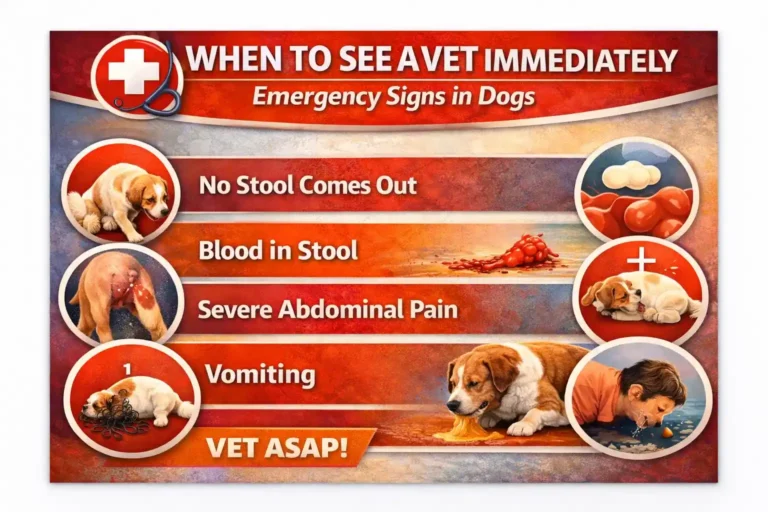
Seek urgent veterinary care if:
- Your dog is straining repeatedly, and nothing comes out
- You see fresh blood or a lot of mucus
- Your dog also has vomiting
- There is abdominal swelling or marked pain
- Your dog becomes weak, quiet, or collapses
- Your dog stops eating and looks unwell
- The problem continues or gets worse over a short time
These signs can be associated with severe colitis, fecal impaction, rectal injury, obstruction, or other serious disease. (PubMed)
What Should I Do If My Dog Keeps Trying to Poop But Can’t?
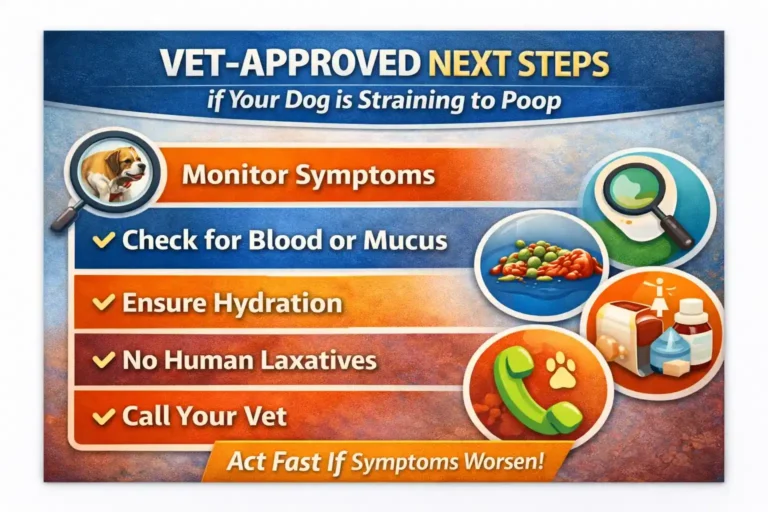
If your dog is straining to poop, take these steps:
- Watch whether any stool comes out
- Check for mucus, fresh blood, or obvious pain
- Make sure fresh water is available
- Do not give human laxatives on your own
- Do not keep trying random home remedies
- Arrange a veterinary visit if it does not resolve promptly
- Go urgently if vomiting, weakness, or abdominal pain is also present
If the issue is mild and your dog otherwise seems normal, quick veterinary advice is still wise because the cause can look simple at home but be very different clinically.
How Do Vets Find the Cause of Dog Straining to Poop?
Veterinarians usually diagnose the cause of a dog straining to poop through a combination of:
- History and symptom review
- Physical examination
- Rectal examination
- Abdominal palpation
- Fecal testing
- Bloodwork when needed
- X-rays
- Ultrasound in selected cases
This workup helps separate constipation from colitis, anal gland disease, rectal disease, foreign body, or obstruction. (VCA)
What Is the Treatment for a Dog Straining to Poop?
Treatment depends on the underlying cause.
Medical Treatment
A veterinarian may use anti-inflammatory treatment, parasite treatment, antibiotics in selected cases, stool softeners, or motility-supporting medication.
Dietary Management
Some dogs benefit from diet adjustment, hydration support, and fiber changes under veterinary guidance.
Procedures
More severe cases may need an enema, manual removal of impacted stool, drainage of anal gland disease, or surgery if there is obstruction, irreversible colon damage, or a structural problem.
Because treatment is cause-specific, the best plan for dog straining to poop but nothing coming out is not the same as the best plan for colitis, constipation, or anal gland pain. (VCA)
What Should I Not Give a Dog That Is Straining to Poop?
Do not give these unless a veterinarian specifically tells you to:
- Human laxatives
- Repeated enemas at home
- Oils or random home remedies
- Over-the-counter medicines meant for people
Giving the wrong product can delay diagnosis or worsen the problem, especially if the dog has obstruction or rectal disease. (VCA)
Can Mild Dog Straining Improve at Home?
Mild cases sometimes improve if the cause is minor constipation or temporary bowel irritation, but this should be approached carefully. If straining keeps happening, if your dog seems painful, or if you notice blood, mucus, vomiting, or lethargy, the safest next step is a veterinary exam.
In simple cases, hydration, exercise, and a vet-guided diet change may help, but persistent or recurrent symptoms should not be managed as guesswork.
When Should I Call a Vet About Dog Straining to Poop?
Contact a veterinarian right away if your dog has:
- Persistent straining without passing stool
- Pain during defecation
- Fresh blood in stool
- Vomiting
- Abdominal pain or swelling
- Weakness or collapse
- Repeated episodes of the same problem
Medical Disclaimer
This article is for educational purposes only. It does not replace a physical examination, diagnosis, or treatment plan from a licensed veterinarian. If your dog is straining to poop, especially with pain, blood, vomiting, or no stool output, seek veterinary care promptly.
Frequently Asked Questions(FAQs)
1. Why is my dog straining to poop but nothing comes out?
This can happen with tenesmus, constipation, rectal pain, anal gland disease, or obstruction.
2. Can a dog have diarrhea and still strain to poop?
Yes. Large-bowel diarrhea commonly causes urgency, mucus, fresh blood, and repeated straining.
3. Is straining to poop always constipation?
No. Tenesmus often points to large-bowel or rectal disease rather than simple constipation.
4. Can anal gland problems make a dog strain to poop?
Yes. Painful or infected anal glands can cause repeated straining and discomfort.
5. When should I worry about my dog not pooping?
You should worry sooner if straining is repeated, nothing comes out, or vomiting, pain, blood, or weakness is present.
6. Should I give my dog a laxative at home?
No. Do not use human laxatives unless your veterinarian specifically recommends one.
7. How long should I wait before seeing a vet?
Do not wait long if symptoms are persistent, painful, or worsening. Seek help sooner if any red-flag signs appear.
References
Barrantes Murillo, D. F., Henriksson, A., & Neto, R. A. L. L. T. (2024). A 2-month partial colorectal obstruction, tenesmus, and hematochezia in a dog. Journal of the American Veterinary Medical Association, 262(8), 1108–1111. doi: 10.2460/javma.24.01.0051
Fritsch, D. A., Wernimont, S. M., Jackson, M. I., MacLeay, J. M., & Gross, K. L. (2022). A prospective multicenter study of the efficacy of a fiber-supplemented dietary intervention in dogs with chronic large bowel diarrhea. BMC Veterinary Research, 18, 244. doi: 10.1186/s12917-022-03302-8
Fritsch, D. A., Jackson, M. I., Wernimont, S. M., Feld, G. K., MacLeay, J. M., Brejda, J. J., Cochrane, C. Y., & Gross, K. L. (2022). Microbiome function underpins the efficacy of a fiber-supplemented dietary intervention in dogs with chronic large bowel diarrhea. BMC Veterinary Research, 18, 245. doi: 10.1186/s12917-022-03315-3
Leib, M. S. (2000). Treatment of chronic idiopathic large-bowel diarrhea in dogs with a highly digestible diet and soluble fiber: A retrospective review of 37 cases. Journal of Veterinary Internal Medicine, 14(1), 27–32. doi: 10.1111/j.1939-1676.2000.tb01495.x
Volkmann, M., Steiner, J. M., Fosgate, G. T., Zentek, J., Hartmann, S., & Kohn, B. (2017). Chronic diarrhea in dogs: Retrospective study in 136 cases. Journal of Veterinary Internal Medicine, 31(4), 1043–1055. doi: 10.1111/jvim.14739
Corbee, R. J., Woldring, H. H., van den Eijnde, L. M., & Wouters, E. G. H. (2022). A cross-sectional study on canine and feline anal sac disease. Animals, 12(1), 95. doi: 10.3390/ani12010095