Best Probiotics for Dogs with IBD: Strains, Diet & Safety
Written by: Dr. Akram Khan, DVM
Medically Reviewed by: Dr. Khalid Mehmood, PhD
Last updated on October 20, 2026

The probiotics for dogs with IBD can help support gut microbiome balance, stool quality, intestinal barrier health, and immune regulation when used alongside veterinary treatment. Dogs with IBD often experience chronic diarrhea, gas, bloating, and food sensitivities due to intestinal inflammation. Probiotics for dogs with IBD may help support gut health, depending on the dog’s condition and the probiotic strains used. Probiotics cannot cure inflammatory bowel disease, but dog-specific strains such as Lactobacillus, Bifidobacterium, Enterococcus faecium, Saccharomyces boulardii, and Bacillus species may support long-term digestive stability when chosen and introduced carefully.
What are the best probiotics for dogs with IBD?
The best probiotics for dogs with IBD are dog-specific formulas containing evidence-supported strains such as Lactobacillus, Bifidobacterium, Enterococcus faecium, Saccharomyces boulardii, and Bacillus species. They may help support stool quality, gut bacteria balance, intestinal barrier function, and immune regulation, but they should be used with veterinary guidance.
Understanding IBD in Dogs and the Role of Probiotics
Canine IBD is characterized by chronic inflammation of the gastrointestinal tract, commonly associated with:
- Dysbiosis (imbalance of gut bacteria)
- Immune system overreaction
- Food sensitivities or allergies
- Genetic predisposition
When the intestinal lining becomes inflamed, beneficial bacteria decline while harmful microbes flourish. This imbalance worsens diarrhea, gas, bloating, and nutrient malabsorption.
Probiotics help restore microbial balance, support the intestinal barrier, and modulate immune responses—making them a valuable supportive therapy in dogs with IBD.
How Probiotics Help Dogs With IBD
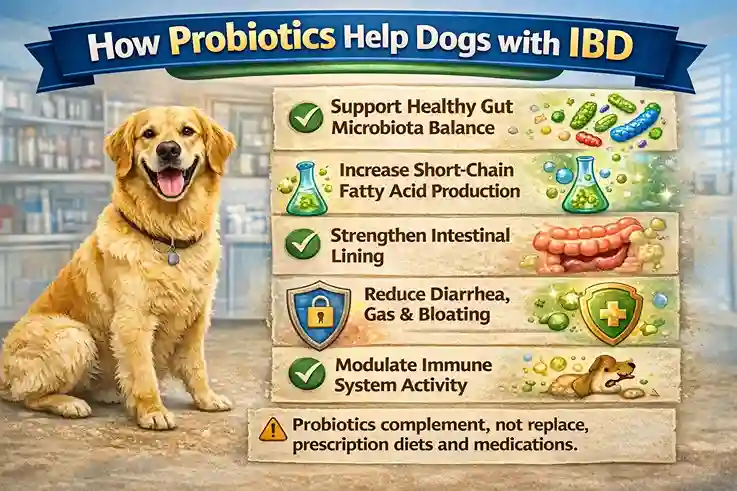
Probiotics are live microorganisms that provide health benefits when given in appropriate amounts. In dogs with inflammatory bowel disease, probiotics may help by:
- Supporting healthy gut microbiota balance
- Increasing short-chain fatty acid (SCFA) production, especially butyrate
- Strengthening the intestinal lining
- Modulating immune system activity
- Reducing diarrhea, gas, bloating, and abdominal discomfort
⚠️ Important: Probiotics are supportive tools, not replacements for veterinary diagnosis, prescription diets, or medications.
Best Probiotic Strains for Dogs With IBD (Evidence-Focused)
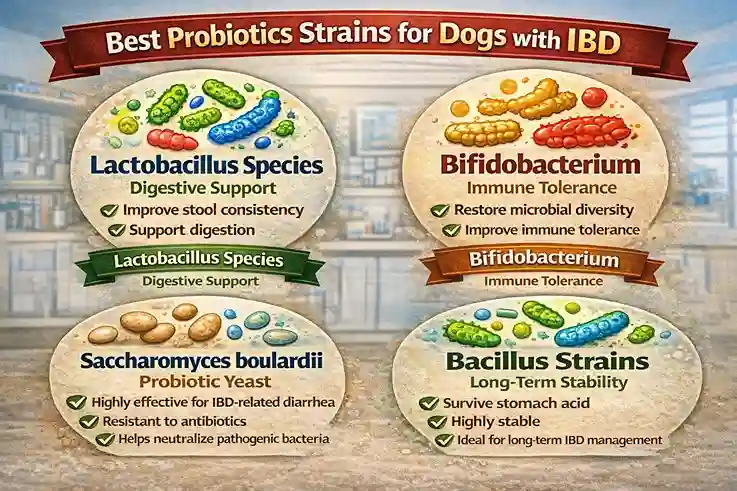
Not all probiotics are equally effective. Peer-reviewed studies highlight the following probiotic strains for canine IBD as most beneficial.
Lactobacillus Species (Digestive Support)
- Lactobacillus acidophilus
- Lactobacillus plantarum
- Lactobacillus brevis
- Lactobacillus lactis
Benefits:
✔ Improve stool consistency
✔ Support digestion
✔ Reduce intestinal inflammation
Bifidobacterium Species (Immune Tolerance)
- Bifidobacterium animalis
- Bifidobacterium longum
Benefits:
✔ Restore microbial diversity
✔ Improve immune tolerance
✔ Support chronic GI disorders
Saccharomyces boulardii (Probiotic Yeast)
Saccharomyces boulardii is a probiotic yeast that has been studied for gastrointestinal support. Because it is a yeast rather than a bacterium, it is not directly affected by antibacterial antibiotics. Its suitability for dogs with chronic intestinal disease should be discussed with a veterinarian.
Spore-Forming Probiotics (Long-Term Stability)
- Bacillus subtilis
- Bacillus coagulans
- Bacillus velezensis
Benefits:
✔ Survive stomach acid
✔ Highly stable
✔ Ideal for long-term IBD management
Best Probiotic Supplements for Dogs With IBD
The following probiotic supplements contain strains or formulations commonly used to support digestive health in dogs:
🥇 Purina Pro Plan Veterinary Supplements FortiFlora
- Contains Enterococcus faecium
- Widely veterinarian-recommended
- Effective for chronic diarrhea and stress-related GI upset
🥈 Visbiome Vet
- High-potency, multi-strain formula
- Designed for severe gastrointestinal disorders
- Often used alongside prescription diets
🥉 Proviable-DC
- Multi-strain probiotic with prebiotics
- Supports gut balance during diet changes and medication use
⭐ Honest Paws Probiotic Powder
- Includes Bacillus subtilis
- Easy to mix with food
- Suitable for long-term digestive support
⭐ Zesty Paws Probiotic Chews
- Grain-free formulation
- Includes prebiotics (inulin, FOS)
- Palatable option for picky eaters
CFU Count: How Much Probiotic Is Enough for Dogs With IBD?
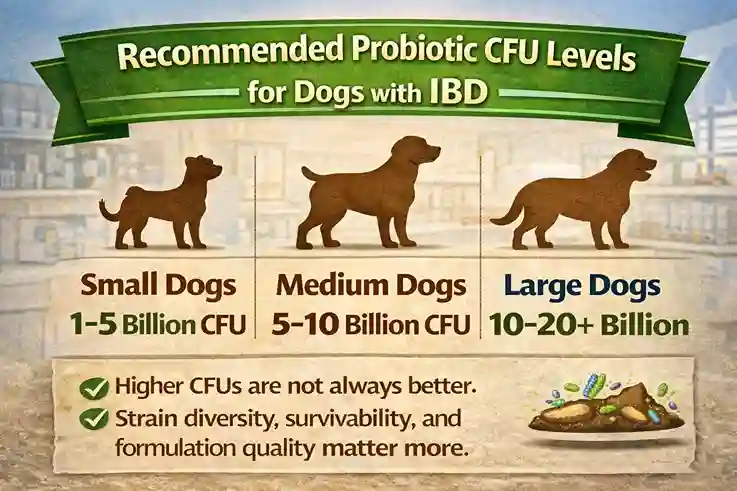
CFU (Colony-Forming Units) measures probiotic potency.
Dog Size | Recommended CFU Range |
Small dogs | 1–5 billion CFU |
Medium dogs | 5–10 billion CFU |
Large dogs | 10–20+ billion CFU |
💡 Higher CFUs are not always better. Strain diversity, survivability, and formulation quality matter more.
Probiotics and Diet: A Synergistic Approach for IBD
Veterinary evidence supports combining probiotics with:
- Hydrolyzed protein diets
- Novel protein diets
- Limited-ingredient diets
- Low-fat prescription GI formulas such as Hill’s Prescription Diet z/d Low Fat
This combined approach reduces immune stimulation while promoting intestinal healing.
Prebiotics That Enhance Probiotic Effectiveness
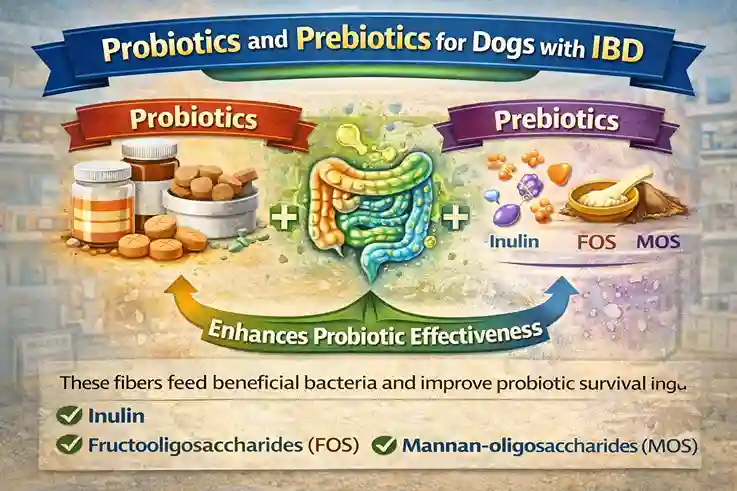
Prebiotics such as inulin, fructooligosaccharides (FOS), and mannan-oligosaccharides (MOS) can provide fermentable substrates that support beneficial intestinal bacteria.
- Inulin
- Fructooligosaccharides (FOS)
- Mannan-oligosaccharides (MOS)
These fibers feed beneficial bacteria and improve probiotic survival in the gut.
How to Introduce Probiotics to Dogs With IBD Safely
To minimize flare-ups:
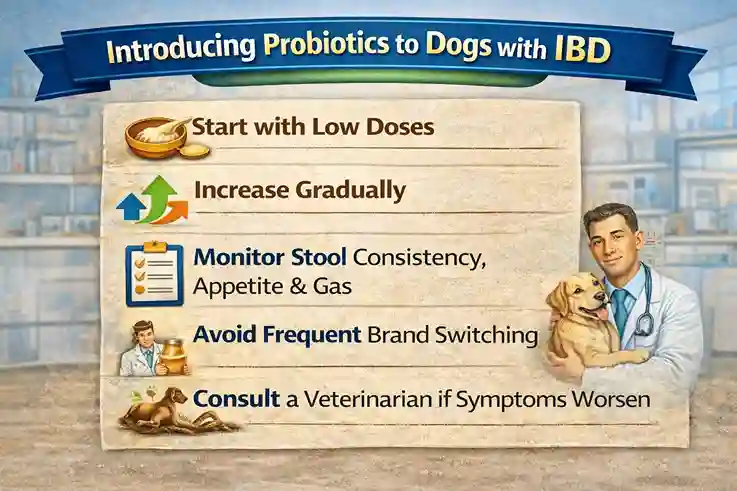
- Start with low doses
- Increase gradually over 7–10 days
- Monitor stool consistency, appetite, and gas
- Avoid frequent brand switching
Consult a veterinarian if symptoms worsen
When to Avoid or Pause Probiotics
Temporarily discontinue probiotics if your dog develops:
- Severe vomiting
- Rapidly worsening diarrhea
- Signs of dehydration
- Complications related to immune-suppressive medications
Always involve your veterinarian when adjusting supplements for dogs with IBD.
Medical Disclaimer:
This article is based on:
- Veterinary consensus
- Peer-reviewed GI microbiota research
- Verified product formulations
- Clinical experience in canine IBD management
It is educational only and does not replace professional veterinary advice.
Frequently Asked Questions (FAQs)
1. Are probiotics good for dogs with IBD?
Yes, when veterinarian-approved and used correctly.
2. Can probiotics replace IBD medication?
No. They support treatment but do not replace medication.
3. Which probiotic strain is best for IBD-related diarrhea?
There is no single probiotic strain that is best for every dog with IBD. The appropriate strain or formulation depends on the dog’s diagnosis, symptoms, diet, and veterinary treatment plan.
4. How long does it take for probiotics to work?
How long does it take for probiotics to work?
Response times vary by dog, probiotic formulation, diet, and underlying intestinal condition. Stool quality and other symptoms should be monitored with veterinary guidance.
5. Can probiotics worsen IBD symptoms?
Rarely, but temporary gas or loose stools may occur.
6. Do I need a prescription probiotic?
Not always, but vet-formulated products are preferred.
References
White, R., Atherly, T., Guard, B., Rossi, G., Wang, C., Mosher, C., Webb, C., Hill, S., Ackermann, M., Sciabarra, P., Allenspach, K., Suchodolski, J. S., & Jergens, A. E. (2017). Randomized, controlled trial evaluating the effect of multi-strain probiotic on the mucosal microbiota in canine idiopathic inflammatory bowel disease. Gut Microbes, 8(5), 451–466. https://doi.org/10.1080/19490976.2017.1334754
-
D’Angelo, S., Fracassi, F., Bresciani, F., Galuppi, R., Diana, A., Linta, N., Bettini, G., Morini, M., & Pietra, M. (2018). Effect of Saccharomyces boulardii in dogs with chronic enteropathies: Double-blinded, placebo-controlled study. Veterinary Record, 182(9), 258. https://doi.org/10.1136/vr.104241
-
Schmitz, S., Glanemann, B., Garden, O. A., Brooks, H., Chang, Y. M., Werling, D., & Allenspach, K. (2015). A prospective, randomized, blinded, placebo-controlled pilot study on the effect of Enterococcus faecium on clinical activity and intestinal gene expression in canine food-responsive chronic enteropathy. Journal of Veterinary Internal Medicine, 29(2), 533–543. https://doi.org/10.1111/jvim.12563
-
Pilla, R., Guard, B. C., Steiner, J. M., Gaschen, F. P., Olson, E., Werling, D., Allenspach, K., Salavati Schmitz, S., & Suchodolski, J. S. (2019). Administration of a synbiotic containing Enterococcus faecium does not significantly alter fecal microbiota richness or diversity in dogs with and without food-responsive chronic enteropathy. Frontiers in Veterinary Science, 6, 277. https://doi.org/10.3389/fvets.2019.00277
-
Minamoto, Y., Otoni, C. C., Steelman, S. M., Büyükleblebici, O., Steiner, J. M., Jergens, A. E., & Suchodolski, J. S. (2015). Alteration of the fecal microbiota and serum metabolite profiles in dogs with idiopathic inflammatory bowel disease. Gut Microbes, 6(1), 33–47. https://doi.org/10.1080/19490976.2014.997612
-
Wang, S., Martins, R., Sullivan, M. C., Friedman, E. S., Misic, A. M., El-Fahmawi, A., De Martinis, E. C. P., O’Brien, K., Chen, Y., Bradley, C., Zhang, G., Berry, A. S. F., Hunter, C. A., Baldassano, R. N., Rondeau, M. P., & Beiting, D. P. (2019). Diet-induced remission in chronic enteropathy is associated with altered microbial community structure and synthesis of secondary bile acids. Microbiome, 7, 126. https://doi.org/10.1186/s40168-019-0740-4
-
Dandrieux, J. R. S., & Mansfield, C. S. (2019). Chronic enteropathy in canines: Prevalence, impact and management strategies. Veterinary Medicine: Research and Reports, 10, 203–214. https://doi.org/10.2147/VMRR.S162774
-
Jergens, A. E., & Heilmann, R. M. (2022). Canine chronic enteropathy—Current state-of-the-art and emerging concepts. Frontiers in Veterinary Science, 9, 923013. https://doi.org/10.3389/fvets.2022.923013