
My Dog Ate a Piece of Raw Onion: How Much Is Toxic?
Written by: Dr. Akram Khan, DVM
Veterinary review by: Dr. Khalid Mehmood, PhD (Assistant Professor in Clinical Veterinary Medicine)
Last medically reviewed: October 02, 2026
Finding out that your dog ate a piece of raw onion can be stressful. Many dogs are naturally curious and may grab food from kitchen counters, plates, or cutting boards before owners realise what happened.
The level of risk depends on several factors, especially the amount of onion consumed compared with your dog’s body weight. A tiny accidental bite may not cause illness in every dog, but larger exposures can damage red blood cells and potentially lead to onion toxicity and anaemia.
This guide explains how much raw onion is toxic to dogs, what factors determine risk, and what owners should know after accidental onion ingestion.

Quick Answer
A small piece of raw onion does not always cause poisoning in dogs, but the risk depends on the amount eaten, the dog’s size, and the type of onion product involved. Onion toxicity occurs when exposure is high enough to cause oxidative damage to red blood cells, which may result in haemolytic anaemia.
What Determines the Risk?
- The amount of onion consumed compared with body weight
- Whether the onion was fresh, dried, powdered, or part of another food
- The dog’s age, size, and individual sensitivity
- Whether the exposure happened once or repeatedly
My Dog Ate a Small Piece of Raw Onion — Is It Toxic?
A small piece of raw onion does not automatically mean your dog will become seriously ill. Toxicity is dose-dependent, meaning the amount eaten relative to your dog’s body weight is the most important factor.
Onions belong to the Allium family, which also includes garlic, leeks, chives, and shallots. These plants contain sulfur-containing compounds that can cause oxidative injury to red blood cells in dogs. All forms of onion, including raw, cooked, dehydrated, and powdered forms, may contribute to toxicity (1).
A large dog that eats a tiny fragment from a cutting board may have a very different risk compared with a small dog that consumes the same amount.
How Much Raw Onion Is Toxic to Dogs Based on Body Weight?
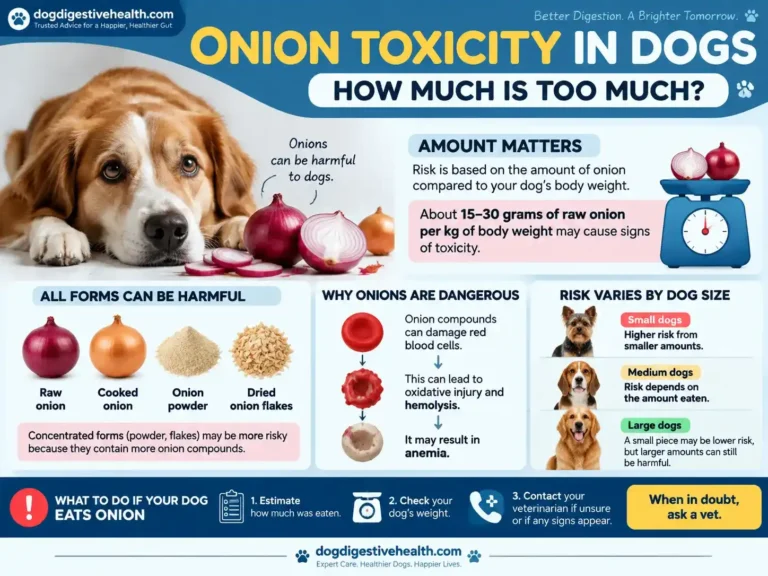
There is no single “toxic piece size” that applies to every dog. Veterinary toxicology evaluates onion exposure based on the amount consumed per kilogram of body weight.
Reports indicate that ingestion of approximately 15–30 grams of raw onion per kilogram of body weight may cause clinical signs in dogs, although individual sensitivity can vary (1).
This means:
Dog Size | Risk Consideration |
Small dogs | A small amount can represent a higher dose relative to body weight and requires greater caution. |
Medium dogs | Risk depends mainly on the quantity eaten and the concentration of onion. |
Large dogs | A tiny piece may represent a lower dose, but larger amounts can still be harmful. |
Puppies | Smaller body size increases exposure per kilogram. |
Because every dog responds differently, the exact risk cannot be determined by appearance alone.
My Dog Ate One Slice of Onion — How Serious Is the Risk?
A single slice of onion may or may not be significant depending on the size of the slice and your dog’s weight.
For example, one thin slice accidentally eaten by a large dog is very different from several thick pieces eaten by a small dog.
Important details to consider include:
- Was it a thin slice or a large chunk?
- Was the onion raw or concentrated onion powder?
- How much does your dog weigh?
- When did the ingestion happen?
If the amount is unknown, especially in a small dog, contacting a veterinarian is the safest approach.
How Many Grams of Onion Can a Dog Eat Before Poisoning Occurs?
Owners often want an exact gram amount, but onion toxicity cannot be calculated using one number for every dog.
The important calculation is:
Amount consumed ÷ dog’s body weight
A few grams may represent a minor exposure for a large dog but a much larger dose for a small dog.
Concentrated forms deserve additional attention. Onion powder and dehydrated onion contain less water, meaning the harmful compounds are present in a more concentrated form (1).
My Dog Ate Onion but Seems Fine — Is There Still a Risk?
A dog appearing normal immediately after eating onion does not always mean there is no risk.
The main concern with onion toxicity is damage to red blood cells. This process may take time to become noticeable because the body gradually develops signs related to oxidative injury and anemia.
Onion exposure can cause changes such as:
- Heinz body formation
- Red blood cell damage
- Hemolysis
- Reduced oxygen-carrying capacity
Some dogs may initially show no obvious problems but develop signs later, particularly after larger exposures (2).
Why Does Onion Damage Red Blood Cells in Dogs?
The toxic effect of onion is related to sulphur-containing compounds found in Allium species.
These compounds can create oxidative stress inside red blood cells. When antioxidant protection is overwhelmed, haemoglobin can become damaged, leading to abnormal red blood cells and eventual destruction of erythrocytes.
This process may result in haemolytic anaemia, where the body loses red blood cells faster than it can replace them (2).
Dogs are particularly vulnerable because their red blood cells are sensitive to oxidative injury.
Raw Onion, Cooked Onion, and Onion Powder: Which Is More Concerning?
Many owners assume cooking removes the danger, but onion remains potentially harmful after cooking.
Onion Form | Risk Level Consideration |
Raw onion | Contains compounds associated with oxidative red blood cell damage. |
Cooked onion | Still contains potentially harmful compounds. |
Onion powder | More concentrated and may deliver a higher dose in a smaller amount. |
Dried onion flakes | Concentrated form requiring caution. |
Foods containing onion seasoning | Risk depends on the amount included. |
Concentrated onion products, such as powders and dried flakes, are particularly important because small amounts may contain more onion compounds than expected (1).
My Dog Ate Onion From the Cutting Board — What Should I Do?
If your dog grabbed onion while you were preparing food:
- Estimate how much onion was eaten.
- Check your dog’s approximate body weight.
- Note the type of onion product involved.
- Record when the ingestion occurred.
- Contact your veterinarian if the amount may be significant or unknown.
Avoid attempting home treatments unless specifically advised by a veterinary professional.
Can One Piece of Onion Cause Anemia in Dogs?
One small piece of onion does not necessarily cause anaemia in every dog. However, anaemia risk depends on the amount consumed, the dog’s size, and individual susceptibility.
The concern is not the onion piece itself but whether the total exposure is enough to trigger oxidative damage to red blood cells.
Research has demonstrated that onion ingestion can produce haematologic changes in dogs, including effects associated with haemolytic anaemia (3).
Summary: My Dog Ate a Piece of Raw Onion — How Much Is Toxic?
- Onion toxicity depends mainly on dose and body weight.
- A small piece of onion may not affect every dog, but larger exposures can be harmful.
- Raw onion, cooked onion, and concentrated onion products can all pose risks.
- Small dogs and puppies require extra caution.
- Delayed effects are possible because red blood cell damage may develop over time.
When the amount eaten is uncertain, veterinary guidance is the safest option.
Medical Disclaimer
This article is for educational purposes only and does not replace professional veterinary advice, diagnosis, or treatment. If your dog has consumed a potentially harmful amount of onion or is showing concerning signs, consult your veterinarian or an emergency veterinary service.
Frequently Asked Questions
1. How much raw onion is toxic to dogs?
The toxic amount depends on the dog’s weight and the quantity consumed. Larger exposures are more likely to cause red blood cell damage.
2. My dog ate one slice of onion. Should I worry?
The risk depends on the dog’s size and the amount of onion in the slice. A small dog may require more caution than a larger dog.
3. Can a dog get sick from eating a small piece of onion?
A small piece may not cause problems in every dog, but risk depends on dose, body weight, and sensitivity.
4. Is onion powder more dangerous than fresh onion for dogs?
Onion powder can be more concerning because it is concentrated and may contain more harmful compounds in a smaller amount.
5. My dog ate onion but seems fine. Is there still a risk?
Yes. Some effects of onion toxicity may appear later because red blood cell damage can take time to develop.
6. What should I do if my dog eats raw onion?
Estimate the amount eaten, note your dog’s weight, and contact a veterinarian if the exposure may be significant or uncertain.
References
- Merck Veterinary Manual. Garlic and Onion (Allium spp) Toxicosis in Animals. Merck Veterinary Manual.
Available from: https://www.merckvetmanual.com/toxicology/food-hazards/garlic-and-onion-allium-spp-toxicosis-in-animals - Kovalkovičová N, Šutiaková I, Pistl J, Šutiak V. Some foods are toxic for pets. Interdisciplinary Toxicology. 2009;2(3):169–176.
doi: 10.2478/v10102-009-0014-6 - Tang X, Xia Z, Yu J. An experimental study of haemolysis induced by onion poisoning in dogs. Journal of Veterinary Pharmacology and Therapeutics. 2008;31(2):143–149.
doi: 10.1111/j.1365-2885.2007.00930.x