
Can Swallowing Aluminum Foil or Plastic Wrap Block a Dog’s Intestines?
Written by: Dr. Akram Khan, DVM
Medically Reviewed by: Dr. Khalid Mehmood, PhD (Assistant Professor in Clinical Veterinary Medicine)
Last updated on October 29, 2026
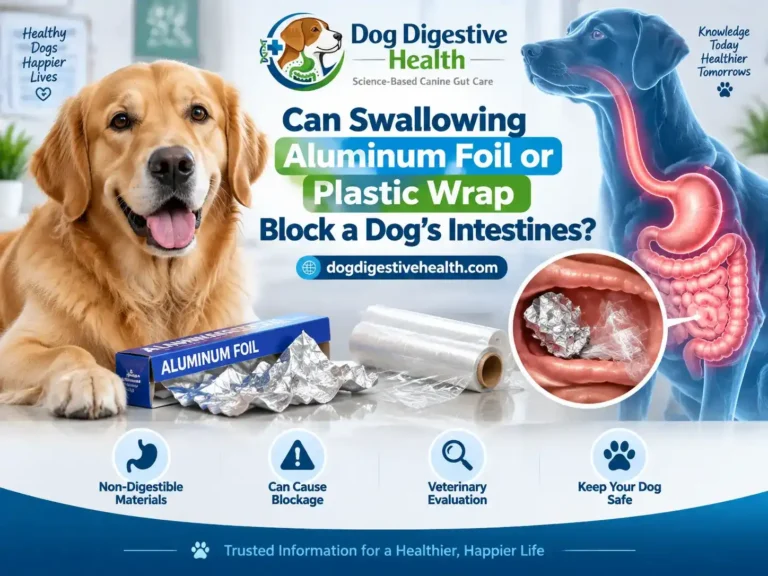
Dogs are naturally curious and may swallow unusual objects while exploring food scraps, kitchen waste, or packaging materials. If a dog eats aluminum foil or plastic wrap, the main concern is usually not chemical toxicity but whether the material can behave as a foreign body and become trapped inside the gastrointestinal tract.
Aluminum foil and plastic wrap are not digestible materials. A small amount may pass through the digestive system in some dogs, but larger pieces, tightly folded material, or a significant quantity may increase the risk of a gastrointestinal obstruction (1).
The risk depends on several factors, including the amount swallowed, the dog’s size, the shape of the material, and whether it moves normally through the stomach and intestines.
Can Aluminum Foil Block a Dog’s Intestines?
Yes, aluminum foil can potentially block a dog’s intestines if it becomes lodged within the gastrointestinal tract. Aluminum foil does not break down during digestion, meaning the body must either move it through naturally or it may remain as a foreign object.
A small piece of foil may pass through some dogs without complications. However, a large sheet, tightly compressed foil ball, or repeated ingestion can create a physical obstruction, particularly in smaller dogs.
The concern is a mechanical blockage rather than aluminum poisoning. A foreign body obstruction can interfere with the normal movement of food and intestinal contents through the digestive system (1).
Can Dogs Digest Aluminum Foil or Will Aluminum Foil Pass Through a Dog?
Dogs cannot digest aluminum foil. The digestive system cannot break it down into nutrients or dissolve it.
Whether aluminum foil passes through a dog depends mainly on:
- The size of the swallowed piece
- Whether the foil is flat, folded, or tightly crumpled
- The dog’s body size
- The location of the material in the gastrointestinal tract
A small, smooth piece may travel through the intestines and leave the body in the stool. In contrast, larger or irregularly shaped pieces may become trapped, especially within narrower areas of the digestive tract.
Can Plastic Wrap Cause an Intestinal Blockage in Dogs?
Yes, plastic wrap can cause an intestinal blockage in dogs because it is a non-digestible foreign material. Plastic wrap, cling film, and Saran wrap are designed to resist breakdown, which means the digestive system cannot process them like food.
When swallowed, plastic wrap may fold, bunch together, or combine with food material inside the stomach or intestines. A large piece may become difficult to move through the gastrointestinal tract.
The risk is higher when a dog consumes plastic wrap from food packaging, leftovers, or kitchen waste where larger pieces may be swallowed.
Is Aluminum Foil More Dangerous Than Plastic Wrap for Dogs?
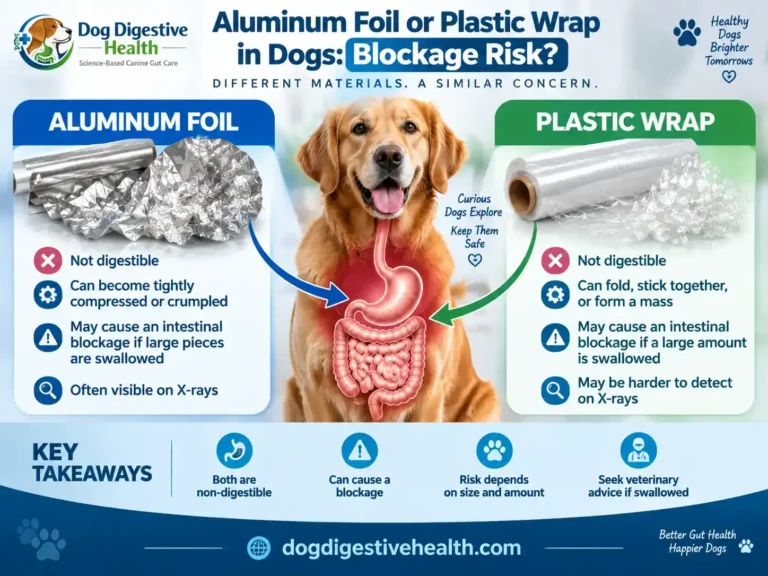
Both aluminum foil and plastic wrap can create a foreign body risk, but their physical properties are different.
Feature | Aluminum Foil | Plastic Wrap |
Digestible by dogs | No | No |
Main concern | Mechanical obstruction | Mechanical obstruction |
Material behavior | Can become tightly compressed or crumpled | Can fold, stick together, or form a mass |
Toxicity concern | Usually not the primary concern | Usually not the primary concern |
X-ray visibility | Often easier to identify | May be harder to detect directly |
The actual risk is determined more by the amount swallowed and the shape of the material than by whether it is aluminum foil or plastic wrap.
Will Aluminum Foil Pass Through a Dog Naturally?
A small piece of aluminum foil may pass naturally in some dogs, but there is no guaranteed timeframe or outcome.
Factors affecting passage include:
- Amount swallowed
- Dog size and breed
- Normal intestinal movement
- Shape and location of the foil
A dog that appears normal immediately after swallowing foil may still require monitoring because some foreign bodies do not cause noticeable problems until they interfere with intestinal movement.
If a large amount of aluminum foil was swallowed, veterinary advice is recommended to determine the safest approach.
Will Plastic Wrap Pass Through a Dog Naturally?
Plastic wrap may pass through the digestive tract in some cases, especially when only a small amount is swallowed. However, larger pieces can create a risk of becoming trapped.
Plastic materials can be difficult to evaluate because some types are not easily visible on standard X-rays. Veterinarians may use the dog’s history, physical examination, abdominal radiography, or ultrasound to assess whether a foreign body is present (2).
The decision to monitor or investigate further depends on the amount swallowed and the dog’s condition.
Does Aluminum Foil or Plastic Wrap Show Up on a Dog X-Ray?
Aluminum foil is generally easier to identify on X-rays because metal-containing materials are more visible on radiographic imaging.
Plastic wrap can be more challenging because many plastics are not clearly visible on standard radiographs. Veterinarians may use additional diagnostic methods, such as ultrasound, to evaluate suspected gastrointestinal foreign bodies.
Imaging findings are interpreted together with clinical signs and the history of what the dog swallowed (2).
What Should You Do If Your Dog Swallowed Aluminum Foil or Plastic Wrap?
If your dog swallowed aluminum foil or plastic wrap, first determine:
- How much material is missing
- When the ingestion occurred
- Whether other substances were swallowed with it
- Your dog’s size and current condition
Do not attempt to force vomiting unless specifically instructed by a veterinarian. Some swallowed materials may cause additional problems if brought back up.
Contact your veterinarian for advice, especially if a large amount was swallowed or if your dog has risk factors that increase the chance of obstruction.
When Should You Seek Veterinary Help After a Dog Eats Foil or Plastic Wrap?
Veterinary evaluation is especially important if your dog develops signs that may indicate a gastrointestinal obstruction, including:
- Repeated vomiting
- Loss of appetite
- Abdominal discomfort
- Lethargy
- Difficulty passing stool
- Persistent drooling or gagging
A gastrointestinal foreign body obstruction can become serious if intestinal contents cannot move normally or if pressure affects intestinal tissue. Early assessment can help determine whether monitoring, imaging, or treatment is needed (1).
Key Takeaway: Can Swallowing Aluminum Foil or Plastic Wrap Block a Dog’s Intestines?
Yes, swallowing aluminum foil or plastic wrap can potentially block a dog’s intestines, but the risk varies between individual cases.
These materials are generally concerning because they are non-digestible foreign bodies, not because they are highly poisonous. A small amount may pass naturally, while larger pieces or tightly compressed material may become trapped and cause an obstruction.
The safest approach is to consider the amount swallowed, the size of the dog, and any developing signs rather than assuming the material will always pass without problems.
Medical Disclaimer
This article provides general veterinary health information and is not a substitute for professional veterinary advice, diagnosis, or treatment. Every dog and ingestion situation is different. If your dog has swallowed aluminum foil or plastic wrap, consult a veterinarian for guidance based on the amount ingested, your dog’s size, and any symptoms that develop.
Frequently Asked Questions(FAQs)
1. Can aluminum foil block a dog’s intestines?
Yes, aluminum foil can potentially cause an intestinal blockage if a dog swallows a large amount or a tightly crumpled piece that becomes trapped in the gastrointestinal tract.
2. Will aluminum foil pass through a dog naturally?
A small piece of aluminum foil may pass through some dogs, but larger pieces may become lodged and require veterinary evaluation.
3. Can plastic wrap cause an intestinal blockage in dogs?
Yes, plastic wrap is not digestible and can potentially cause a gastrointestinal obstruction, especially if a large piece is swallowed.
4. Is plastic wrap toxic to dogs?
Plastic wrap is generally not considered toxic, but the main concern is that it may act as a foreign body and block normal movement through the intestines.
5. What should I do if my dog swallowed aluminum foil or plastic wrap?
Contact your veterinarian for guidance, especially if your dog swallowed a large amount or develops vomiting, loss of appetite, abdominal discomfort, or difficulty passing stool.
References
- Hayes G. Gastrointestinal foreign bodies in dogs and cats: a retrospective study of 208 cases. Journal of Small Animal Practice.2009;50(11):576–583.
doi: 10.1111/j.1748-5827.2009.00783.x - Mullen KM, Regier PJ, Ellison GW, Londoño L. The Pathophysiology of Small Intestinal Foreign Body Obstruction and Intraoperative Assessment of Tissue Viability in Dogs: A Review. Topics in Companion Animal Medicine.2020;40:100438.
doi: 10.1016/j.tcam.2020.100438 - Cornell University College of Veterinary Medicine. Gastrointestinal Foreign Body Obstruction in Dogs.
doi: Not available (Veterinary educational resource).